An Appropriate Costume

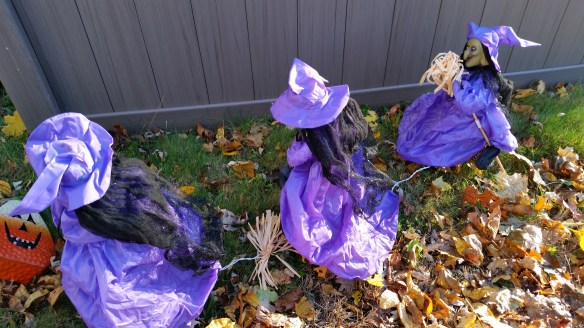
halloween-three-little-witches


As a young child growing up in the country I was accustomed to seeing death. Baby chicks perished; Ducklings drowned; something attacked my rabbits and the ones that hadn’t died were too wounded to survive and had to be killed. Several of our dogs and cats suffered their demise in front of our house. I understood death as a natural part of life and nothing to be feared. Until I was in college no significant adults of my acquaintance passed on except my Great Grandmother when I was only four.

Halloween wasn’t a big deal when I was small. What I remember was the occasional party, with games, and carving pumpkins. We lived in the country and without a neighborhood to go trick or treating, I wasn’t taken anywhere to accumulate candy. Besides, my mother didn’t approve of eating candy; it was bad for the teeth. Later on, however I enjoyed dressing up my children and taking them around to the neighbors.

Where I live now Halloween costumes will soon proliferate as children roam the sidewalks for trick or treat,. Dressed as ghosts, scarecrows, or pirates or masked as the current political figures the wearers follow a tradition that goes back many centuries. Halloween in the United States is somewhat similar to the Mexican Day of the Dead. It comes from a long tradition of honoring those who have moved on from their bodies to the wider life of the spirit.

It was once believed that on October 31 the spirits of the dead could inflict harm or at least return in some way to communicate with the living because the veil between this world and the next is thin. Then some hoped to consult spirits of the dead, believing they could tell where treasure was buried, or what the future held. Some remnants of fear remain from then, though they are not taken seriously.

My grandmother passed on when I was in college and hers was the first dead body I ever saw. It did not frighten me. She had been prepared for burial and set out in her living room prior to the funeral the next day. That evening as I approached her body I realized it wasn’t my grandmother, that it was just clothes she had worn once and now no longer needed. Death did not then nor does it now seem to me to be something of which to be frightened. Life is more than a physical experience.

Halloween costumes can serve as a reminder that there is little to fear from the transition called death. A change of clothing is appropriate to a change of form. Just as I can’t fit into my baby garments or the clothes I wore for my first day of school, I can expect someday to outgrow this body, and to discard it for clothing suitable for the form I will then inhabit. While the unknown is always a little unnerving to contemplate, whatever happens whether in this life or the next is an adventure to which I look forward.
The Importance of Responsibility

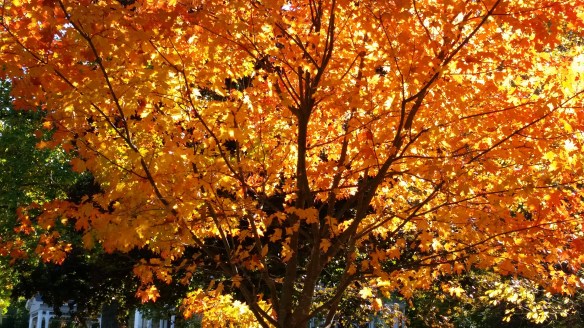
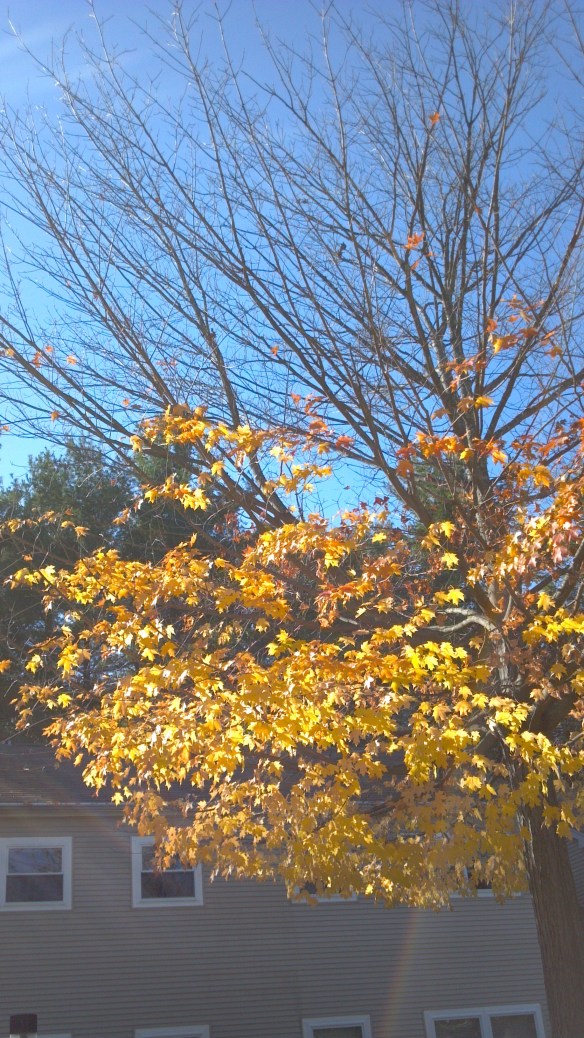
light-through-the-leaves-2          I don’t remember how old I was when feeding and watering our chickens became my responsibility; something tells me I was around eight. I also had to rake their droppings from the shelf beneath the rod they perched on. I didn’t really like this, however if I wanted my allowance, I had to. They provided us with eggs and occasionally meat. I didn’t care for eggs, and I wasn’t very fond of the live chickens, however I did enjoy roast chicken on a Sunday, (purchased, not from our flock) served up with the crimson jelly my mother made from apples, cranberries and quinces from my great grandfather’s trees.
My mother considered me irresponsible. Perhaps her expectations were too high for my abilities. Or maybe she didn’t start me off a little at a time, learning by doing small tasks. When children are growing up it is important to give them responsibilities. Even a small child can do simple tasks. If the child is forgetful or perhaps deliberately tests the parent by ignoring his or her duties, it is the responsibility of the parent to follow up on the discipline with reminders as well as consistent persistence. That’s part of the responsibility of parenting. It also helps with self-discipline later on when the child is grown.

As an adult I find there are times I have to make a decision as to what is and what is not my responsibility. When I see trash on the sidewalk or paper towels on the floor of a restroom, I wonder if it is my responsibility to pick up after someone else. At home do I put away my husband’s clothes as well as mine or leave them for him to put away? Who is responsible for what in a household is often divided along lines of familiarity. Growing up, who mowed the lawn, took out the trash, checked to see if the door was locked at night?

I remember my mother saying at a certain time in the evening, her father would wind the grandfather clock and that would be his signal for her current boyfriend to depart. We didn’t have a grandfather clock to wind, however my father was responsible for the houseplants and flowers in our home. All summer he would carefully arrange fresh flowers in vases, some from his garden, some from my grandmother’s. My mother was responsible for the cooking, for the purchase of food and for what and when we ate. She also carved the roast or chicken we had on Sundays because she thought she did a better job of it.

The word responsibility implies a response to something. If I am aware of a an important duty, like paying my taxes, being sure to vote, stopping at stop signs, or even washing my hands after I sneeze, cough or go to the bathroom, then I respond by acting. I take responsibility for that which is my personal obligation to society or to myself. However there is this gray area where I need to make decisions: do I try to help if my help may not be wanted? Do I act when my action may not be what is needed? Taking responsibility for what I do or do not do requires me to think and think again.

Tasha Halpert

Where Does the Time Go

dali-clocks

Five minutes or more of waiting can seem to stretch forever, yet when I am engaged in something pleasurable, the moments vanish quickly into wherever time goes. When I look back over the years, they telescope, yet I remember three months in El Paso that while I was living through them, seemed like three years. It is quite beyond my comprehension, and perhaps that is appropriate because after all time is something human beings invented.

Did they do this because life as they were living it needed dividing up in order to be made orderly? Or was it because people needed to make appointments? Or even because there needed to be some sort of way to know the when of things? There are books that will tell you when calendars were invented, and who invented them, and others that detail the kind of clocks that first measured it. I haven’t read any that have told me why.

Sometimes to me time resembles a big clump of jelly like stuff. I try to hold onto it but instead it squeezes through my fingers and disappears. Finding time, using time, saving time…all these are illusions generated by my wanting to accomplish what I want to do when I want to do it. Perhaps I need to think of time differently. If I focused on what needs doing rather than trying to find the time to do it would I manage better?

To be sure, I keep lists of the tasks I hope to accomplish right now or in the near future: phone calls to be made, deadlines for submissions, household tasks to be done. Then there are other items on my lists that do not have a time consideration: letters to be written, information to be googled, piles to sort through. It is these that seem to revolve endlessly, making their way from list to list until I “find the time” to do them and finally cross them off.

Sometimes they fall off the list, never to be seen again. Because none of this type of task is actually necessary it seems more difficult to get done. It is also possible that they don’t matter, or else that I have given them more importance than they originally deserved. It isn’t always easy to know what is important and what is merely something it would be nice to do if there were time to do it. And there’s that word again: time.

Have you ever noticed that it can take the same amount of actual clock time to come home as it does to go somewhere, yet it seems to take much longer to go than it does to come home? This is just one more mystery I experience involving the passage of time. However, to be honest I usually find that I always have enough time when I focus on the doing part rather than the amount of time to do it. Perhaps that is because there really is no such thing as time at all.

Tasha Halpert


Muffins for Fall Munching

Down to her frillies 3


I once attended a weekend Renaissance Fair with some friends. Wearing a costume of a mobcap, a full skirt, blouse and a vest, with my similarly garbed friends I was having breakfast in the restaurant of the motel where we were staying. As I perused the buffet table a man came up to me. “There are no more muffins,” he said. I shook my head and assured him I wasn’t a waitress. “We need more muffins,” he said loudly. My similarity to the waitress’ colonial garb was too convincing. My friends were helpless with laughter. I giggled and joined them. To this day Stephen kids me about the incident.

While I like making muffins now, I didn’t learn to make them in my mother’s kitchen. She didn’t bake from scratch or even at all, and I was not encouraged to do so. Once married I tried to make them but my muffins were invariably heavy, flat and dense in texture. Though edible, they were not how I thought muffins ought to be. When I sought inspiration from more experienced cooks, I found out what I was doing wrong. Voila, my muffins rose nicely.

I discovered that muffins, unlike cakes, cookies and other baked goods did not need to be well beaten. Once I learned to fold the wet ingredients lightly into the dry ingredients my troubles were over. The source of my information was a column in the Boston Globe called the Confidential Chat. It ran several times weekly and was a wonderful source of recipes, advice and help as well as an opportunity to share for those of us who wished to do so. At the peak of my participation I wrote around fifteen or so letters a week, many of which were published, and in the process I learned to write succinctly.

Writers to the column used pen names, so publication was anonymous. However, letters answering you that were not published were forwarded bundled in an envelope you provided, and you could choose to answer any of them if you wished. In certain ways the Confidential Chat was part of the foundation for this column because it helped me learn to write precisely and convey information clearly. Long-winded or unclear letters simply were not published. Since I enjoyed seeing mine in the paper, I worked hard to write well. I also loved the recipes and shared many.

Here is a recipe I use a lot for Banana Chunk Muffins. You may substitute melted butter for the oil. If you do, be very sure to mix lightly. Ingredients: 2 eggs, 1/3 cup oil, ¾ cup any milk, 1 tsp vanilla, ½ cup sugar, 1½ cups flour, 1 tsp baking soda, ½ tsp salt, 1 tsp cinnamon, 2 or 3 bananas cut into ½ to 1 inch squares, ½ to 1 cup optional chopped walnuts, ½ to 1 cup optional chopped dates. Method: Preheat oven to 350 degrees, Mix fruit, nuts with dry ingredients, beat wet ingredients together well and lightly mix into dry. Use liners or grease 1½ dozen muffin cups or 1 8″ square pan. Fill ¾ full and bake for 30 minutes for muffins, 35 to 40 for pan. Enjoy!

Tasha Halpert

Fall Reflections by Tasha Halpert

Fall REflections 15 Bright spot   As a child I looked forward to fall. I enjoyed the swish of the leaves as I shuffled through them and the crisp air redolent of the smell of burning from people’s yard clean ups. Each year I collected colorful leaves and treasured them until they dried up and crumbled. When my children were small we collected our favorites and ironed them between sheets of waxed paper. We’d tape them on the glass storm door or onto windowpanes. The wonderful variety of colors and the way the each leaf is uniquely designed by nature has always fascinated me.

Recently, driving down the highway I gazed with pleasure at the vista of the changing leaves. In some places they had already turned, and the autumn colors had emerged in a blanket of bright hues. However, in a few places summer’s green still predominated. Then I noticed an outstanding patch of red in the midst of a section of green leaves. It stood out so strongly that my eyes were drawn to it and lingered until I had driven past it. That particular section of leaves seemed so vivid compared with the usual display of roadside color.

The patch of brilliantly red leaves I had just passed wasn’t especially large, yet it overpowered my attention in a way that the conglomeration of greater color had not. As I drove I thought about the difference between it and the other colorful leaves that lined the roadside. I realized it was the contrast that made it so strong. I was reminded of how Shakespeare spoke of the light of a candle in the darkness saying: “So shines a good deed in a naughty world.” There is something about contrast that enhances the presence of what is outstandingly lovely to experience. The same is true of scarcity or of specialness; these enhance the way something is experienced.

I realized that my attention had been drawn to the brightness of the red against the darkness of the green. A hillside of lovely fall leaves is a beautiful sight to behold, yet without contrast my eyes soon grow used to it; I don’t see the view with as much interest or delight. The same thing applies to taste. If all the food on my plate is bland, it all begins to taste the same. If it is either entirely crunchy or entirely smooth I don’t enjoy it as much. With what I hear, the same applies: What makes Beethoven’s music so special to me is the interplay of loud and soft, thunderous and sweet.

This is also true with regard to life in general. I enjoy it when things go smoothly, when everything falls into place, when people show up when they’re supposed to. I am grateful for the excitement of winning, the feelings of accomplishment when I am praised. Yet without at least temporary failure, without glitches, without the serendipity of strange twists and turns, life would not be nearly as interesting or as vital. While I may lament a loss or mourn a missed opportunity, because of that contrast I am even more grateful for my gains and my successes.

Death is a Part of Life by Tasha Halpert

DSCF0192 The recent announcement of President Carter’s cancer follows on the heels of my hearing about many others whose illness of one sort or another has proclaimed their relatively immanent mortality. In other words, a multitude of serious sicknesses–cancer, heart problems and other conditions of ill health have invaded the lives of people I know and in many cases, love. Perhaps this has to do with getting older. I do not remember hearing as much about such things only a few years ago.

I may have been fortunate in this respect: The death of people I knew and loved wasn’t part of my childhood experience–I went to my first funeral, an aged cousin when I was twelve. Yet death as a part of life was no stranger to me. Growing up with pets and small farm animals I had an intimate acquaintance with it. Ducklings, rabbits, dogs, cats, and the chickens we ate for dinner all lived and died as I watched. I buried my pets myself with due ceremony. I watched as the chicken for dinner was beheaded with an ax.

When I was in my twenties I thought little about death. Then my children’s father nearly perished in an automobile accident. The thought of those I loved dying now forced itself on my attention and I began more to appreciate the specialness of life and of my relationships. Still, I was occupied with life and death wasn’t something I thought much about. Time went by and my grandmother died. She seemed to me an appropriate age to pass on. While I mourned her absence, I was busy with life and my little ones, we were no longer living close to one another and I did not miss her presence.

Years later death grew more familiar. I lost my father to illness, then my own precious son. Some years later several young friends died untimely deaths. Moe and more I was brought to an understanding of the place of death in life. As much as I mourned, I began to recognize that death was indeed a part of life; that dying was merely the blowing out of the candle that was lit at birth. Life is a gift for which I am grateful and the lives of those I love and have loved are very dear to me. Yet like flowers we grow, bud, blossom an finally wilt away.

Untimely death is harder to bear than what seems a natural process. My rabbits were killed when a dog got into their pen. My dog was run over in front of me. Later on my son died far sooner than he might have. Yet even untimely, this is still death as a part of life. Although I miss him still, my sorrow is not so much for his death as it is for the life he was not able to live. We are all most fortunate for whatever time we have on this earth. In my nightly prayers I make sure to express my gratitude for my dear ones, those whose candles still burn brightly. May they continue.

DNA Reflections

“Could that be so-and-so?” I ask, then I recall

when last I saw that face; it could not look the same.

Who was I then? Who am I now?
Have the interleafing passages of time
made changes? My mirror
reflects both now and then.

As leaves fall branches reveal their truth.
As years pass, faces describe ours.

Our DNA resembles that of trees:
rooted in cell memory, skin bark encloses our flesh.
No birds nest in our hair,
only random thoughts
and an occasional prayer.

Words and images by Tasha Halpert Copyright 2013Image