
Two Recipes from my Kitchen for Comfort Food

woodenspoon1

As I have said before, I did not learn to cook from my mother. She did not think me responsible enough to deal appropriately with food, something that to her was a precious substance and not to be wasted. After I got married I learned how to cook from a cookbook. I made some funny mistakes and we ate them anyway because we were on a rather limited budget. Back in the 50’s you could actually live on $30.00 a month for food. To be sure, we ate a lot of hot dogs.

Over the years I have enjoyed experimenting with different recipes and learning what works and what does not. For instance, it might be just fine not to use a recipe for a vegetable casserole but under no circumstances try to make cookies without one. Of all the many recipe collections I possess, my old Fanny Farmers cookbook is my got-to for recipes. I look there first when doing research. There is something tried and true about a book that has been around so many years.

In addition, I am what you might call an old fashioned cook. I do not use nor do I possess a microwave oven and I hope never to have to have one. I know many people love them and find them convenient. No doubt they are. However, I feel no need to hurry my food along that way. By definition comfort food need not be cooked quickly. Sometimes the very best food is some that takes its time and lets he flavors develop.

Here are two of my favorite comfort food recipes: Onion soup and Bread pudding. The onion soup recipe is one I devised from trying different ways to make it. The Bread pudding has evolved from several recipes, my favorite being from The Cat Who Cookbook by Julie Murphy and Sally Abney Stempinski created from dishes in the “Cat Who” series by Lillian Jackson Braun.

Onion Soup Tasha: To serve 4 to 6, thinly slice two medium to large onions to make 1½ to 2 cups. In a heavy bottomed pot melt 2 Tbs butter and 2 Tbs olive oil. Add and sauté the onion, stirring frequently over medium heat. When onion is transparent, reduce heat and continue to cook uncovered over relatively low heat for an hour, stirring occasionally. Add 4 to 6 cups beef broth. Low sodium is best. Cook 15 more minutes and serve with garlic bread, or melt some cheese on toasted bread and float it on top for the French version.

Pleasing Bread Pudding: Depending on appetites, serves 4 to 8. Butter a 1½ quart casserole. Remove the crusts from 4 slices of firm, not soft bread. Cut or tear into smaller pieces. Place in casserole. Measure 1 cup any kind of milk, beat in two eggs, pour over bread. Sprinkle on 1 cup dried fruit—black and/or white raisins, dried cranberries, cherries etc. Sprinkle on 1 teaspoon cinnamon and ½ cup sugar. Add 1 teaspoon vanilla. Stir well. Add another cup of milk to make 2 cups. Stir again. Place casserole in a shallow pan filled with water. Bake at 350 for 45 minutes or until nicely browned on top.  Tasha Halpert

An Excellent Seafood Chowder by Tasha Halpert

CA Mural          As a child I loved to play with and rearrange the contents of my mother’s pantry, especially the bowls, utensils, and such. As an adult, I truly enjoy finding the perfect implements and utensils for my own food preparation and cooking. In the many years I have been doing it, I have accumulated a nice variety of cooking tools and containers. Because I truly enjoy working with food, I’m always looking for new items I can use. When someone left a cute little orange bowl here after a party, I fell in love with it. However, not wanting to be selfish, I set it aside in case the owner could be found. When after more than six months of inquiry had passed, I decided it was mine.
It sits cheerfully on my kitchen counter, washed and replaced immediately after use because once something fell on it in the dish drainer and took a chip out of the edge. It is a useful size, perfect to contain the ingredients for so many of the dishes I create. Recently, my orange bowl held the onions and celery I chopped up for a seafood chowder.

Since I have worked so hard to perfect this recipe I thought it might be fun to share it with my readers. One of my challenges was to create it without milk for my lactose intolerant husband and to thicken it without cream. Another was to cook it in such a way that the fish, clams or other seafood did not get tough. It shortens the time if you want to omit the thickening, however, it does wonders for the texture.

My basic seafood chowder with fish, clams, and/or other seafood begins with about 3/4 of a cup each of chopped onion and chopped celery, and 2 tablespoons each of butter and olive oil. Sauté until they are nice and tender. Add two medium potatoes, peeled and chopped into half inch pieces. I think large chunks of potato overtake the taste, and they do swell up in the broth. Add 4 cups of water, 1 teaspoon of black pepper, 1/2 teaspoon of salt and an optional teaspoon of thyme. Bring to a boil then simmer covered until potatoes are cooked through.

If all you want is a simple fish stew, add 3/4 of a pound of cod and whatever else you like (chopped clams, shrimp, scallops–bay or large, etc.) Cover pot and turn off the heat. Fish will cook in the cooling broth and not get tough when carefully reheated. However, if you take the trouble for the next step you will have a very special dish.

To make a chowder instead of a simple fish stew, you must have a thickening agent. In which case, before you put in the fish, melt 2 tablespoons butter in a small pot. Add 1/4 cup any flour–gluten free is fine. mix well, then slowly add 1 cup any kind of unflavored milk, whisking constantly to make a very thick blend. Add this to the vegetables and broth, stir well and bring to a boil. Now add whatever fish you are using, turn off the heat, cover and let sit until fish is cooked through. Reheat gently to serve or refrigerate. It tastes even better the next day and will serve 4 nicely.

The Three Bite Rule

When I was growing up there was no such thing in my family as not eating what was put before you, or of getting up from the table before you had finished what was on your plate. The “starving children in China” statement was applied whenever I protested. I learned to swallow pieces of liver as if they were pills, with gulps of milk. However I was unable to cope well with the frequent soft boiled eggs, and finally my mother stopped giving them to me. I have memories of sitting at the table staring at the egg in its shell in the egg cup in front of me. That was one battle I won. Not until I was an adult did I learn to like soft boiled eggs and I never did learn to appreciate liver.

My mother built her cooking around my dad’s taste, so much of what we ate was pretty standard. She believed in providing nutritious food, and though plain, it was. Despite the fact that she really didn’t like to cook, she understood that providing nourishment is an important aspect of caring that nature has built into mothers, and she did her best. All too often family members, like me as a child, do not express appreciation for the family cook’s labors in the kitchen. Though it didn’t occur to me as a child, as an adult I personally think they might be grateful someone has taken the trouble to make a meal for them to eat.

As regular readers of my column know, I have always enjoyed cooking. I find it satisfying as well as enjoyable. One aspect of this is that I prefer to prepare meals from scratch. Some might be surprised to learn I don’t own a microwave, nor do I wish to. I even like chopping food by hand rather than using a machine, peeling my fruit and vegetables, and doing all the hands on work that is required to use completely fresh ingredients rather than prepackaged ones. I do not claim that this is particularly virtuous on my part. It is simply my preference.

This is because putting myself into the meal is part of my joy in the creation of it. My energy goes directly into the chopping, the peeling, the mixing and the stirring. This is my purposeful contribution to the health and welfare of those I love and fix food for. I am fortunate to have an appreciative husband who enjoys whatever I prepare. I had one once who wasn’t and his influence on our younger children made quite a difference in what they were willing to eat. He was a meat and potatoes man and we were on a casserole budget, so complaints were often made. Yet being hungry he still ate whatever it was.

I tried to make interesting meals, and I used to tell my children they had to eat three bites of whatever I served them or I would make them eat the whole thing. Fortunately young children are not logical and none of them ever figured out how if they wouldn’t eat three bites, how could I get them to eat the whole thing? I even did this with their playmates and guests. Today one of my delights is to introduce people to foods they may not have experienced–at least not the way I prepare it. However, I don’t tell them they must eat three bites or I’ll make them eat the whole thing.

Tasha Halpert

Salad and casserole 3

Keeping Christmas Merry

By Tasha Halpert

Twinkles 3 (best)When I was growing up no one around me thought much about Christmas until after Thanksgiving, and even then mid December was when we would begin shopping. Once I knew the reality of Santa, I was eager to participate. I was taken to the Five and Dime in Beverly. There I would purchase stocking presents for my parents with my saved up allowance. My gifts were always practical: Pond’s Cold Cream for my mother, pencils for my dad. I usually made their presents for under the tree–Santa only brought the stocking gifts.
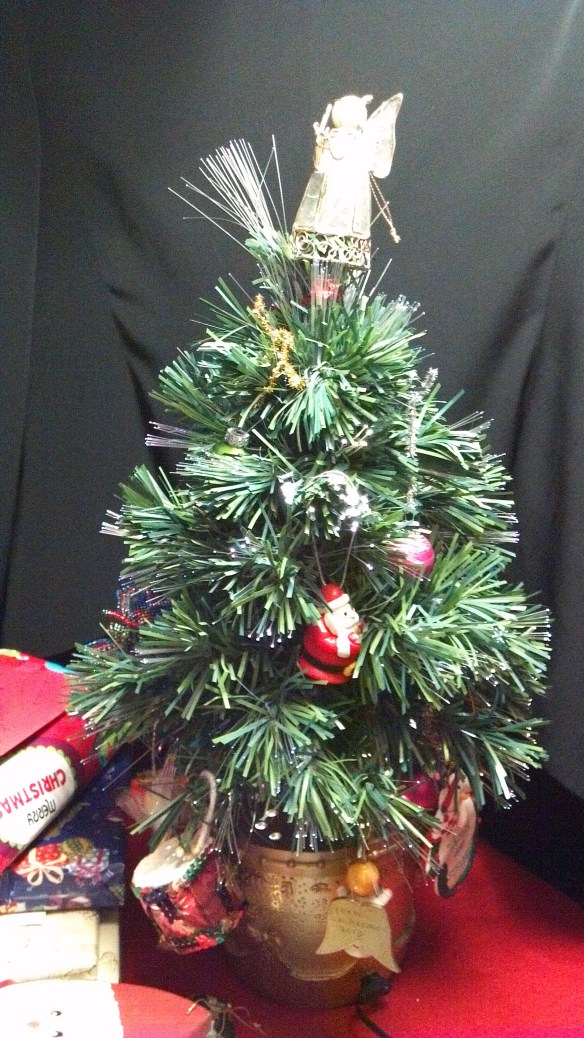
We didn’t put up the Christmas tree until the day of Christmas Eve. It stayed up until January 6. Elaborate house decorations were not part of our tradition, however we had lovely ornaments saved from year to year along with the real metallic tinsel that made the branches bow nicely. I do not remember much stress associated with the holiday, We had a few friends over on Christmas eve with simple snacks and went to a relative’s for Christmas dinner.

How nice it would be if today’s Holidays were as simple and lacking in stress as they used to be. I’ve had some thoughts on how to help that happen. For instance, it’s hard when the holidays bring back thoughts of those who are no longer with me. I remind myself to be grateful for the time we had together. Then I tell myself, be thankful for those who are with me still.

Music lifts my spirits. Playing Christmas carols, not to mention the lovely classical music written for this time, brings me back to myself and helps me remember what the holidays are really about. I especially like to play Christmas music while wrapping presents or preparing food. I prepare food ahead during the holidays, and I often combine kitchen tasks. Since I’m already in the kitchen, I chop vegetables for soup while I bake Christmas cookies.

Family traditions can be onerous. It is best not to “should” on yourself during the holidays. Instead, make new traditions of your own, more appropriate to your current life and lifestyle. One of mine is to bake cookies for those who have been helpful to me during the past year: My garage mechanic, the kind folk at the library, the postman, my hair stylist.

Here is one of my easy cookie recipes you might enjoy making and sharing. Jiffy Jam Delights: Bake at 375 for 10 minutes on a well greased cookie sheet. Makes 30 to 36 delicious cookies in a half hour from start to finish. Ingredients: 1/2 cup Butter, (no substitutes please),1/3 cup Sugar, 1 Egg, 1 Tsp. Vanilla, 1/4 tsp Salt, 1 2/3 cups all purpose Flour, 2/3 cup Jam (raspberry preferred by us. Method: Beat butter, sugar well. Add egg, vanilla salt. Blend in flour. Drop from a teaspoon onto greased sheets. Make a dent in the tops of the cookies and fill with a half teaspoon or so of jam. Bake only until firm and dry to the touch. Cool before eating. Jam is very hot.


Hospitality by Tasha Halpert

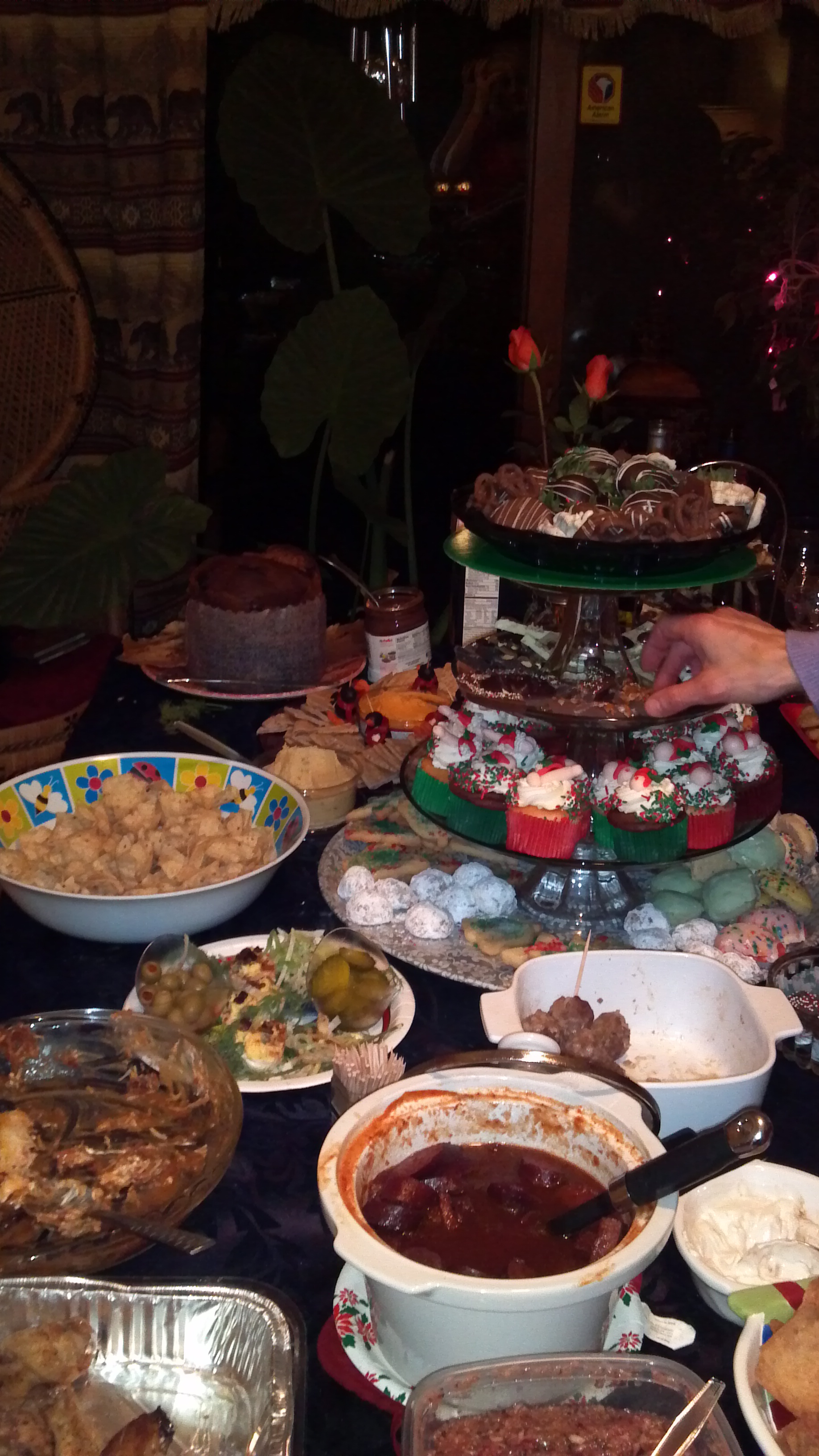
Deb's party food 2As she does whenever she comes to the States, our friend from Denmark was visiting us. Over a lunch I had enjoyed making for us all, we had fun catching up on our recent activities. She was exclaiming over the food, saying how good it was and how happy she was to be with us. “I love cooking for my friends,” I replied. I do. It is one of my favorite occupations. Stephen and I both enjoy entertaining friends, and making meals for them is a big part of my joy.

She commented that she too enjoyed cooking for her friends. She then went on to say that her experience here in the States was that when they were entertaining, many people seemed to prefer taking people out to eat rather than preparing food for them at home. She said that in Europe it was more common to prepare dinner for their guests at home and less common to take them to a restaurant. I thought this was an interesting commentary, and I wondered what it indicated about Americans.

Around the holidays, the newspapers overflow with advertisements for meals to which you are supposed to bring your whole family. Alternatively, supermarkets and other providers of food advertise “home cooked” meals delivered to your door. My parents would never have considered eating anywhere for the holidays but at the home of a relative. Eating out was only for very special occasions, perhaps to celebrate a victory or a special anniversary.

Thinking back on my childhood years I remember that when my parents entertained it was usually relatively spontaneously and for cocktails before luncheon after church or dinner. Afterward our guests either went home or to a restaurant. My mother did not like to entertain and seldom had people for dinner parties. She had had a lot of that as a young child in her parents home and had been as it were inoculated against it. Her mother had given her all sorts of jobs to do related to making ready for guests, none of which she particularly enjoyed.

Her father had been in he diplomatic service in Germany prior to World War II and they had lived all over the globe. Her mother had entertained at lavish dinner parties with food prepared by a cook or catered. To my mother fell the task of setting the table, arranging flowers and so on. Later she and her two sisters would be called upon to perform musically for the guests. No wonder she disliked parties.

My first husband didn’t care to entertain either. We had one big party a year. it. My cooking was confined to the family. I have found it wonderfully different with Stephen. He has always loved to entertain and there have been many times in our lives together when I never knew how many would be sitting down to dinner. Because I have plenty of supplies on hand, this has never bothered me. To be sure, I enjoy dining out, especially as someone’s guest, however I am very happy to eat loving prepared home cooking.

Cooking With Love and Parsnips, by Tasha HalpertSnow scene 3

I believe that when you cook with love because you love to cook, the food tastes better. From the time I was small I have enjoyed and appreciated all things to do with cooking. One of my favorite occupations as a child was to arrange the items in the pantry off our kitchen. The wide shelving held all sorts of pots, pans, bowls, and other cooking supplies. In my mind I can still smell the wooden shelves covered with shiny oilcloth. Was it held on with thumbtacks? My memory stops there.

My mother considered food to be for nourishment, not pleasure. She used her food money carefully, and she did not like to spend extra money on the ingredients for desserts, which was all she permitted me to cook. She never ever baked anything, nor did she use much in the way of herbs or spices. My dad never cooked, nor did anyone else in my family. Why I so love to cook is a mystery to me.

Another reason my mother didn’t let me cook was that she considered me careless and irresponsible–perhaps I was, though most children without experience might be considered so. Occasionally I was permitted to make brownies and later, salads. As a young bride I had to teach myself to cook from a cookbook. Today although I have a fine collection of them, I seldom refer to my general cookbooks except for inspiration, unless I am baking. Successful baking generally requires exact measurements.

I also have many small cookbooks in my collection. These include recipes collected for church fund raising, pamphlets featuring commercial ingredients, and others that friends have given me. Most have one or two recipes I refer to on a regular basis that can be found nowhere else. While many of the small collections are for baked goods and casseroles there is one in particular that I have found to be very useful: Marjorie Standish Chowders Soups and Stews.

The recipe in it I have used most is for Parsnip Stew. Being a lover of parsnips for their sweet, meaty taste, I was delighted to come across this recipe. Easy to make and universally popular, I thought my readers would enjoy it. Although the original calls for salt pork, I make it with butter and a touch of olive oil. Ingredients: 2 tablespoons butter, 1 tablespoon olive oil, 1 small onion diced, 2 cups peeled, diced potatoes, 2 cups water, salt and pepper to taste, 3 cups cubed parsnips, 1 quart milk–any kind will do; Being somewhat lactose intolerant I use oat milk.

Method: Melt butter and add onion, stir and cook until transparent. Add potatoes and water, salt and pepper. Bring to a boil then simmer for 10 minutes. Add parsnips, bring back to a boil, simmer 10 more minutes. Test for doneness and add milk. Heat to serving temperature or pour into a container and store until ready to reheat. Serve with several tablespoons or more of minced parsley.