Into the Next Room

Maple Flowers          The first person whose death I remember hearing about was a relative named Cousin Ellen Parker. My memory of her is of someone roundish, gray haired, and somewhat wrinkled. I have no real memory of her other than of her appearance. She must have died when I was around four. My great grandmother died in her eighties when I was five. I don’t remember hearing much about that. I do have a vivid memory of picking dandelions in our yard and seeing her walking along in her purple hat. When I told my mother she insisted Grandma Great was dead and I couldn’t have seen her. But I had.

In those days death wasn’t usually discussed in front of children. I knew nothing of people dying, only small animals and occasionally pets. The rest of my family was healthy and active, living vigorously for many more years. I grew up with the idea that death was something that happened to people who were old. Times have changed. I have outlived not only my parents but now some of my friends and acquaintances.

This past week Stephen and I heard about three people dear to us who have stepped into the next room–another way to say they have passed from this life. As I write this, it is the birthday of another friend whose death I found out about earlier this year. Stephen and I both find it difficult to believe that these and other friends are gone from our sight. I find myself regretting that I never sent that card I meant to send, or made that phone call.

How can we know when someone’s time will run out? When the card we mean to send or the call to make can no longer be sent or made? No matter how well meaning I try to be there will always be that last small gesture that won’t be made before they are gone. There’s no way to predict when someone will make that transition from life on earth to the wider realm from which no one returns.

As I grow older in years I notice that more and more of the people I have known depart this life for the next. How can this be? Children believe one must be old to die. I’m not old so how can they be old enough to leave this life? When I was growing up I thought of fifty as old. As I approached that time I thought of the succeeding years as indicating age. Now it seems to me that there is no time limit on “old,” nor any way to tell what age is appropriate for the end of life.

It seems no matter how many years I accumulate, I still somewhere within me, retain my youth. From the other side of fifty and more, although the years tell me a different story, I don’t feel very much older. Why have these dear ones left me? It seems only yesterday that we were all in the sunshine of our years. Now the shade encroaches. Still I trust that those I miss are freer now, and without pain. My sorrow at their passing is only for me, not for them. However, I have my memories of them, and these will remain with me for all my years to come.

Tasha Halpert

The Dailyness of Doing

Nature's Art 1. 2012-06- While I was growing up, when it came to household chores my mother did not consider me to be capable. This may have been because she expected more of me than I was able to do at a young age, or it may have been that she was so particular that my childish efforts were simply inadequate. She had very high standards. Regardless of the reason, she never encouraged me to do any cleaning or other household tasks even after I was in high school. What this meant was that I never really learned how to clean properly.

I remember the day I came home to the first apartment my young husband and I had and found my father sweeping the rug. I asked him what he was doing. He said he was cleaning the rug. But I don’t have a vacuum, I told him. You don’t need one, he said, and inquired of me where I kept my dustpan and brush. I had never realized you could clean a rug just by sweeping it.

I had to learn how to keep house the hard way, by trial and error and doing it. The other day as I cleaned the sink in the bathroom, I began thinking about household tasks in general. I realized that when I complete some tasks, I give a sigh of contentment and think to myself: good, now that’s accomplished. There are others I complete and with a sigh of resignation wonder how soon I’ll be doing it over again. Much depends on the task in question; some are more satisfying than others. Cooking, for example is my delight and I have no problem making three meals a day.

On the other hand, when I wash the kitchen floor, although it looks very nice, I don’t feel happy because it doesn’t last. Somehow it gets dirty practically immediately. Although small in surface, it is still a chore to keep clean. The stove presents the same issue. It seems that no sooner do I clean the pans under the burners than when I next turn them on, they’ll emit a bit of burning smoke from another stray crumb.

It is hard for me to take much satisfaction when I finish doing something I know I will have to do again practically immediately. Yet when I do not allow myself to take that satisfaction, I do not feel rewarded. If I do not feel rewarded it is much more difficult to do what needs doing again with any promptness. The good feeling I get from completing any task is an important part of what helps motivate me to repeat it, no matter how soon.

There is only one solution I can think of: to do the task as fully as possible in the present moment. What this means is that while I am doing it, rather than thinking of how soon I will have to do it again, or how onerous it is, I focus exclusively on the performance of it. It helps almost any situation to be mindful during it. As I direct my attention and my energy to the activity of the task, I am not only more efficient, but also more able to find pleasure in it.

Tasha Halpert


An Excellent Seafood Chowder by Tasha Halpert

CA Mural          As a child I loved to play with and rearrange the contents of my mother’s pantry, especially the bowls, utensils, and such. As an adult, I truly enjoy finding the perfect implements and utensils for my own food preparation and cooking. In the many years I have been doing it, I have accumulated a nice variety of cooking tools and containers. Because I truly enjoy working with food, I’m always looking for new items I can use. When someone left a cute little orange bowl here after a party, I fell in love with it. However, not wanting to be selfish, I set it aside in case the owner could be found. When after more than six months of inquiry had passed, I decided it was mine.
It sits cheerfully on my kitchen counter, washed and replaced immediately after use because once something fell on it in the dish drainer and took a chip out of the edge. It is a useful size, perfect to contain the ingredients for so many of the dishes I create. Recently, my orange bowl held the onions and celery I chopped up for a seafood chowder.

Since I have worked so hard to perfect this recipe I thought it might be fun to share it with my readers. One of my challenges was to create it without milk for my lactose intolerant husband and to thicken it without cream. Another was to cook it in such a way that the fish, clams or other seafood did not get tough. It shortens the time if you want to omit the thickening, however, it does wonders for the texture.

My basic seafood chowder with fish, clams, and/or other seafood begins with about 3/4 of a cup each of chopped onion and chopped celery, and 2 tablespoons each of butter and olive oil. Sauté until they are nice and tender. Add two medium potatoes, peeled and chopped into half inch pieces. I think large chunks of potato overtake the taste, and they do swell up in the broth. Add 4 cups of water, 1 teaspoon of black pepper, 1/2 teaspoon of salt and an optional teaspoon of thyme. Bring to a boil then simmer covered until potatoes are cooked through.

If all you want is a simple fish stew, add 3/4 of a pound of cod and whatever else you like (chopped clams, shrimp, scallops–bay or large, etc.) Cover pot and turn off the heat. Fish will cook in the cooling broth and not get tough when carefully reheated. However, if you take the trouble for the next step you will have a very special dish.

To make a chowder instead of a simple fish stew, you must have a thickening agent. In which case, before you put in the fish, melt 2 tablespoons butter in a small pot. Add 1/4 cup any flour–gluten free is fine. mix well, then slowly add 1 cup any kind of unflavored milk, whisking constantly to make a very thick blend. Add this to the vegetables and broth, stir well and bring to a boil. Now add whatever fish you are using, turn off the heat, cover and let sit until fish is cooked through. Reheat gently to serve or refrigerate. It tastes even better the next day and will serve 4 nicely.

An Easter Basket of Memories

Rabbit in Cabbage 2On Easter my family usually went to dinner with Great Aunt Alice. Until my sister was born when I was 8, I was always the only child present. Aunt Alice had several toys she would bring out to amuse me. One was a little truck loaded with colorful blocks. They had letters, numbers and pictures on them. Even now I can see that red and yellow toy with a string to pull it by. The bed of the truck was loaded with the blocks, and I was always careful to put them back when it was time to go upstairs to dinner.
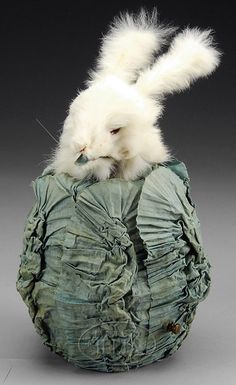
The other toy was a very special, ancient rabbit that lived inside a head of cloth lettuce. When it was wound–only adults were allowed to do that, and the golden knob on the side was pulled out, the rabbit head would emerge, extend itself and turn. Its ears would rise into the air. Then it would chew on the small piece of cloth lettuce in its mouth. When it finished, it would retract into the cloth lettuce with a little snap as the ears went back against its head.

I thought of that rabbit when I was contemplating what I would write for this column. I wish I had it now. I remember my children being shown it when they were little. Though I don’t know if they remember it the way I do. I loved patting it. It was covered in soft, white actual fur. It did not play music or do anything more than just that. I believe it had been in the family at least since my Great Aunt was a child. when I was contemplating my column and it leapt vividly into my mind as though I had seen it yesterday.

Once we arrived and took off our coats, the adults stood around and drank cocktails, while I had ginger ale. Aunt Alice, who favored simple appetizers, always served a plate of peanut butter on crackers and there were also nuts in a bowl. Too young to read, I sat on the big rug and played with the blocks. Dinner was served upstairs in a large dining room. The oval mahogany table gleamed with silver and cut glass. The platters and bowls of food were brought in by women in black uniforms with white aprons. There was usually soup, then a roast and vegetables, and finally, dessert, followed by fingerbowls to dip fingers into and cloth napkins to dry them with. My treat would be the chocolates for after dinner, something we never had at home. My mother did not think it was healthy to eat candy and never bought it.

Time is a strange accordion. It can compress decades into years, and years into moments. I can see so clearly the large thick rug I sat on to play with the alphabet blocks and watch again the white bunny with the pink glass eyes rising up out of the faded green cloth leaves. It looks so real as it turns its head, the ears rise into the air and it chews on its bit of green cloth. I can feel again the soft fur as I pat the head and the ears, stiff with wire beneath the fur. What was only yesterday has added itself to now creating an Easter basket of memories for me to enjoy.


Practicing Unconditional Love


Sidney and pony 6


          Holy week celebrates the life story of Jesus, specifically its culmination. His life is a very special example of unconditional love. Whatever you may or may not believe concerning His life, you cannot argue the fact that here is someone for whom love was the supreme guiding light. In his life and in his words there are numerous examples of unconditional love: that love which is given without expectations or parameters. While Christians are supposed to practice this kind of love, they may or may not focus on it to the extent He did. Unfortunately, it is often not easy to do. It begins in families.

          We learn about love in childhood. If the love we are given does not feel to us like love, we grow disappointed and eventually believe we are not loved. To a child’s mind, if we are not loved it must mean we are unlovable. With the help of a therapist I learned to see my parents love as authentic, thus I was able to begin to love myself. The more I can love myself, the easier it is for me to be grateful for and accepting of the love of others.

          My parents did the best they could. They were two very different, very volatile individuals. Their attitude toward one another was so fierce and their fights and disagreements so frequent that even though now I know I was loved, I could not feel it then. In addition they had high standards for me, their oldest child, and were quite strict in what they expected of me. Too often they stressed my inadequacies rather than my successes. This attitude, with which they both had been raised, did little for my self esteem.

          As a result of learning to love myself, I started to practice unconditional love. I began with people I didn’t know well, went on to friends, and finally to family. It is most difficult to practice unconditional love with dear ones because I have expectations of them. Expectations and unconditional love do not mix. Still as I learn to love more deeply I can allow myself imperfection. After all if I do not spot my errors, how can I correct them. If I love myself enough, I can smile at my errors and congratulate myself on my efforts rather than criticize.

          Awareness is important; it is easy to justify criticism of others by thinking of them as in need of correction. However, when I encounter what seems to need correcting, I can ask myself if the fault I perceive in another is a reflection of something in my own being that needs work. If not, it may be that what I am uncomfortable with in the other person stems from a wound of which I am not aware. Then perhaps I need to relinquish judgment and practice compassion. The practice of unconditional love is ongoing. As I work at it I find that as well as deepening my love of others I am deepening my love of myself. In this way I find more and more harmony in the beautiful song of life.

Tasha Halpert

The Three Bite Rule

When I was growing up there was no such thing in my family as not eating what was put before you, or of getting up from the table before you had finished what was on your plate. The “starving children in China” statement was applied whenever I protested. I learned to swallow pieces of liver as if they were pills, with gulps of milk. However I was unable to cope well with the frequent soft boiled eggs, and finally my mother stopped giving them to me. I have memories of sitting at the table staring at the egg in its shell in the egg cup in front of me. That was one battle I won. Not until I was an adult did I learn to like soft boiled eggs and I never did learn to appreciate liver.

My mother built her cooking around my dad’s taste, so much of what we ate was pretty standard. She believed in providing nutritious food, and though plain, it was. Despite the fact that she really didn’t like to cook, she understood that providing nourishment is an important aspect of caring that nature has built into mothers, and she did her best. All too often family members, like me as a child, do not express appreciation for the family cook’s labors in the kitchen. Though it didn’t occur to me as a child, as an adult I personally think they might be grateful someone has taken the trouble to make a meal for them to eat.

As regular readers of my column know, I have always enjoyed cooking. I find it satisfying as well as enjoyable. One aspect of this is that I prefer to prepare meals from scratch. Some might be surprised to learn I don’t own a microwave, nor do I wish to. I even like chopping food by hand rather than using a machine, peeling my fruit and vegetables, and doing all the hands on work that is required to use completely fresh ingredients rather than prepackaged ones. I do not claim that this is particularly virtuous on my part. It is simply my preference.

This is because putting myself into the meal is part of my joy in the creation of it. My energy goes directly into the chopping, the peeling, the mixing and the stirring. This is my purposeful contribution to the health and welfare of those I love and fix food for. I am fortunate to have an appreciative husband who enjoys whatever I prepare. I had one once who wasn’t and his influence on our younger children made quite a difference in what they were willing to eat. He was a meat and potatoes man and we were on a casserole budget, so complaints were often made. Yet being hungry he still ate whatever it was.

I tried to make interesting meals, and I used to tell my children they had to eat three bites of whatever I served them or I would make them eat the whole thing. Fortunately young children are not logical and none of them ever figured out how if they wouldn’t eat three bites, how could I get them to eat the whole thing? I even did this with their playmates and guests. Today one of my delights is to introduce people to foods they may not have experienced–at least not the way I prepare it. However, I don’t tell them they must eat three bites or I’ll make them eat the whole thing.

Tasha Halpert

Salad and casserole 3

A Little at a Time


My Buddha by the sink

My mother was an artist. She went to art school and studied sculpture as a young woman. Later when my brothers were both in school she studied painting at the Boston Museum of Art. She had a studio over the garage where she occasionally worked. She also kept her art materials there along with lots of interesting women’s magazines. I loved to go up and read them. From them I learned many helpful household hints. I still remember one that told how to change a bed by walking around it only once. I used to do that. Now Stephen and I make ours together.

It may have been then or it could have been later on in my life that I came across the twenty minute system for accomplishing lengthy tasks. The article suggested allotting twenty minutes daily or whenever convenient, to a chore that was normally postponed because it might take too long or be otherwise tedious. When I tried the suggestion I was pleasantly surprised to see that it worked. One example was that instead of cleaning out all the bureau drawers, or every shelf in the pantry at once, take twenty minutes to clean and tidy one, stop and do another on another day.

At one time I practiced this technique quite frequently, however it slipped into the mists at the back of my mind. Recently I was reminded of it. What happened was this: For a very long time I had postponed cleaning out the refrigerator. Week after week each time I wrote out a new to do list, that particular task was at the top. Still I found reasons not to. Then I noticed how sticky one of the racks on the refrigerator door was. I decided to clean it off then and there. Because there were many small jars to be removed, washed off and replaced, it took me about twenty minutes or so to complete the task.

As I shut the refrigerator door I remembered the household hint from so long ago and laughed. The next day I cleaned off the second shelf of the door. Several days later I washed off the whole bottom shelf of the refrigerator. Today I cleaned the oven, and so it goes. Each task that takes around twenty minutes to complete adds up eventually to a thorough cleaning and tidying. I will probably go through my bureau drawers next, and perhaps after that a couple of other tasks I can think of that need attention.

I remember hearing someone say once that when he thought about what he had to do, it always seemed far more daunting than it turned out to be once he actually began to do it. The same holds true for me about the time spent doing something. Dividing a task into smaller segments works much better for me these days than trying to get it all done at once. As well, it spreads out over all the different times spent, the feeling of satisfaction I get from my small yet necessary accomplishment.

Tasha Halpert


Recipes Can Be Useful by Tasha Halpert

Kitchen ImplementsSometimes I use recipes, sometimes not. I have loved to cook ever since I was a small child when I made up mud and berry pies and added dandelion fluff for decoration. I had a spot in the lilac grove on one side of our yard where I kept my play dishes and utensils. When the wind blew, the boards for shelves I stuck between the branches would fall to the ground along with my dishes. That was a most unsatisfactory pantry. I did not learn to cook with real food until after I was married. . My mother did not allow me to make anything but salads and brownies. She did not consider me responsible enough for meal preparation.

These days in my kitchen a heavy magnet holds a collection of recipes to my refrigerator. There are always more of them than I can reasonably expect to attempt. Some, when I go over them as I must do from time to time will prove too time consuming. Others will require ingredients I don’t have on hand or want to invest in. Still, when I first saw them I had considered making them, and might even have done so were I inspired to.

Every few months, when the collection is beginning to outgrow the magnet I go through it. Then I discard those that, while they seemed tempting no longer appeal to me. Then I generally pull out one or two of the remaining ones to try. Some will become great favorites and get written into my spiral recipe notebook or pressed into the pages of a loose-leaf notebook that holds the recipes I have accumulated over the years. I truly enjoy cooking and like many who do, have collected recipes for most of my adult life. I also create my own recipes for that spiral notebook.

My husband and I are fond of garlic. One day I invented this recipe for fried eggs that is now a real staple. Melt a tablespoon of butter in a frying pan over medium heat. Cover the bottom with three or four large sliced garlic cloves. Turn the heat down to medium low and break in three or four large eggs. Place fresh basil, cilantro, or in a pinch parsley leaves over the eggs. Cook until whites are firm. Carefully divide and turn eggs over. Cover with slices of your favorite cheese. Take from heat and cover. Let cheese melt, then serve to two.

Mushrooms and eggs go beautifully together for supper. Beat three or four eggs with two tablespoons of water. (Using water greatly enhances their flavor.) Add fresh herbs to taste, or even dried ones. I like tarragon, thyme is lovely, as is parsley or sage. Add a half a cup of cheddar or Swiss cheese squares to the eggs. Melt a tablespoon of butter over medium heat. Slice in 4 or 5 mushrooms of medium size. They should cover the bottom of the pan. stir and turn until they render up their juice and are cooked through. Add and melt another tablespoon or so of butter. Pour the egg and cheese mixture over the mushrooms. Turn gently as eggs cook until they are done and serve to two.