 A favorite memory I have of Easter is of dying my eggs using onion skins. For weeks I saved up the papery wrappings of the outside of the onions. Now it was time to put them to use. Using string I secured the onion skins to my eggs and set them on to boil. The results were quite lovely and I was grateful to my friend Maggie for sharing her knowledge of how eggs were originally colored in her native homeland.
Eggs have always had mythological significance. The oldest recorded writings the Vedas of India, say the world evolved from a cosmic egg. According to Wikepedia other mythologies featuring creation and eggs include the Egyptian, the Phoenician, the Greek, the Chinese and the Finnish. As all life hatches from eggs—whether those of mammals or of egg layers, it make perfect sense that a holiday that began as a fertility celebration would feature them.
Easter is essentially a spring festival. The Christian expression of it also relates to life and generation of which eggs are a symbol. Red dyed eggs have been found buried at Bronze Age sites. These were surely connected to the worship of the pre-Christian deity, the goddess in charge of spring farm and field fertility. The name Easter derives from the name Eostre, the Anglo Saxon goddess of spring or Ostara the Germanic version of the goddess’s name.
How the rabbit came to be associated with Easter and eggs is another story. A rabbit relative associated with the goddess, the hare a strong, somewhat fierce animal is nocturnal and its babies unlike those of rabbits are born with eyes open. Some say the figure on the surface of the moon is that of a hare. The hare has also been associated with the moon because its gestation period is the same 28 days. Thus the goddess’s sacred animal came to be part of Easter.
Despite their differences, the hare became a rabbit when Germans immigrated to the United States in the 1600s and settled in Pennsylvania, spreading out from there to the surrounding states. Their Easter celebrations did not catch on right away, however, because of the stronger puritan influence that suppressed what was thought to be essentially too pagan in its expression. It is most likely that children envious of Easter goodies and fun influenced the universality of the celebration so that eventually it spread everywhere.
Easter eggs continue to be important and many households will overflow with them after the holidays. My favorite way to use hard boiled Easter eggs is in egg salad sandwiches. This recipe is for 6 eggs. I don’t peel them but instead break them in half and scoop out the insides. Chop and mash with ½ cup mayonnaise, 1 teaspoon tarragon, Salt, pepper, a tablespoon or more of horseradish sauce and ½ teaspoon of dry mustard. Add ¼ cup finely chopped celery, and ¼ cup finely chopped onion. If you like curry flavor, add a teaspoon or so to taste.
 My mother felt strongly that food was precious and not to be wasted. She had been a young child during World War I in Germany, and the experience of scarcity had shaped her attitude. To her way of thinking, all food was to be used up one way or another. Then came World War II and rationing. I too was very young, yet this also gave me lessons in thrifty use of food. Fortunately I have been able to put my early lessons to good use in learning how to create meals from whatever I have left over even if I hadn’t already planned ahead.
 When I visited Russia with my mother, in the guesthouse where we stayed we were served cabbage at every dinner. Although I got rather bored with it, I understood why it was so prevalent. It keeps very well and is inexpensive. It is also a most nutritional vegetable, especially raw. Its anti oxidant properties assist in cancer prevention, its anti inflammatory properties are helpful with arthritic conditions, it is a fine cardio vascular nutrient, and it is good for the lining of the stomach and intestines, helps with ulcers too.

 My mother grew vegetables and fruit and canned them for use during the winter and spring. I remember her on the hot days in August and September, lifting the glass jars out of their steaming water bath in the large canning pot in our small kitchen. Once cooled, the jars went to line shelves in the basement. During winter and spring she had all kinds of vegetables and fruit to choose from. Eating locally was common in those days because food that grew in faraway places was not available. Canning diminished with the advent of freezer chests. Consuming food in New England that was grown in Mexico, China or other distant countries was unheard of.

 The first flowers I remember picking were dandelions. Proudly I brought them to my mother, who lovingly thanked me. I have memories of making dandelion flower crowns with her. We’d slit the stems, slide a flower through, and repeat until the crown or wreath was large enough to wear. Dandelions are the first flowers many children are allowed to pick. They are such pretty little bright spots, and unbeknownst to many, such good medicine It seems a pity that people feel they have to eliminate them.
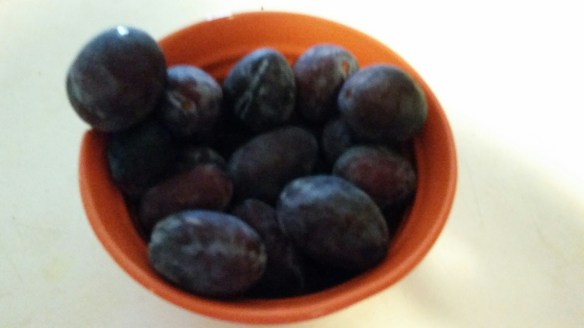
 As a child I loved to play with and rearrange the contents of my mother’s pantry, especially the bowls, utensils, and such. As an adult, I truly enjoy finding the perfect implements and utensils for my own food preparation and cooking. In the many years I have been doing it, I have accumulated a nice variety of cooking tools and containers. Because I truly enjoy working with food, I’m always looking for new items I can use. When someone left a cute little orange bowl here after a party, I fell in love with it. However, not wanting to be selfish, I set it aside in case the owner could be found. When after more than six months of inquiry had passed, I decided it was mine.
 Pujakins