The Fruits of Summer

Belfast veggies 12My parents both gardened, but differently. My mother had a vegetable garden; my father grew flowers. She spent her summers growing, harvesting, and putting up what the garden produced. He filled the house with fresh flowers in vases. His roses were lovely. He worked as an arborist and summer was a busy time for him as he helped others plan and tend their property. I always had a little garden of my own. I too grew flowers.

Later as a young wife I grew vegetables, though except for beans, not easily from seed. My children helped some but I did most of the work myself. My tomatoes were successful and appreciated. When I moved to Grafton I enjoyed growing herbs and flowers in my spiral garden, where I learned the virtue of perennials interspersed with annuals here and there. These days I no longer garden, instead I enjoy the fruits others’ efforts.

The farm markets in the surrounding countryside burst with local produce of all kinds. Vegetables and berries gathered daily line shelves and counters, and the freshly picked corn is piled high for the taking. Summer is the perfect time to indulge in this freshness. Between now and harvest time, the hot sun nourishes both roots and leaves. Its warm rays ripen the eventual harvest that people once stored for winter. These days we simply enjoy what grows.

Yet summer is also a time for people to take time off and appreciate the opportunity to spend it relaxing. Whether on the beach or in a park, the hot weeks are a time to be in nature, to let the sun bathe our senses and ripen our opportunities to kick back and nourish ourselves in nature and with play. The long daylight hours encourage extra outdoor activity. The relaxed pace allows time to catch up on reading and as well as see friends and family.

Rest is an important part of good health for everyone. Vacations are intended to provide more than just a change of pace. Whether they are taken at home in the form or staycations, or as trips to planned destinations, days off are a real necessity for everyone’s health and well being. One of the fruits of summer that does not grow on a tree or in a garden is time to let go, to set down the list of tasks and let things slide a bit.

Once a busy gardener with summer weeding chores, I find myself now doing more reading, as well as spending more time enjoying and appreciating others gardens. However, aside from weeding and watering, once the hot days of summer begin a well planned garden does not require much of the gardener. The harvest will come later when trees heavy with fruit and bushes with berries demand attention. For now it is time to enjoy a bit of lazy time, to lean on the fence or sit in my easy chair and let the garden grow.

Tasha Halpert


A New World to Hear

Image

DSCF0168

I remember my great grandmother’s ear trumpet. It was a long instrument, flared at one end. She held the small end to her ear. I also remember a black box the size and shape of a thick brick that had a cord running from sitting on a table that must have been an early hearing instrument. My grandmother wore a case the sizes of a slim cigarette pack clipped to the front of her dress with a cord connected between it and a button in her ear. There was a dial on the box she could turn on and off.

My dad used to say she turned it off when she didn’t want to hear what was being said. I remember as a child thinking how handy that must be. Aids to hearing have come a very long way since then. As people age, much like the normal need for eyeglasses to address a lessening of vision, so too there is a need for aids to hearing. Unfortunately these are extremely expensive compared to eyeglasses. Hopefully one day this will change.

Because of the deafness that seemed to run in my family, I was not surprised when my own hearing began to diminish. I found I needed to have the TV on louder. It was helpful to watch movies on DVD with subtitles, especially when the actors had British accents. If Stephen spoke to me and I was in the other room I had to get closer to him to hear what he was telling me.

Ambient noise interfered with my understanding of words; parties were less fun. My children noticed and suggested I get hearing aids. Still, I wasn’t sure I really needed them, or so I thought. Then as luck would have it I was gifted with a set. My daughter offered me her late mother-in-law’s hearing aids. I am very glad I said yes. It has been an adventure for me to use them. I find myself marveling at sounds I have not really heard before, or not for a long time.

I remember my mother telling me that when my grandmother put on her new hearing aid and went outdoors she said, “What’s all that noise?” It was the birds chirping. She had not heard birds for many years. My ears have not been that bad. I have been able to hear more or less, just not clearly. I notice the difference with the aids: without them, it’s like I have water in my ears. With them when I turn on the sink faucet, I hear splashes and ripples. When I unwrap paper it crackles. The stove timer sounds shrill. I hear sounds I didn’t before.

In the past when I thought about getting hearing aids I felt somewhat uncomfortable. I expected them to be clumsy, perhaps difficult to manage. None of this has proved true. Today’s aids are quite different from those of my grandmother’s or even of recent times. They are virtually invisible. I am very grateful to my daughter for her thoughtfulness, and I look forward to learning more about the new world I am hearing. As I have come to appreciate the clarity I get from wearing eyeglasses, now I enjoy the adventure of listening to a new and different world.


Spring Has Truly Sprung

Spring blossoms, white          When I was a child in grade school, each year our music teacher organized May Day celebrations. Every class participated, and a May Queen was selected from among the girls in the ninth, the topmost grade. The younger children had their own maypole. I found it hopelessly confusing. You had to go over one and under the next as you wound your ribbon around the pole, weaving it into the others until there was only a little left. After rehearsals, much to my relief I wasn’t chosen to do it.

There were dances and songs–I still have a printed paper program from then in a scrapbook made for me by a devoted relative. The songs were of British origin and invoked the days of “lasses and lads” who met and parted though the specifics were a mystery to my young mind. No one talked of the fertility symbols or the meaning behind the rituals centered around the day we were celebrating.

The first of May is the midpoint between the Vernal Equinox and the Summer Solstice. Nature is pushing forward. The increase of the light from now forward reflects the brightness of the days that begin their most obvious decline around the first of August. In the northern hemisphere there are many celebrations associated with this date. They reach far back in the history of humanity, symbolizing our connection with the earth and its fertility.

Most recent is of course the “May Day” workers’ celebrations of the former Soviet Union. My mother and I were in Moscow on that date twenty six years ago. I remember the colorful flags hanging everywhere, and the crowds of people in Red Square. However, from far back in human history, May Day has been one of the great spring celebrations of Europe and the British Isles. It is associated with fertility for both crops and farm animals, promoted through ancient rituals, many of which involved fire.

In these modern times we believe more in fertilizer than in fertility rituals. Few people these days will dance around a maypole–an obvious phallic symbol, or go off into the woods with a partner to insure that the fertility of land and pasture will continue. There is no need. Supermarkets are stocked all year round with almost every seasonal vegetable and fruit–no need to wait until June for strawberries or fall for apples. Those who have never experienced this timing cannot miss it, but in some ways I do.

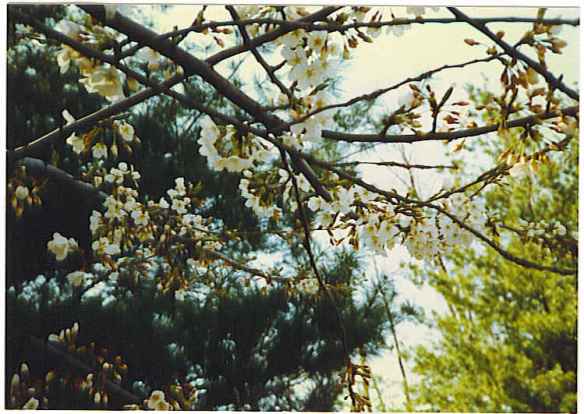
Yesterday Stephen and I drove along a wooded country road in the sunshine. The light illuminated the unfolding blossoms of the trees clustered around it. The cloudless blue sky above and the sunlight filtering through the branches above us lifted our hearts and filled us with joy. Summer with its own delights is in the wings; spring is on the stage revealing its special beauty now. It seems important to take time to notice this delicate time of unfolding.

The Three Bite Rule

When I was growing up there was no such thing in my family as not eating what was put before you, or of getting up from the table before you had finished what was on your plate. The “starving children in China” statement was applied whenever I protested. I learned to swallow pieces of liver as if they were pills, with gulps of milk. However I was unable to cope well with the frequent soft boiled eggs, and finally my mother stopped giving them to me. I have memories of sitting at the table staring at the egg in its shell in the egg cup in front of me. That was one battle I won. Not until I was an adult did I learn to like soft boiled eggs and I never did learn to appreciate liver.

My mother built her cooking around my dad’s taste, so much of what we ate was pretty standard. She believed in providing nutritious food, and though plain, it was. Despite the fact that she really didn’t like to cook, she understood that providing nourishment is an important aspect of caring that nature has built into mothers, and she did her best. All too often family members, like me as a child, do not express appreciation for the family cook’s labors in the kitchen. Though it didn’t occur to me as a child, as an adult I personally think they might be grateful someone has taken the trouble to make a meal for them to eat.

As regular readers of my column know, I have always enjoyed cooking. I find it satisfying as well as enjoyable. One aspect of this is that I prefer to prepare meals from scratch. Some might be surprised to learn I don’t own a microwave, nor do I wish to. I even like chopping food by hand rather than using a machine, peeling my fruit and vegetables, and doing all the hands on work that is required to use completely fresh ingredients rather than prepackaged ones. I do not claim that this is particularly virtuous on my part. It is simply my preference.

This is because putting myself into the meal is part of my joy in the creation of it. My energy goes directly into the chopping, the peeling, the mixing and the stirring. This is my purposeful contribution to the health and welfare of those I love and fix food for. I am fortunate to have an appreciative husband who enjoys whatever I prepare. I had one once who wasn’t and his influence on our younger children made quite a difference in what they were willing to eat. He was a meat and potatoes man and we were on a casserole budget, so complaints were often made. Yet being hungry he still ate whatever it was.

I tried to make interesting meals, and I used to tell my children they had to eat three bites of whatever I served them or I would make them eat the whole thing. Fortunately young children are not logical and none of them ever figured out how if they wouldn’t eat three bites, how could I get them to eat the whole thing? I even did this with their playmates and guests. Today one of my delights is to introduce people to foods they may not have experienced–at least not the way I prepare it. However, I don’t tell them they must eat three bites or I’ll make them eat the whole thing.

Tasha Halpert

Salad and casserole 3

My Always Valentine, by Tasha Halpert

Stephen and Flowers People who do not know us sometimes ask Stephen and I how long we have been together. I think this might be because we don’t act like an old married couple. We are often openly affectionate in public and might seem more like young lovers. Yet we have been together for many years now, so many that I am always a bit taken aback when I think of the total. To me there is something odd about how past years seem to accordion. It is as if they compress in some way so that they don’t seem to be nearly as much time as when I contemplate them stretching into the future.

Stephen is my always Valentine and I am his. What that means is that we treat one another with respect. We do not compete nor have we ever done so. We don’t need to. Instead, we cheer one another on, each wanting the best for the other. Neither do we put one another down or make fun of one another. While gentle teasing may be appropriate between couples, mean behavior is absolutely unkind. It is also true that no matter how long we may be together, in order for our relationship to stay strong it has to grow at the same rate we do.

I believe it is vital for individuals to keep growing; whatever does not grow normally begins to decay. For our love to grow along with us we must work to make it do so. In my experience, love grows with appreciation, with honesty, and with the expression of gratitude. We do our best never to take one another for granted. When he washes the dishes, I thank him. When I cook a meal or drive us somewhere, he thanks me. When he sees a book I might like at the library, he points it out. When I see something he might want to eat at the market, I purchase it.

These many small gestures add up. Along with the days of our lives they form a fragrant bouquet that surrounds us with loving kindness. Being kind to one another is an important ingredient in our marriage. Another is sharing feelings with honesty. If something is troubling one of us, we share it, even if it may feel painful to do so. This is something I insisted on when we began our relationship, and over the years it has helped us avoid many problems.

Our years together have gone by so quickly that it is difficult to understand how they could have accumulated the way they have. Yet like leaves piled under a tree in the forest, they have melded into a kind of fertilizer that feeds the ongoing growth of our relationship. I am enormously grateful to have Stephen in my life. He feels the same. We both feel blessed. It is most wonderful to have an always Valentine, and each of us does our best to make sure that as long as we both live, we always will.


Growing Up By Myself

Bed Friends 1

When I was growing up I lived a couple of miles from a small seaside town on a large property that belonged to my Great Aunt Alice. I didn’t have any siblings until I was almost nine. Virtually an only child, I was surrounded by busy adults and often told to stop bothering them and find something to do. A voracious reader, when I wasn’t nose deep in a book, I played games of pretend, making believe I was someone other than a lonely child in an isolated neighborhood with only herself to rely on for amusement.

I had quite a collection of teddy bears, dolls and other stuffed animals. When I was small I was sure they came alive at night. This belief was influenced by Johnny Gruelle’s Raggedy Ann and Andy books. These innocent stories about a group of toys that had adventures were written in the early 1900s and became even more popular in the 30’s and 40’s. In these stories, ice cream cones grew on trees, cupcakes and hot dogs could be plucked from bushes and lemonade and sodas were available in puddles and brooks.

Raggedy Ann’s magical woods full of “fairies and elves and everything” held all sorts of fun inventions that I yearned to experience for myself. I loved the stories and used to watch my toys to see whether they too might have adventures while I was sleeping. Sometimes I thought I spotted them in different positions than I had left them, though I could never be sure.

Later I moved on to books by Robert Louis Stevenson, Alexander Dumas, and Edgar Rice Burroughs. Then I wanted to be a pirate or have exciting adventures when I became a grown up. I made bows and arrows out of handy branches and tied string to my father’s hoe and rake to make a hobby horse. If my father needed his rake he knew where to look–in my lilac bush “stable.”

My family believed in fresh air and I spent a lot of time all year round out of doors in nature. Where we lived I was fortunate in having a large open area to play in There were all kinds of trees to climb and large fields of tall grass that I made into my private jungle. My pretend life was much more interesting than my actual one. The world I lived in as a young child was without TV or any form of electronic toy or game. I had to use my imagination to conjure up my entertainment.

I wonder if my childhood led me to grow up looking at the world from a different perspective than most. Steeped in nature and in the creativity of my mind, its sights and sounds enhanced my imaginary life. Today I perceive links and patterns everywhere. I find significance in synchronicity and receive messages from the nature around me. The world was and is alive for me in a way today’s youth may not discover. With the current focus on electronics, most children will not have my opportunities. I learned to listen to and observe nature and found there a sense of companionship and of comfort that is with me still.

The Gift of a Smile by Tasha Halpert

bigsmile          One of my happy childhood holiday memories is of my father sitting by our fireplace near Christmas time, wrapping cartons of cigarettes, boxes of whiskey, ties and other items that he distributed to the various individuals he did business with. There was always a big pile when he was done. Then he would load them into his car and the next day he’d hand deliver them. Occasionally I got to ride with him. This was always a great treat.

Christmas memories are in themselves a gift of the season for me. I delight in recalling the images from my childhood: my mother playing carols on her violin on Christmas Eve, the table at my Great Aunt’s set with gleaming crystal and shining silver, the tree, all decorated with the carefully preserved ornaments and the foil tinsel that was always saved from year to year. I cherish these and other memories. It is always a treat to hear those of others as well.

As I was shopping in our local market a grocery wagon drew up next to mine. The sweet faced older lady pushing it beamed in my direction. “I just loved your last column in the paper,” she said. She went on to tell me a special Christmas story about her son when he was a child. I was very touched and thanked her, not only for the compliment but also for sharing her happy story.

To me that kind of experience is the same as receiving a gift from Santa Claus. Santa, whose origins go back hundreds of years to St. Nicholas, Sinter Klaas, and the Christkindl that became Kris Kringle, is seldom seen without a smile on his face, and no wonder. His job is to bring joy to the hearts of those who celebrate Christmas. The glee of young children who cherish Santa is not misplaced. Santa is about love. He does not spend money, just time and effort.

The smile of love cannot be purchased nor must it be paid for. Smiles and friendly words are to me more precious than anything money can buy. At Christmas we celebrate the birth of a baby. How appropriate! The smile of a baby is perhaps the most special of all gifts. Those who are privileged to receive such a gift know what a treasure it is.

To me a gift at the holidays whether given or received is a kind token of affection. When I give, it’s not because I feel under any obligation to do so, rather I like sharing something I believe the recipient will enjoy or appreciate, and if not that he or she will pass it on to someone who might like it more. When people give to me I am always delighted because someone has acknowledged their fondness for me. In other words, I feel blessed.

It is said that it is more blessed to give than to receive. Perhaps that is true. For myself I feel equally blessed whether I am giving or receiving. It does not matter to me whether I am the recipient or the donor. What does matter is the smile I see when I look into the eyes of my friend, family member or even a stranger and the exchange of kind regard that I feel free to accept.


An Attitude of Gratitude

Fall Maple Gold 2            When we first moved to Grafton I knew nothing about the surrounding area. We were back in New England because we had moved up from Virginia where we had lived for the past seven years, to be closer to family. A friend who lived in the area and liked it, had invited us to check it out. She helped us find a real estate agent, and we fell in love with a house in Grafton. Soon we met and became friends with an artist who lived in Worcester.
She offered to show me some of her favorite spots in and around the city. She and I spent the next months tramping around in the woods with her dog as we picked raspberries, blackberries, swam, and simply traipsed through in her favorite little wildernesses. It was a wonderful experience for which I am very grateful. Although I don’t see much of my friend these days, my memories of our adventures in the nature spots she showed me still warm my heart.

In my life there is much that has vanished away. As I have grown older I have lost friends and family members. I live differently now than I did twenty or even ten years ago. Of course all of this is appropriate. However when I was growing up and even in my early adult years I had no concept of the amount of change that I would live though. Were I to be regretful of these changes I might be filled with bitterness and sorrow for what no longer is part of my life. However, I do not choose to do that. I have too much to be grateful for.

When I was growing up Thanksgiving meant gathering with family at the home of either my Great Aunt of my Grandmother. I don’t remember anyone suggesting we speak about what we were grateful for, though of course someone always said Grace, a prayer of gratefulness. In those days I didn’t think much about gratitude. I was too busy caring for my home and family.

When I was in my early thirties I was invited by a friend to go to a conference where I met a remarkable teacher. She introduced me to the concept of expressing gratitude for those things in my life that I needed to be grateful for. I began then to practice my attitude of gratitude, and for many years I have said a short prayer of thanks whenever I am grateful. Some years later I had a houseguest who expressed gratitude toward his various and tools. I found this intriguing and as time went on have done this also, thanking my car for a safe journey, or my computer for helpful performance.

In a grateful heart there is no room for regret or resentment. My attitude of gratitude changed my life for the better and continues to enrich it today. The more I remember and express how grateful I am for the richness of my life and the joys that fill it, the less I miss what has passed from it. This year, on Thanksgiving as always I have much for which to be grateful, yet during the rest of the year there is no day on which I do not give thanks over and over again.


Hospitality by Tasha Halpert

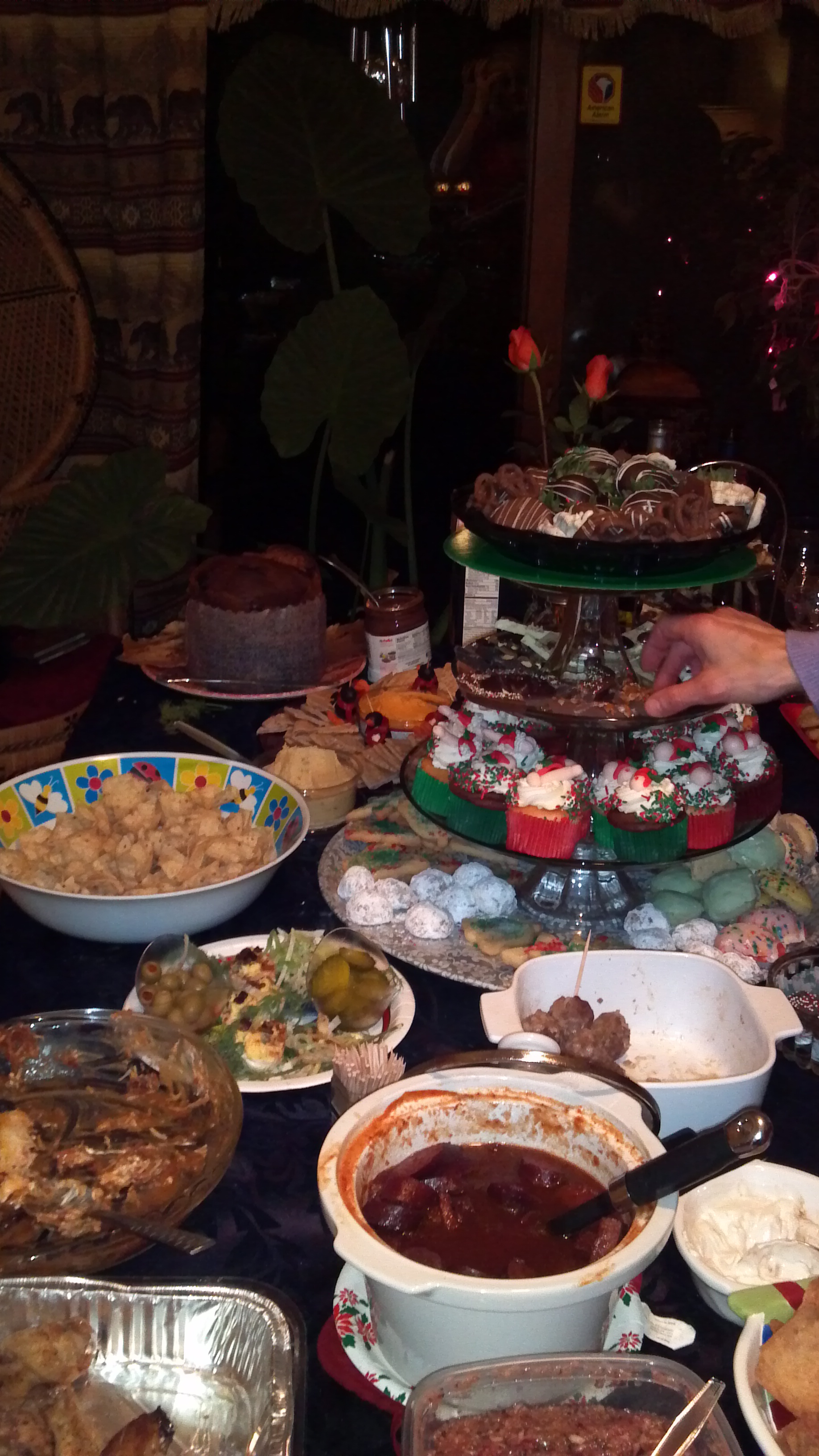
Deb's party food 2As she does whenever she comes to the States, our friend from Denmark was visiting us. Over a lunch I had enjoyed making for us all, we had fun catching up on our recent activities. She was exclaiming over the food, saying how good it was and how happy she was to be with us. “I love cooking for my friends,” I replied. I do. It is one of my favorite occupations. Stephen and I both enjoy entertaining friends, and making meals for them is a big part of my joy.

She commented that she too enjoyed cooking for her friends. She then went on to say that her experience here in the States was that when they were entertaining, many people seemed to prefer taking people out to eat rather than preparing food for them at home. She said that in Europe it was more common to prepare dinner for their guests at home and less common to take them to a restaurant. I thought this was an interesting commentary, and I wondered what it indicated about Americans.

Around the holidays, the newspapers overflow with advertisements for meals to which you are supposed to bring your whole family. Alternatively, supermarkets and other providers of food advertise “home cooked” meals delivered to your door. My parents would never have considered eating anywhere for the holidays but at the home of a relative. Eating out was only for very special occasions, perhaps to celebrate a victory or a special anniversary.

Thinking back on my childhood years I remember that when my parents entertained it was usually relatively spontaneously and for cocktails before luncheon after church or dinner. Afterward our guests either went home or to a restaurant. My mother did not like to entertain and seldom had people for dinner parties. She had had a lot of that as a young child in her parents home and had been as it were inoculated against it. Her mother had given her all sorts of jobs to do related to making ready for guests, none of which she particularly enjoyed.

Her father had been in he diplomatic service in Germany prior to World War II and they had lived all over the globe. Her mother had entertained at lavish dinner parties with food prepared by a cook or catered. To my mother fell the task of setting the table, arranging flowers and so on. Later she and her two sisters would be called upon to perform musically for the guests. No wonder she disliked parties.

My first husband didn’t care to entertain either. We had one big party a year. it. My cooking was confined to the family. I have found it wonderfully different with Stephen. He has always loved to entertain and there have been many times in our lives together when I never knew how many would be sitting down to dinner. Because I have plenty of supplies on hand, this has never bothered me. To be sure, I enjoy dining out, especially as someone’s guest, however I am very happy to eat loving prepared home cooking.

A Place of Peace by Tasha Halpert

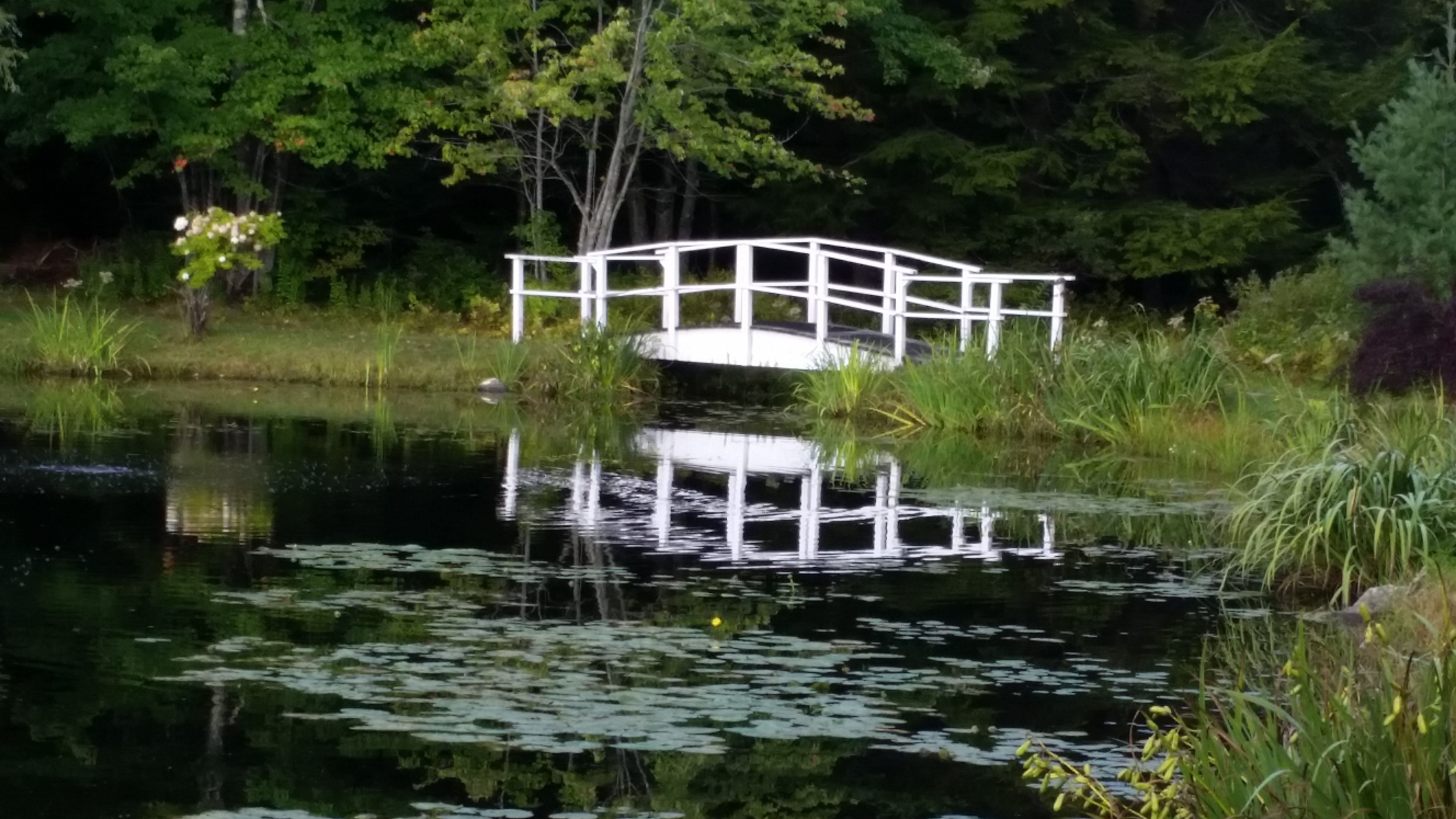
Peace Village Bridge ReflectionIt is easy to get caught up in the busyness of everyday life. For me it is often difficult is to pause and to take the time for an opportunity to do some self exploration. Such an opportunity was recently offered me. At first I found myself wondering how I could fit it in to my schedule, as well as make sure Stephen would have good food to eat while I was away. Yet because it included time to be with my daughter I didn’t hesitate long before saying yes.

She invited me to go with her to a spiritual retreat at a very special center in the Catskill mountains in New York State. Peace Village, a tranquil place of residence halls and meeting rooms is run by the Brahma Kumaris, a worldwide organization that originated in the 30s in India. The organization is devoted to self study and progress toward enlightenment. The Brahma Kumaris have created an atmosphere there that is highly conducive to personal growth.

At one time I studied and taught yoga. Later after we moved to Grafton my husband Stephen and I for many years had an inner peace center in our home where we held weekly meditations as well as what we called Peace potlucks, monthly. Stephen and I meditate almost daily, so I anticipated enjoying my time at the retreat which was said to include that as well as other opportunities to learn and to grow.

My happy expectations were fulfilled. During the three day retreat called By Ourselves In Company, the twenty-five of us were given a exercises designed to help us to become better acquainted with ourselves, as well as other techniques we could use to learn and grow. The participants were all ages and in all stages of life, more women than men, and several married couples. There were chances for us to interact and to learn from one another’s experiences as well as to be by ourselves and explore our own responses and reactions. The process was well designed and helpful.

Most special for me was the opportunity to do something with my daughter that we could share in as well as share. She leads a very busy life and while we do get to see one another often, it is always in the context of our days. The atmosphere the Brahma Kumaris have created in Peace Village is gentle and flowing. There is no hustle or bustle, no noise or stressful energy. On the hour music would play and everyone would stop what they were doing, breathe and reflect on the presence of the moment.

Here it was easy for me to absorb the lessons given as well as to learn to know myself better. The lack of distraction was key in helping me to focus. Yet what I really learned there was how important a peaceful atmosphere is to the nurturing of my being. The challenge will be to recreate it or at least to bring about some of the elements of that peace in my daily life so that I can continue to learn to see and to know myself more clearly.