Heartwings Love Notes 2006 My Cherished Toy Remembered

Heartwings says, “Learning to let go is important to one’s happiness.”

When I was a young child, my very most favorite toy was my teddy bear. He had arms and legs that moved freely up and down, and fur-like outsides. His eyes were not sewn on, but were made of glass and stuck in on long pins. His paws had a velvet covering, and his nose and mouth were embroidered in black thread. His “fur” was a light grey. Over time some of it rubbed away. I took him with me everywhere I was permitted to, and I always slept with him at night. Mysteriously he was usually on the floor by morning, something I never could understand until later on, when I was told that I was a restless sleeper.

Over time he acquired wear. The velvet on his paws thinned, his fur grew worn in some places. One of our dogs chewed on his left ear, making it raggedy, so I added a blue beret I had in my doll clothes collection to cover it. When I was in the first grade, I took him to school one day. When the beret covering his ear slipped away, my classmates made fun of him. Needless to say, I never did that again. When I was in the second grade, my parents took me south with them. We lived down there for several months, while my father worked on an assignment for his business. My school work was continued, and my mother taught[TH1] [TH2]  me every day.

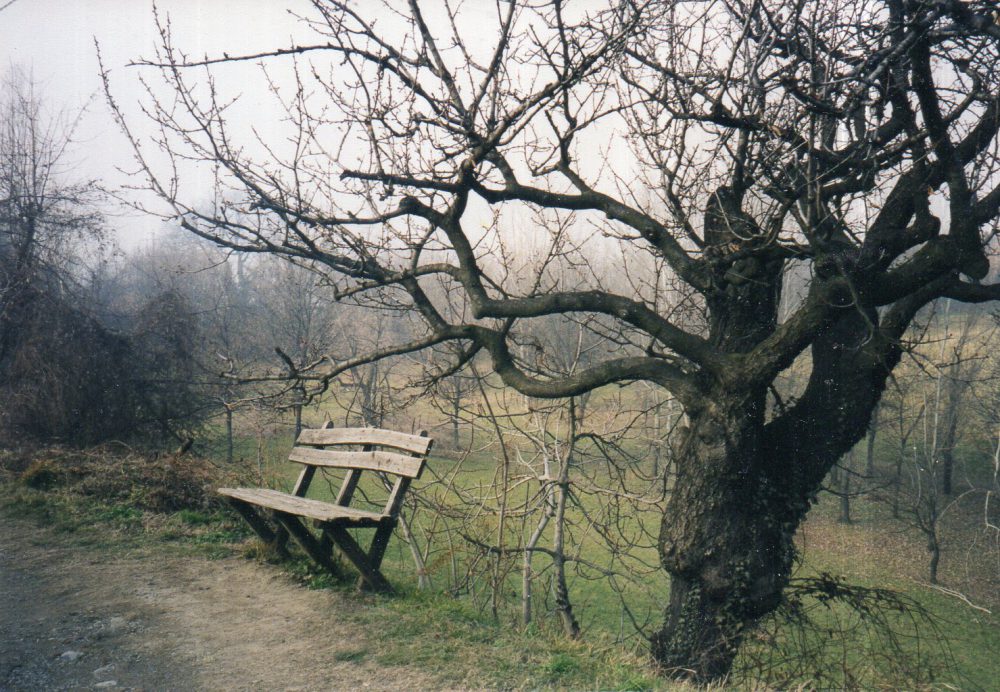
While we were living in Florida, we took a trip to an extensive garden somewhere in the everglades. My legs grew tired, and I sat to rest on a bench with my teddy. As we were driving home, I suddenly realized my teddy bear wasn’t with me. My heart sank. I begged my parents to turn around and go back. My pleas were to no avail. They were adamant.  I never saw my teddy again. In today’s world most children have more say, and their wants are given more attention. The majority of parents today would have made a strong effort to retrieve the cherished toy. To be sure, things have changed in the past eighty years, and certainly for the better in that respect.

Some years ago, a kind friend made me a lovely grey teddy. Dressed in a pointed turquoise hat and cape he lives in my bedroom, where I enjoy his presence each day, though he does not share my covers at night. My original teddy is enshrined in my memory, where I can still see him vividly in my mind’s eye. With his brown glass eyes and his worn yellowish grey fur, I envision him on a bench in the Everglades, perhaps talking with a bird or two. Or maybe he is not there any longer, but was found and treasured by another small child who gave him a good home and even took him to bed at night.

May you have cherished memories to visit now and then.

Blessings and best regards, Tasha Halpert

PS Do you have a story of your own to share with me? I so enjoy hearing from readers. Please do write and make my day. Tashahal@gmail.com Or hit reply, I’ll answer you.


 [TH1]

 [TH2]

Heartwings Love Notes 2005 The Time Between

Heartwings says, “The time between is an opportunity to be present with change.”

Driving the streets of the local countryside, I am struck by the green foliage that is not as yet committed to its autumn display. Here and there I see a tinge of red, a flash of yellow, with more of that than red. Fall is late this year. What is now called Indigenous People’s Day comes up this weekend, and the leaf peeping traffic will surely be diminished.

The green leaves are much darker green than they were, yet the nights have not been cool enough for the complete demise of their green. However, the warm sun of days in the seventies does feel welcome. Its nice to get out for a walk or to do errands in the sunshine. Happily, with the cooler weather my appetite begins to return and I have more energy to cook.

I seem to remember that in years gone by, frost had visited my garden by now. It seems only a short time ago that my kitchen windowsill was lined with green tomatoes hopefully intended to ripen. Usually, the garden was in need of weeding before the ground hardened, and sometimes I just let the cold frost them and wait until the spring to pull them up. The danger is that the seeds would get into the ground and grow more weeds.

My gardening days are over. With the exception of a few pots of succulents that spend the warm months on the porch, and the occasional basil plant to be used for cooking, I no longer nurture a garden of plants. Do I miss my spiral garden, from Sartell Road, or the smaller oblong one of our Warren Street home? Not really. I wouldn’t be able to manage the weeds and lean on my cane for balance at the same time. I haven’t tended a normal garden for close to ten years. My porch garden is enough for me, and when it leaves to stay with a kind friend for the winter, I will still have several houseplants to tend. They will do to satisfy my need for greenery. It is all right to follow the seasons of life and live appropriately by them.

On any given day now, I hover between getting up and lingering under the covers. I stay in when it rains and have the luxury of grocery delivery that saves me from shopping when I want to stay home. I’m not ready for the proverbial rocking chair on the porch as yet, but I do feel justified in taking things easier.

The seasons of life and the seasons of the year carry appropriate themes. My great grandchildren are in their own spring, my grandchildren enjoy their summer. Time suggests the appropriate tasks. The days between each season lead us to prepare for the next. I’m almost ready to get out my winter sweaters and warm coats. The trees are nearly ready to clothe themselves in their lovely fall garments. The seasons unfold.

May you be present with change as it occurs,

Blessings and best regards, Tasha Halpert

PS Please feel free to comment or make suggestions for topics, or just to share. I do love to hear from readers, and I do thank you for reading.

Heartwings Love Notes 2004: Dealing with Disappointment

Heartwings says, “There is sunshine behind the clouds, when you look for it.”

I’ve been reading Tarot Cards since the Seventies, both professionally and for my own edification. The cards can be used to clarify situations. For instance, the five of cups in my Tarot deck refers to disappointment. Generally, it shows three spilled goblets and two full ones. The person on the card is looking at the spilled ones and not at the two full ones on the shelf behind him. The implication is that while there may be something amiss, all is not lost. It is imperative to look at the full ones to see what has been saved or perhaps even gained.

Oddly, as soon as I had chosen the theme for this article, I began experiencing disappointments. They were small, not major ones, yet still had to be dealt with. Something I had been counting on failed to materialize. It was more than anything a slap to my ego, yet it needed to be resolved. I have found that if I let small negative thoughts hang around, they can grow into big resentments.

Another difficulty is that negativity can attract more of the same. It’s like trash and litter. Left on the street, it will grow. Someone sees some and adds his or her contribution just because there is already some there. It’s the same in my home. If I leave something on my arm chair, next thing I know there are several more items there, too. If I keep the chair clear that does not usually happen.

I have several ways to deal with disappointment, and they all begin by acknowledging my feelings. If I try to gloss over my sadness or dismay, I can’t deal with it at all. I can’t pull the weeds in the garden of my life if I don’t or won’t see them. This was a lesson I had to learn the hard way, and there are times I get to repeat it. Being a naturally cheerful person, I had to learn not to trivialize feelings of disappointment and sweep them under the metaphorical rug. 

Once I learned to look directly at the spilled cups, I could look around for the full ones. Once I had dealt with my feelings of loss, I could look to see what I might have gained. That is what the full cups represent. It has been my experience that there is always a benefit—perhaps small but yet significant, that comes from any loss. In my case, one of the losses became an opportunity to avoid additional, unnecessary calories. Another led to several opportunities I would otherwise not have had.

Not every gain is immediately apparent, and they may take time to discover. Nor am I talking about major sorrows, such as a significant loss. I am speaking of disappointments that occur on a daily or weekly basis, small stones, or snares on the pathway of life. When I treat them as bringing me opportunities, that is what they will do.

May you seek the full cups and find them easily.

Blessings and best regards, Tasha Halpert

PS Do you have a story to share, or a comment? I always enjoy my readers’ responses very much. Do let me hear from you, and visit my blog on WordPress for more Love Notes. http://tashasperspective.com and click on Pujakins.

Heartwings Love Notes : Autumn Soup for a Fall Treat

Heartwings says, “Homemade soup is fun to create and even more, to eat.”

Late summer or early fall is the peak time for fresh local corn. Stephen and I are very fond of it, but we can’t always get to the farmstand to buy it. Having grown up with a big garden, I’m something of a corn snob. Supermarket corn just doesn’t cut it. Fresh picked and eaten the same day is standard operating procedure for me. However, for recipes, canned or frozen corn will do. It’s usually fresher tasting than day old or maybe much more supermarket corn, and anyway, for a recipe it’s a lot less work than using any fresh corn kernels.

Stephen expressed a desire for corn chowder, so I got out some of my favorite cookbooks and began looking through them. The first snag I encountered was that without exception the recipes I found wanted me to use canned creamed corn. All I had on hand was regular canned corn. Since I didn’t particularly want to go out and buy that kind, I figured that was out. Next, I knew I didn’t want to use actual dairy milk or cream. Stephen has asthma and he is better off without actual dairy in his diet.

Coconut milk is my usual substitute for the bovine variety, and I had plenty of that on hand. Chicken broth makes a good soup base, so I figured I’d use that too. But how to thicken it? Normally I’d make a roux of butter and gluten free flour, however that seemed like too much work. I remembered seeing something about thickening soup with stale bread—was it perhaps in my ancient Fanny Farmer cookbook? I had some gluten free bread in the fridge I could use.  Then I wanted to add some onion, but I didn’t wish to take the time and energy to chop and sauté it. Cue in the blender. I was almost ready.

I opened a can of corn and poured it into my blender. Next came a cup of chicken bone broth—extra healthy, and a cup of coconut milk. I added about a quarter to a third of roughly chopped onion, some ground garlic, and a little lemon pepper. Last, I added a good-sized slice of bread torn into pieces, crust and all. If you use salt, add some now, but only a small amount. Stephen has to watch his blood pressure, so I leave it out and salt my own.

All the ingredients being present, I covered the blender and turned it on. With its usual grinding noises, it began to chop and combine the mixture it contained. Once everything in the blender was thoroughly combined, I turned it off, took off the cover and poured it into a jar to let it season a bit. I expected to cook it before we ate it so the onion wouldn’t be raw. When we had it for supper along with some toasted cheese sandwiches, we proclaimed it a success.

May your cooking experiments turn out to be delicious.

Blessings and best regards, Tasha Halpert

PS Do you have any recipes. Especially those you have created or any you are fond of, to share? I’d be so happy to see them. Meanwhile, Happy Autumn and joyous days to you. Tashahal@gmail.com

Heartwings Love Notes 2001: Eating Humble Pie

Heartwings says, “Humble pie is an acquired taste.”

As a child, I was clumsy and uncoordinated. Being tall for my age may have had something to do with it, however I also have poor proprioception. That means I lack awareness of the space around me. For instance, it’s easy for me to bump into things or kick them, or worse, stumble over them. Lacking in coordination, I did badly in most athletic situations. I played goalie in field hockey because I didn’t have to run. The problem with that was I felt guilty whenever the opposing team scored a goal. Sports really was my least favorite physical occupation.
Then I studied yoga. I began with a book which a friend gave me when I told him I was having trouble sleeping. I studied the pictures, followed the text, and found I was indeed sleeping sooner and more soundly. Next someone I knew announced she was teaching a series of eight yoga classes, which I eagerly took. Fortuitously, I discovered another teacher, signed up for her classes, took her teacher training, and became one of her teachers. How proud I was of my abilities and how good I felt about my new career.
Then I had an accident to my neck. Because many of the important postures put pressure on my neck, I had to give up both teaching yoga and doing it for myself. I was very disappointed. However, there was nothing I could do about it. By this time anyway, with five children, motherhood had become a fulltime occupation. I still meditated regularly and used some of the relaxation exercises I had learned to help me through my busy days.
I prided myself on all that I could get done. My days were full, yet my ability to cope and remain calm was something I cherished. Things went on like this for many years. The children grew up, my life changed, I was now married to a man who, unlike my former spouse, loved to entertain. We started an inner peace center, teaching meditation and classes. I never knew how many people we might host at any given meal. I was proud to be able to feed them at a moment’s notice. Spending hours in the kitchen was no problem; I loved cooking for people.
Many years passed. I found myself slowing down. I found I had acquired Parkinson’s disease. I got tired faster; I could no longer spend long hours preparing and cooking food. Slowed steps made trips to the grocery store tiring. I had to rely more on frozen foods and mixes. Again, I found myself having to cope with no longer being able to do what I used to do. This included mending and other activities requiring dexterity. Once proud of my ability to surmount obstacles, I have to ask for help with them. These days, I’ve had to get used to eating large helpings of humble pie. However, somehow I’m getting used to the taste.

May you enjoy whatever you need to deal with as you learn and grow.

Blessings and best regards, Tasha Halpert

PS Please share any recipes you have for Humble Pie, I so enjoy hearing from my precious readers. Please email me at tashahal@gmail.com. Enjoy past Love Notes at my blog: httpl://tashasperspective.com.

Heartwings Love Note 2000: It’s About Time

This Love Note marks a milestone: Number 2000 in total over a period of many years, at 52 a year. You can do the math how many that is. I am eternally grateful to my readers and to the invisibles who have had a hand in the Notes’ creation.

Heartwings says, “Waste not, want not; use whatever time you have wisely.”

When as a child I visited my grandmother in her summer home in Beverly farms, I would stand by the big cuckoo clock in the hall to see the bird emerge. I loved it! I even remember being very little and someone lifting me to see the bird up close. My dear grandmother would even advance the hands to make it sound the hour ahead, just for me. Perhaps that was the beginning of my fascination with time and clocks. All these years later, its passage remains a mystery.

 I remember as a child waking up on sunny summer mornings and thinking about how I had a whole day to play, and what fun that would be. Indeed, the hours stretched out and brought me much joy as I amused myself. An only child until I was eight, I had developed a good ability to entertain myself. I was never lonely, though I was mostly alone unless an adult was interested in playing with me, and mostly they weren’t, so my time was my own.

Now, some eighty years later when I wake up on any morning, whatever the time of year, I go over in my mind what I need to get done, not to mention what’s left over to do from the day before. (Usually, I had planned more than I could accomplish.) Then as I get ready, beginning with my exercises, I prioritize my “to do” list. It’s simpler than it used to be. Eighty years holds a world of change, and hopefully I have learned what’s important.

Children tend to live as human beings; adults as human doings. And time is at the center of the action in either stage of life.  It seems there is only so much of it—sixty seconds make a minute, or so they say. However, how do you feel after holding your breath for sixty seconds or laughing for the same amount of time? Do they feel the same? That’s the odd thing about time. It’s supposed to measure the same, yet it does not, at least in my experience feel that way. Another example is going somewhere versus coming back, which feels much shorter, clocks to the contrary.

Stephen and I have always collected interesting clocks. Our small apartment is full of them. Most of them are synchronized, more or less, within five or so minutes. Several display the accurate time, and others may lag a bit, depending on the age of their batteries. However, I know which ones are correct. Also, I like seeing what time it is whenever I feel like it, even without wearing a watch—mine is currently in need of batteries. I’m not sure I get any more done by looking, but I do like to know. Recently I came across a study that showed that the heart’s activity influences our perception of time as it passes. Time is a conundrum it’s fun to explore.

Enjoy whatever time you have and don’t try to save it at the price of your joy.

Blessings and best regards, Tasha Halpert

How do you feel about time? Do you take your time? Or do you find there’s never enough? How’s your time management. Write and tell me about your relationship with time. I so love to hear from readers. Please write me at tashahal@gmail.com. You can see more love notes on my website www.heartwingsandfriends.com, or see my blog at https://tashasperspective.com.

Heartwings Love Notes Kitchen Helps and Hints

Heartwings says, “Good tools are an important part of success in the kitchen.”

When at around the age of ten or eleven I first began to cook, I was permitted only to make brownies. In a year or more, I graduated to salads. That was it. My mother feared I would “ruin the food,” her words, and although cooking was low on her list of things she liked to do, she did all the rest. Once I got married and had my own kitchen, I taught myself to cook whatever we were going to eat. I had the impression I ought to serve meat twice a day, and because I was on a rather meager budget, we ate a lot of hot dogs.

These many years later I still do enjoy cooking, although I do not feel I must serve meat twice a day. Perish the thought! Protein twice a day, when you have diabetes, as I do, however is important and a rule I do try to follow. Besides meat and fish, this can include nut butters, cheese, cottage cheese, eggs, and other forms of protein. I don’t make many elaborate meals, because at eighty-seven my stamina is not what it once was. However, I do try for us to have mostly healthy, Mediterranean style dishes and lots of fish.

I have learned that certain tools are essential to efficient, enjoyable cooking. I have several different sized cutting boards, and my smallest is probably the one I use most. Two serrated knives, one large, one smaller and several small, pointed utility knives are helpful and better still, several pairs of scissors. Although I have a good chef’s knife for chopping, they are easier for me to use to deal with celery, scallions, and fresh herbs. I also use the scissors to reduce peppers and onion to smaller pieces once I’ve cut into them.

One of my most favorite tools is a canning funnel. It’s not that I do any canning, although my mother did. Our basement closet was once filled with glass jars of fruit and vegetables picked from her garden. Today the food I can purchase in the market is a lot more available and does not require standing over a hot stove. My canning funnel as well as its traditional sister, with the smaller spout, is absolutely invaluable for pouring soups, stews, cooked fruit, and anything liquid into jars without spilling.

I once had plastic funnels and somewhere along the way I acquired stainless steel ones. I highly recommend these as one of the most valuable tools in a kitchen. A good, versatile garlic press is also vital if you use much of this nutritious vegetable or herb, depending on what you call it. My lemon squeezer is another big help for our daily before breakfast half a lemon in water liver cleanse. Slotted spoons and several sizes of ladles are helpful. Lastly, I have two smaller and one larger spatula.  These small ones are extremely handy for all sorts of cooking, and the larger one is useful too, for serving.

May you have success with your efforts in cooking, and enjoy it.

Blessings and best regards, Tasha Halpert

PS Do you have some kitchen tools you are especially fond of? Please email me or comment and share your story. I so enjoy hearing from readers. Thanks! 

Heartwings Love Notes 1098 Where Can It Be

Heartwings says, “Putting things back where they belong is important.”

As a child I was taught to be tidy. Emily, the practical nurse my parents hired to help care for me when I was around two or so, tried hard to make sure I learned to put my toys, and later, my clothing away. She was with us until I was around eight years old when she left to get married and have a family of her own. Unlike my mother, she was patient and physically affectionate.

I am not faulting my mother in any way. Her behavior was molded by her upbringing. While kind and a good mother, she grew up with strict German parents who did not encourage demonstrative behavior. Even as a grandmother she was reluctant to accept or to give physical affection. Fun and fond behavior was not a priority, neatness was. 

Once I was married and had children of my own, I did my best to be as tidy as I could. This grew more difficult with each addition to the family, which eventually added up to five children. I didn’t have a lot of time to devote to being neat or organized. My mother often criticized me for my “messy house,” and it never seemed to occur to her that there was a good reason for this. I thought it was more important to enjoy and care for my children than to be neat.

Neatness does have virtues beyond looking nice. Having things in order means when I need to find something, I’ll know where it is and can find it without any difficulty. That is why the saying, “a place for everything and everything in its place,” has been my guideline as long as I can remember. For instance, I try hard to keep all of my tools where I can easily reach them and as close as possible to where they will be used. Being a systematic Scorpio, I have sectioned off the shelves in my pantry by assigning them to what I can make or do with the contents.

However, unfortunately this works as long as I am the only person putting things away. Also, there often is more to be put away than the shelves can conveniently hold. This results in items get shoved to the back, effectively disappearing from view and becoming unavailable. So, although I no longer have little children to run around after or an eagle-eyed mother judging my attempts to be tidy, I struggle still with my tidiness conundrums.

The current state of my health doesn’t help either. Despite Stephen’s great help, much does not get done. There are days I simply only have enough energy to cook meals and see to my immediate emails, not to mention attend doctors’ appointments. Prioritizing becomes important, and as it was once so it is again: I do what is important and let the rest go.

Reaching and Grasping

Heartwings says, “It is very helpful for one’s reach not to exceed one’s grasp.”

Reaching for things is somewhat more challenging for me than it used to be. I am often faced with the need to ask for help. Fortunately, Stephen is usually available, and though he has also shrunk, at least he is much taller than I am.  Sadly, I have diminished from five feet four inches to five feet one and a half or maybe two. In addition, I have lost flexibility. Asking for help is getting more necessary, and I am getting more used to doing that. It seems there is always more to be learned.

In a yoga class and lecture that I attended many years ago now—yet somehow it seems just a year or two have past, the visiting sage told us this. “My mantra is I know nothing; I want to learn.” I balked at first at the seemingly negative affirmation. Affirming I know nothing? That didn’t sound right. But affirming I wanted to learn, did. So, I gave the whole sentence some thought.

Eventually, light descended upon my brain, and I finally understood. This sentence describes what is called Beginners Mind. What that means is that at the beginning I expect to learn, so it is important not to cloud the mind with what I think I might know. When I think I know something, my mind does not generally seek more information.

If I think I have grasped whatever it is I need to learn, I most probably will no longer reach out further with my mind. It is more important than you might think for your grasp to exceed your reach. Because there is always more to be learned, whether it is the how-to of a project, the pitfalls, or else the simple understanding or a further interpretation of what something might mean. We cannot always know how much more there is to know. 

When I look at each day with a beginner’s mind attitude, there are wonderful conundrums that arise. They give me something to think about other than the dismayingly negative tales of misbehavior that often comprise the daily doings of the world at large. The arguments and disagreements people have that stoke violence could so often be resolved by a better understanding or even a simple agreement to disagree.

For me the world I live in is filled with interesting experiences to be explored with discoveries to be made along the way. Perhaps because I am a poet, I especially delight in finding beauty that has simply created itself. The lovely weeds right now along the roads, waving in the breezes from passing cars, are a delight to be seen. The delicate Queen Ann’s lace, mingled with the tall, graceful Artemesia are probably destined eventually to be cut down, yet each day they remain, they fill the eye that gazes upon them with their beauty. I am grateful to be able to see them and to find something so special within my grasp.

May you be able to look upon life with a beginner’s mind.

Blessings and best regards, Tasha

PS Do you have comments, questions, or stories to share? I would love to hear from you, and I find great joy in your correspondence.

Heartwings Love Notes 1096: Memory and Forgettery

Heartwings says, “Remembrance of things past can be precious.”

Lately my forgettery works better than my memory, or so it seems to me. I shudder to think old age is creeping up on me, however that might be the case. At eighty-seven going on eighty-eight maybe it’s appropriate to have some memory issues. The thing is, I have said for years if I must Lose out either in mind or in body, I’d prefer to keep my mind.

My mother was physically strong even into her nineties. She once fell down a flight of stairs and got to her feet with nothing to show for the experience but a few bruises. She was physically active in her old age, and unlike me, she could go for long walks at a fast pace. Her mind, however began to leave her in her mid-seventies and by the time she was my age she had become more absent of mind than not.

My grandmother on my father’s side was strong and vital until age eighty, when she fell asleep the night of the lovely Christmas party she had for us, and never woke up. She was found the next morning, where she had dozed off sitting against her pillows. She was reading the book the children’s father and I had given her for Christmas and never woke up. What a lovely way to go. I would like to be that fortunate.

She had a youthful demeanor, and by sales people and other strangers, when I was with her, she was often thought of as my mother. I like to think I’ve inherited her good health and her mental resilience. She might have been somewhat forgetful. I remember my mother once saying that when she stayed with her, my mother was always stepping on the notes to herself that my grandmother left on the floor. I prefer to leave my notes on my desk or on the kitchen counter. I have two pads of recycled paper I keep in different places to help me remember to do things that I need to do in a timely manner.

In some way, it appears to me that I am more apt to neglect what I do not write down. So, lately I am taking care to write even more down than I used to. I also write down stray hints and phrases that are themes for columns. These float in and as quickly float away if I don’t make note of them. Today’s subject is an example of a quick inspiration based the word “forgettery.”

My long-term memory is excellent and goes back to my very early childhood. I have impressions from being in my blue highchair and even in my blue crib. I was so good at escaping from it that my parents moved my bureau up against it to prevent me. I hope my memory continues to hold up and that my forgettery will not increase, however, only time will tell, and time’s not saying right now.

May you remember whatever you need to, by the time you do.

Blessings and best regards, Tasha Halpert

PS How about you, dear Readers? Do you have memory tricks you use or other methods that are helpful? I love it when you share, and I treasure your responses. Thanks in advance.