Saving What Is Useful

useful bags.jpg  When my mother and I went to Russia in 1991 among the places we visited was the Hermitage Museum in St. Petersburg. It was very impressive. My favorite part was the room with six Rembrandts. Sitting among them was an extraordinary experience. As we left we bought some postcards and other souvenirs and when none seemed to be forthcoming, asked for a bag to put them in. The cashier gave us a sour look then finally dug out a used plastic bag– an obvious treasure from her hoard and placed our items in it. Recycled bags were more common there than new ones were then.

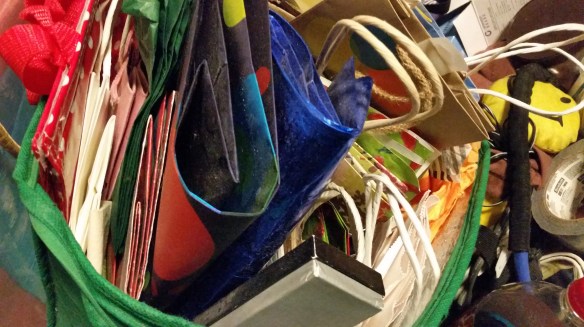
I certainly do save and either use or recycle lots of plastic bags, however I have a stash of various sizes of paper bags as well as small gift boxes that threatens to erupt from its container. Some are saved for when we give people gifts. The ones with decorations for Christmas or birthday, for instance come in very handy. Others with no decorations or simply printed with the name of a store can be used for any occasion, and also for carrying things. I only wish I knew just how many of these decorated bags I would need in the near future so I could pass some of them on to others.

I simply cannot bear to throw out anything that is ultimately useful. Take for instance the elastics that come on things. I haven’t bought any rubber elastics for years. They come in various sizes, shapes and colors, mostly on vegetables. The small bag I have stays full because what I use gets replaced. Twisty ties are something else I tend to save. They too come in various lengths and are useful for tying up many things as well as substituting for the difficult to reuse flat plastic closures most bread bags come with. The long ones are good for wrapping around electric cords and small tools.

I seldom use paper towels unless I want to clean up a mess, thus saving paper. I tear appeal letters and ads for insurance and so forth on 81/2 by 11 sheets with a blank side into thirds, pinch them together with a clip and use them to make my grocery and “to do” lists. Smaller scraps of paper become notes, though I have to be careful not to lose those. String of any length of course gets reused, as does ribbon, and of course wrapping paper. Unless it’s torn, I fold and save Christmas and birthday wrapping paper, as did my parents.

Being of a saving nature runs in my family. My father once told me he found an envelope among his mother’s things with bits of string in it labeled “pieces of string too small to use.” However I have since heard this story from other sources, so it may have been something he borrowed rather than experienced. My mother, my father, my grandmother and my other relatives all followed the Yankee thrift rule: recycle, reuse or do without, so it’s not surprising I developed this habit and needless to say as I have discovered, passed it on to my children.

Thoughts from a Thrifty Cook

Tasha's Fridge 1My mother felt strongly that food was precious and not to be wasted. She had been a young child during World War I in Germany, and the experience of scarcity had shaped her attitude. To her way of thinking, all food was to be used up one way or another. Then came World War II and rationing. I too was very young, yet this also gave me lessons in thrifty use of food. Fortunately I have been able to put my early lessons to good use in learning how to create meals from whatever I have left over even if I hadn’t already planned ahead.

A chicken, for instance normally provides two people at least three meals: hot, cold, and soup. That’s easy, but what about the bits and pieces of vegetables, meat, fish, or even pasta that might otherwise molder in the back of the ‘fridge. Why not make a soup, or combine them in a quick stirfry? If your family is fussy about food you probably can’t do that, however a retired couple like us, or even a single person may find it fun to experiment. One warning: it is important for the leftovers from the originals to make good combinations. A curry and a chili won’t mix well.

To use up most leftover vegetables, sauté half an onion until soft and then tip in whatever you have. This freshens the taste and makes them seem like a different dish. Add half a box of chicken or beef broth and serve this as a soup with a salad for supper. Throw in a handful of uncooked pasta of your choice and simmer or add leftover rice for a heartier dish. Or combine the vegetables and the rice or cooked pasta, sprinkle on curry powder, voila, another meal. Cook any leftover hamburger or some other chopped up cooked meat and add to the simple stirfry for a more filling lunch or supper. You can also cover it with leftover mashed potato, pop into the oven and have a shepherd’s pie.

I often use some of that convenient boxed coconut milk to season my leftover vegetables. Or in the summer I may add some salad dressing and toss them with lettuce, chopped sweet onion, and whatever else you like for a cold meal. Adding some canned salmon or tuna makes a more filling meal. The coconut milk is also very tasty with leftover chicken stirfry or soup. Simply chop up what you have, add whatever vegetables you like and warm them all up together with either leftover or freshly cooked rice. For soup, add chicken broth.

Whenever I make rice I make enough so I have some left over. I like to use it to make what I call Pudding As Rice: Per person use ½ cup rice, 1 Tbs butter, 1 Tbs brown sugar, about a half cup or so mixed dried fruit of your choice—brown and white raisins, dried cranberries, cherries, dried pineapple, or whatever else you fancy. Mix and cook together over low heat 15 minutes or so, stirring occasionally until all is mingled into a tasty mix and serve with almond, coconut or dairy cream poured over it. Or instead, combine it with fresh or canned fruit. This simple dessert pleases almost everyone.


Thrifty Ways

clothes-in-closetWhen I was a child a friend of my mother’s gave me the dresses that that her twins had outgrown. Because they were dressed alike, I had to wear two of whatever came my way. In the days when I was growing up, thrift meant making do with what was available. Aside from the fact that while my family had enough, they weren’t exactly wealthy, there was a war on and many things, including clothing and shoes were rationed.
In addition, in the years that followed, my mother had to stretch what my father earned to cover the needs of the three more children born after I turned eight years old. I remember how excited I was when in my sixteenth year I got a pair of Bermuda shorts. They were newly fashionable and I felt very special to have a pair. Although they were wool, I wore them all that summer and for a number of summers after that. For a long time they were my only pair.

Growing up in a thrifty household inclined me toward a thrifty lifestyle as an adult. When I was raising my own family of five children I had to stretch our food dollars to try to nourish as well as please my family. I learned all kinds of tricks to make inexpensive cuts of meat palatable and I baked cookies by the dozen so the children would have treats. Home made was far less expensive than store bought. My sewing machine hummed as I made dresses for my daughters and even some outfits for my sons when they were small.

Judging from the advertisements I see today, thrift is not especially fashionable. Bargains, of course are. However what is considered a bargain by some standards is not by others. When I was growing up the annual church fair rummage sales held in local churches were the best places to find inexpensive, serviceable garments. My mother was a faithful customer.

I do not remember there being consignment shops or other places one could find good second hand clothing when I was a child. When we got together I introduced Stephen to consignment and thrift store shopping, and he embraced it happily. I find it more fun to shop that way because you never know what you will find and the prices are far more reasonable than what other stores charge.

Over the years, I have amassed a wonderful collection of clothing. Much of it has come from consignment or thrift stores, the rest from sales. Certain garments have endured the test of time and I wear them joyfully in the appropriate season. Others get rotated back into the mainstream to be discovered by someone else who enjoys saving money by shopping wisely. What is especially nice for me is that now I can have a number of pairs of shorts for the price I would pay for one bought new, or a cashmere sweater that someone has passed on, at a fraction of the cost in a regular store. Perhaps this is a kind of payback for the days when I wore the twins’ hand me down dresses over and over again.

Tasha Halpert

Lenten Discipline, Spiritual Discipline

icicles-2Regardless of one’s spiritual orientation, self-discipline can be helpful to one’s personal growth. In the days before supermarkets or even grocery stores, for people in spiritual or religious communities or congregations to find enough to eat in the latter months of winter could be difficult especially in the six weeks before Easter. The Christian religious institutions of the day dedicated this time, known to Christians as Lent to the spiritual practice of fasting. From a practical standpoint, this extended what supplies remained. It also provided a spiritual bonus to do so. Making a virtue of necessity, the Lenten observances of the past centuries helped individuals get through the scarcity of food.

When I was growing up of course food was abundant. Fasting certainly was not a necessity. I was taught that the way to fulfill my Christian Lenten obligations was to give up something I might enjoy eating. I was told that fasting wasn’t just about going without a meal or not eating meat; it could mean giving up chocolate, or ice cream or sweets in general during Lent as a discipline instead of not eating meat on certain days or whatever else might be considered appropriate.

My great aunt Alice was a woman of character and community mindedness. She was a great believer in doing good and volunteered in a number of organizations as well as gave generously to charities. She had a different approach. She believed in taking on rather than giving up something during Lent. She would assume extra volunteer work or make a special effort at that time to visit elderly or invalid family members or friends.

I have come to believe that my Great Aunt’s idea of a good Lenten discipline is more meaningful as a spiritual practice than giving up desserts or candy. However, I am not one to visit the sick, nor am I usually involved in any community activities of a volunteer nature. Instead I believe that for me to fulfill the spirit of this period I can take on a practice of deliberate focus: to enhance my awareness of gratitude and of opportunities for me to give. I can become more mindful of my blessings, spend more time acknowledging the kindness of friends and family, and be more aware of whatever opportunities may present themselves for me to be kind and thoughtful to others.

Self-discipline can consist of an act of rigorous denial or of observing and then acting as might be appropriate. One can lead a spiritual life whether or not one has taken vows or lives within a specific religious or spiritual setting. If my Lenten practice becomes a habit or enhances my ability to be more mindful, that will do me more good than giving up candy. In the process it may also help me to be more aware of when I can do someone a kindness. By prioritizing these attitudes in my everyday life, I can enact a Lenten discipline that will do more good in general than simply fasting from anything I might enjoy eating.

A Valentine to Lost Loves

dscf0142

When I was eight years old my dear nurse, Emily left to get married. She had taken care of me since I was around eighteen months of age and was in most respects my second mother. She was a practical nurse. That meant besides looking after me, she helped with household chores as well as driving me where I might need to go. She was a devoted caretaker and when she left I missed her sorely. While my own mother loved me dearly, she loved me in her own way. Unlike Emily she was not a physically affectionate person. Also she had much higher expectations of me than Emily did.

When I was twelve, my friend and classmate Sally went away to boarding school. A bookish, unathletic, somewhat plump child, I had no interest in the things my classmates did, and neither did she. As a result from the third to the seventh grade we formed a team of two, and I defended her from the bullies that taunted her for her shyness. I missed her sadly. She lived in a big house by the ocean and our idyllic summers were spent swimming and playing tennis in her private court. Her freezer always held a tub of ice cream and we could make cones when we wanted. When we reached sixteen and I began dating, despite my efforts to remain close, we drifted apart. She had been my best and only friend. She remained distant.

Once I was married and had children I became friends with woman whose two boys were around the age of my two girls. We all went everywhere together. She had a wonderful voice and we used to sing folk songs at our children’s school. We even performed in a contest. Very close, we spoke on the phone almost daily. Then for some reason she became angry with me and disappeared from my life. For months I was devastated. Later on I had another friend I went to the beach with each day. Sadly, after several years she went back to Germany and never returned. By then I was beginning to learn what it was to lose someone I loved, and how to handle it; I was able to recover faster.

Throughout my long life I have had many opportunities to learn to live with loss. I had to come to terms with son’s death when he was twenty-eight, and as I grew older, my parents passing. More lately have come the deaths of others I loved. As time has gone on, these experiences have helped me learn to let loved ones go with a more peaceful heart. I have discovered that I do not need to stop thinking about them, nor do I need to regret their absence. I can take the images of them together with the memories of our time together and put them lovingly in a special album I keep in my heart. Then when I wish to I can open it, turn the pages and smile as I remember with joy the good times we had and the love we shared.

Tasha Halpert

The Eyes of Unconditional Love

heart-and-bellsOnce upon a time I wrote a poem about the eyes of love. It began: “consider with the eyes of love.” Though at that time I hadn’t yet learned about the difference that the qualifying word unconditional makes, what I meant by love in the poem actually was unconditional love. My parents and grandmother loved me very much. They were also quite critical of me, as well as of others they loved and otherwise thought well of. Unconditional love means just that—no criticism, no conditions on the love. It also to me means looking at others as well as at myself without a disapproving attitude.

My dear mother had most probably inherited her critical outlook on life from her highly critical mother who made frequent remarks concerning how she well as others looked. In her eyes one’s stomach was not supposed to be anything but flat as a pancake, one’s waist slender, etc. I at one time wondered why, when she was quite thin my mother wore a girdle. Then I learned it was because she believed bulges were not to be tolerated. She used to try with little success to get me to wear one. They were so uncomfortable, I wouldn’t. Eventually she too stopped wearing one.

My father too had his viewpoint. Once I acquired them my eyeglasses became an issue for him, especially when I was dressed up. I can hear him now as he aimed his camera, saying, “Take off your glasses and look pretty.” Thus whenever I was in my party clothes the glasses I wore from the third grade on became an issue for me, making me think I ought to take them off in order to look properly attractive. He was also particular about my hair, which was supposed to look smooth and symmetrical–properly arranged in a tidy manner.

My grandmother had very strong ideas about what it was to act like or to be a “lady.” When I was twelve, inspired by my first experience of being paid for it, I decided to earn money giving the puppet shows I wrote and performed for birthday parties. My grandmother quickly put an end to this. She told me sternly that ladies didn’t work. Then she gave me a twenty-dollar bill and said, “Now you don’t have to earn money.” She had grown up in a household where as she informed me, if a log rolled off the fire she rang for a maid to come in and put it back. While she did volunteer work, she had never earned money.

The critical eye that I inherited from my family persisted for a long time. It took me years to be aware of it. Then I had to learn to stop the little voice in my head that called attention to whatever deviation from the “norm” of beauty I perceived. To begin with I applied this to my view of others. Gradually I learned to do this for myself as well. The eyes of unconditional love do not see critically but with an understanding that for good reasons, we are all perfect just the way we are. These days the eyes I see through are my own, and I look out upon the world with love. As well, when I look in the mirror now, I smile.

Tasha Halpert

A Sip of Spring in January

spring-water

The school I attended as a child had no weeks of vacation between Christmas and March. I had little to look forward to except an occasional snow day or being home sick with a cold. Not that I liked being home sick—my mother was not one to allow me to “enjoy poor health” as she put it. This meant I was confined to bed without much to do and no pampering. The best I could expect was an opportunity to listen to the radio. Television didn’t arrive in our household until I was twelve. The winter days were dreary with school and homework. I didn’t like skiing and skating was no fun so I spent my free time indoors reading. The advent of spring at least meant I could spend more time outside.

There is a deceptively warm period in the first month of the year called the January thaw. It usually comes at the end of the month, but sometimes earlier. It is the opening note of a long prelude to spring. Sadly, it raises hopes too soon dashed. February sets in, the snow falls, the cold descends, and winter reminds us that we have a long way to go. The upside is that at least the days are longer and brighter as the sun grows stronger and shines from higher in the sky. The burgeoning light keeps us apprised of spring’s actual advent.

Expectations often create disappointment. However it is difficult to avoid having them. The anticipation that is the creator of my expectations is what happens when I yearn toward something that is just out or reach or even beyond my control, like spring. This habit begins in childhood. Once we outgrow the present moment mindset of our early years, we are vulnerable to it. For instance, when the circus was coming to town it was a big event in my young life. My grandmother always took me and every year I loved it.

The difficulty with anticipation, especially when one is an adult, is that it can suck the juice out of the actual event. A few years ago Stephen and I took a friend’s two children to a local circus in a town nearby. Based on my memories of Barnum and Bailey, I had unrealistic expectations of the little circus and did not enjoy it nearly as much as I would have otherwise. On the other hand the two children we took had a wonderful time. Unexpectedly, my enjoyment ended up being about that rather than about the performances.

Today in the news I saw that the circus of my childhood—Barnum and Bailey, will be no more. This may have started I suppose when they released the elephants and now they are disbanding completely. I wonder if those who like me once anticipated the arrival of the circus will be disappointed. I haven’t been to a Barnum and Bailey performance in many years myself, however I have my memories. Thankfully I can sip those memories whenever I wish. That’s the blessing of memories, like food in the pantry or the refrigerator they are available when I wish to reach for them. Memories of spring, however, cannot compare to its actual advent, and that I eagerly await.

Tasha Halpert


A New Year, A New Beginning

snow-designMy grandmother lived alone in Boston. A widow for many years she had an unusual way of celebrating New Year’s Eve. As my father told it, she would pick a movie theater that was showing a film she wanted to see and go to the last show. In those days on New Years Eve the theaters would pass out noisemakers and at midnight everyone would sound off with them.

I don’t know if any movie theaters do this today; certainly when they did it then it was a wonderful way for her to celebrate. Seeing the old year out is a in whatever way chosen is a ritual that has been practiced by peoples of all times and places for centuries if not millennia. I enjoy my personal rituals, which include ringing all the bells in the house not to mention kissing my husband a midnight. Then there are the ones I also practice for New Year’s Day.

The old year now past holds both failures and successes. I need to take these into account as I do my rituals to begin the New Year. What are my expectations? My resolutions, my hopes and dreams for the next twelve months to come. Realistically I must base them partly on what has been as well as what I hope will be. The trick is not to limit myself by any failures nor be overly egotistical about any successes.

When I look out of my window in the morning after a fresh snowfall, the gleaming white expanse seems like a new beginning. The crusty, trampled, slightly soiled snow beneath is hidden from sight. Everything looks fresh, ready to be inscribed with the present. A new beginning is a blank sheet of paper, a bed newly made with clean sheets, the first breath of air I take when I walk out of my door. A new beginning is a wonderful opportunity.

However, I must remember that beneath the newly fallen snow are the remnants of the snows that fell days before. They lurk there like the mistakes, the mishaps, the opportunities not taken and the regrets I may have for all that remains undone. A new beginning must also take into account what has gone before. Mistakes and misses can be useful if I am willing to learn from them. If I am not, they remain like the old mounds of snow banks–freshly covered but still obvious in any parking lot.

I have always enjoyed my New Year’s Day rituals. I try to do a little of whatever I hope to be doing for the next year: corresponding with friends, calling family, writing a poem, cooking, and other activities that I enjoy. In addition I make two resolutions. Like most I haven’t always kept them. Still I keep hoping. My favorite activity on New Year’s Day is to look back, to see how far I have come, and to plan for the future. Each year brings its share of joys and sorrows, regrets and triumphs; I welcome them all.


After the Gifts Are Unwrapped

gifts-4  In days gone by when my children were small and Christmas was something of a big production, by the evening of the 25th everyone was satisfied to play with his or her toys, eat the festival leftovers and chill out. It was then that I would take my guitar in hand and drive with it to the Beverly hospital to play for the patients. I was a regular volunteer there so I would don my pink volunteer jacket and go around to the wards and private rooms to play Christmas music together with my usual folk tunes.

During my time in Manchester-by-the-Sea I used to play my guitar several times a month and sometimes even more often for the patients who were well enough to be listening. However I did have to be mindful of my lyrics. This being in the days of Pete Seeger and the Weavers, my repertoire consisted mainly of traditional folk songs, some of which had lyrics that might not sound cheerful such as: “Go tell Aunt Rhody the old gray goose is dead,” or one that began “When I’m dead and buried, don’t you weep after me,” a rousing spiritual that was great fun to sing as long as I omitted the first verse and went right into the body of the song.

On Christmas night I felt as though with all the visitors having gone home by then, the patients could use a bit of cheering up. After all, the visitors were returning to their families and friends while the patients were still in their rooms or wards and perhaps more aware of being there than usual. It was heartening to see the welcoming smiles on their faces and to receive their enthusiastic approval. More than once someone who had been relatively comatose would actually clap their hands and manage a smile.

Today my children are grown and gone and my family is for the most part scattered far and wide. Holidays are quieter. Nor do I play my guitar any longer, though next year I hope to have learned some carols on my new harp. However, I don’t expect to be singing them in a hospital. Life brings changes, some welcome, some not so. The happy memories of Holidays past become gifts to cherish with joy, more so perhaps than any other gift beneath the tree.

Now that the presents have been opened and our holiday meal consumed, I find myself reminiscing to myself over past holiday celebrations. I note familiar faces that have moved on from my life. Some still walk this earth others do not. I am reminded of the places where I have lived in the past and see again the rooms as well as the homes that hold the memories of holiday times. Each year holds its blessings. I am grateful for each and every one, and most of all I am grateful to be able to celebrate with joy the love that flows to me from those who each year remember me.


Greens for the Holidays

tree-16-1          As a young child I was only allowed to decorate the back of our Christmas tree. An artist, my mother had a specific vision of how a tree ought to look. She once told me her ideal tree would have blue and silver balls, white candles or lights, and silver tinsel hung exactly evenly from every branch. Needless to say this was not the case in our home. We had a variety of ornaments, some of which were antiques handed down from another era.

As I grew older I was allowed to decorate more of the tree, and finally the front. The year I was twelve, my mother was too busy to do anything and I got to do the whole tree. I loved my task and gloried in my opportunity to arrange the lights, the colorful ornaments and the tinsel. We didn’t have any other greens in the house, however we always had a wreath on the front door.

Looking around at the gaily-decorated wreaths on the doorways of homes in my neighborhood, I had a funny memory. I was out for a walk one day years ago, and a gentleman stopped me: “I beg your pardon,” he said, “Why are there so many wreaths on these doors? In England that signifies that someone has died.” I laughed and assured him that it was a Christmas custom in the States to decorate one’s doors in this way. The presence of these evergreens, along with others is a symbol of the continuation of life.

Those who have celebrated the light festivals of the holidays have always decorated their homes with fresh pines, spruce, holly and mistletoe. With the prominent bare branches of deciduous trees, it would be only natural for them to see evergreens as representing hope for the future. The minds of people who lived in more primitive times would fasten on these as symbolizing a potential for a future that seemed distant and dim in the cold, dark days of midwinter.

The branches of greenery we place on mantles, over doorway, and use in table decorations were once thought to bring the benevolent spirits of the trees into people’s homes to bless them. There are many traditions from many countries concerning the use of greenery for the holidays. Mistletoe, the evergreen vine that is often hung over doorways has a long history as a symbol of peace, and later as an opportunity to steal a kiss, thanks to the evolution of a tradition.

The tree that we decorate with lights and other ornaments is another important symbol of the continuation of life. Various trees worshiped by the pagan religions were central to holiday celebrations. Our Christmas trees are part of a long line of traditions that goes back into the mists of history. Our decorations too come from a variety of sources, ranging from ancient Rome to Germany and the Scandinavian countries. Whether we are celebrating the Solstice, Hanukah, Yule or Christmas, what we are really doing is affirming the eventual return of life and light to a dark, seemingly lifeless earth.