 Children have little to no sense of the future, and they don’t have much of a past to remember. They live mainly in the present moment and that is why they might say, “I want it now!” because that is the time they know most about. For adults as they age, the past may tend to trail behind them like a long scarf. For them all too often it may be more vital than the actual present. The future may seem a vague, perhaps even fearful place to contemplate.
When I think about my childhood I have a collage of images: things I did, places I lived and played, those where I worked at learning. My adult past is far more present because it is more recent, especially the time I have lived here in Grafton. Because I have been in one place for twenty six years, my memories are attached to particular places. Some of these have changed others have not. All of them are in some sense present in my mind.
Recently, as I was driving through town on my way to the library, I looked around, remembering. When we first arrived here twenty six years ago, quite a bit was different. There was a furniture store where we bought our wicker porch set. There was a bookstore where we browsed and purchased a variety of books. There was a drug store with a marble soda fountain, where we found things to buy that we needed.
Some of the places I’ve mentioned have gone through several different transformations since. Yet my mind still holds the memory of what they looked like then. It’s almost as if in some way they still exist because I remember them so vividly. Yet it does not do to dwell to long on the past, or in it. If I become disappointed because the bookstore is no longer there, I cheat myself. I obscure the enjoyment of what is there because I am drenching it in regret.
As I drove through the past of my remembering, I was also driving toward the future. The years that we have spent here in this town have been good ones in our lives. Each place we have lived has held both difficulty and joy, sad memories and happy ones. I have no regrets about leaving any of them behind for where we are now. In my mind I can see, like an overlay, all the different times and places that have been and still are part of my life here.
The past and the future are not divided from one another; rather they are a seamless whole through which I travel at will. What is most important is to keep my eye on the present moment. If I don’t I am liable to lose my way or get into an accident. The present moment, while a product of all that has gone before, has its own uniqueness. It may bring me something I need to do in the future, or possibly something from the past that needs my attention. Either way, the present moment can help me to live mindfully and do the best I can.
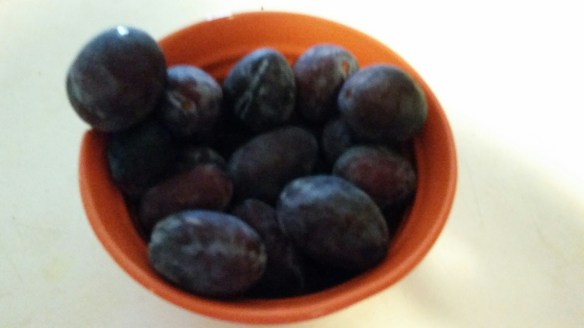 My mother grew vegetables and fruit and canned them for use during the winter and spring. I remember her on the hot days in August and September, lifting the glass jars out of their steaming water bath in the large canning pot in our small kitchen. Once cooled, the jars went to line shelves in the basement. During winter and spring she had all kinds of vegetables and fruit to choose from. Eating locally was common in those days because food that grew in faraway places was not available. Canning diminished with the advent of freezer chests. Consuming food in New England that was grown in Mexico, China or other distant countries was unheard of.
 As a child I so looked forward to school vacation and the freedom it brought from discipline, homework and schedules. Whenever weather permitted, my time was spent out doors wandering around the rather large property where my parents and I lived. It belonged to my Great Aunt Alice, whose father had built the grand house she lived in now, as well as the cottage originally intended for the gardener. That was where I, and later on my brothers and sister lived. There was a broad, open field to roam in, trees to climb, and a small marsh bounded by a dyke that kept out most of the distant seawater.
 I began at an early age to learn my role as a would be peacemaker. My parents were both very special and wonderful people, yet they had a lot of differences and often had trouble bridging them. As the eldest and only child by a number of years I had a good deal of practice as a kind of go between for them when there were difficulties to be dealt with. In addition I often found myself with my hands over my ears while my parents attempted to resolve their differences at the top of their lungs. Loving both of them dearly, I was often at a loss as to how to make things better. Most of all I had to deal with my desire for things to be different, and my inability to make this happen.
 I was fortunate to be able to go to a small private school located in an old mansion with lovely grounds. I had gone to the kindergarten in a small, separate building built especially for that purpose. Now I was excited to be in first grade, going to the real school with the big kids. Because the school was in a nearby town, and my dad needed our only automobile, my parents paid for me to ride with others in an old station wagon driven by the school custodian, Mr. Clews.
 Pujakins