The Politics of Fear


I grew up with parents who had little to no interest in politics. They were staunch adherents to the Republican party and voted for the candidates of that party without thinking much about it. I took little interest in the political scene until I met Stephen, who is a student of history and follows the ins and outs of politics. I now listen and learn, and I consider myself to be an informed voter. What I don’t like is the inability of many of the current candidates to do more than spout what they want people to hear, and most especially in order to manipulate them, to slant what they say to appeal to their desire to be safe.

Too often candidates for election seem to try get votes by playing upon the fears of those they hope will vote for them. As I have said before and probably will say many times again: Fear is False Evidence Appearing Real. The reason it appears real is that it is based on belief, not facts. Stephen and I once had a remarkable spiritual teacher who taught us that all is a belief, and that you can change your beliefs if they are not working for you.

For instance, if I believe that this country is in deep trouble, ready to crumble into doom and destruction as some say it is, then that is my belief, and it is fostered by those who would manipulate me into doing what they want me to do. However it may not be the truth. There are statistics to prove otherwise. Check out the articles by those who do not believe this. There is plenty of scientific evidence to the contrary. This is especially true of global warming. However it is difficult to argue with belief. It is based on emotion not reason.

There may or may not be any hard facts to bolster a person’s belief, however these are not as important to the believer as the adherence to what is believed. People believe what they wish to, or what suits their outlook on life, or even what is important to them personally. I recall my parents railing against President Roosevelt because he had instituted social security, never mind how much help it was to how many people. They believed it was a bad idea. It is natural to have beliefs and we all have them. It may however be important to examine one’s beliefs from time to time.

I strongly believe that it is wrong to try to sell anything no matter how helpful it may seem by pitching it in terms of fear. “If you do not buy this, this terrible thing will happen.” I reject this approach because I feel it is dirty to play on people’s fears. It tries to undercut rationality and good sense in order to appeal to people’s need to feel safe. Because it is key to survival, one of the most basic needs of an infant is safety. I won’t vote for a candidate that tries to frighten me. To me that is not ethical; honest behavior and factual statements will guide my choice of whom to vote for.

Tasha Halpert


My Always Valentine, by Tasha Halpert

Stephen and Flowers People who do not know us sometimes ask Stephen and I how long we have been together. I think this might be because we don’t act like an old married couple. We are often openly affectionate in public and might seem more like young lovers. Yet we have been together for many years now, so many that I am always a bit taken aback when I think of the total. To me there is something odd about how past years seem to accordion. It is as if they compress in some way so that they don’t seem to be nearly as much time as when I contemplate them stretching into the future.

Stephen is my always Valentine and I am his. What that means is that we treat one another with respect. We do not compete nor have we ever done so. We don’t need to. Instead, we cheer one another on, each wanting the best for the other. Neither do we put one another down or make fun of one another. While gentle teasing may be appropriate between couples, mean behavior is absolutely unkind. It is also true that no matter how long we may be together, in order for our relationship to stay strong it has to grow at the same rate we do.

I believe it is vital for individuals to keep growing; whatever does not grow normally begins to decay. For our love to grow along with us we must work to make it do so. In my experience, love grows with appreciation, with honesty, and with the expression of gratitude. We do our best never to take one another for granted. When he washes the dishes, I thank him. When I cook a meal or drive us somewhere, he thanks me. When he sees a book I might like at the library, he points it out. When I see something he might want to eat at the market, I purchase it.

These many small gestures add up. Along with the days of our lives they form a fragrant bouquet that surrounds us with loving kindness. Being kind to one another is an important ingredient in our marriage. Another is sharing feelings with honesty. If something is troubling one of us, we share it, even if it may feel painful to do so. This is something I insisted on when we began our relationship, and over the years it has helped us avoid many problems.

Our years together have gone by so quickly that it is difficult to understand how they could have accumulated the way they have. Yet like leaves piled under a tree in the forest, they have melded into a kind of fertilizer that feeds the ongoing growth of our relationship. I am enormously grateful to have Stephen in my life. He feels the same. We both feel blessed. It is most wonderful to have an always Valentine, and each of us does our best to make sure that as long as we both live, we always will.


The Last Jar of Honey, by Tasha Halpert

Pink and white flowers  I don’t remember exactly when we met; it was between fifteen and twenty years ago. What I do remember is her smile. She never failed to greet me with it–that and a wonderful warm hug. Her name was Santina Crawford. I called her the Honey Lady because that was what I bought from her, delicious local honey from the bees her husband Howard tended so well that he won prizes every year at various fairs and exhibitions. He even proudly showed me articles that were written about him in the local papers.
I brought her all my glass containers and never failed to leave without a variety of different sized jars of honey both for us to enjoy and to give away. She and her husband also sold apples. Their farm with the apple orchard and the hives is in a densely commercial area just off highway 495 in Franklin. When I first met Santina and Howard they were well along in years, and I used to worry that they’d retire and the farm would get gobbled up by a developer. As time went by, each time I would visit I would relieved that the little sign reading “Akin Bak Farm, Honey” was still there on the pole by their driveway.

Once completely rural, the land around the farm now teems with businesses. Heavy traffic zooms past on 146 at a steady rate. Several years ago her grandson, a Cornell graduate, came to help. He revived the apple business, which Howard, because of his accumulation of years could no longer manage. He even built and began a farm stand not only for the apples, but also the produce and eggs from the chickens he and his wife began to raise on the farm. Then several years ago when I visited, with tears in her eyes, Santina told me that Howard had passed away. Santina kept on handling the honey, however, her son no longer wanted my glass jars.

During my many visits over the years we would sit and chat together in her kitchen. She shared much of her background with me. Part of a large family, she grew up on the farm where she eventually lived with her husband. While she was growing up, she and her siblings worked in people’s homes and on the farm. Every year I brought home quantities of their apples, some of them heirloom varieties, all of them special. I also brought many of my friends to meet my honey lady and to purchase jars for themselves.

When I called this fall to see the best day to get some honey from my friend I was told she had passed on in August. I was shocked and saddened. If only I had gone to see her sooner! I have only one large jar left from what I didn’t know was my last visit. It is nearly finished. I hoard the special crystals of sweetness that remain. One day the last of them will be gone. Still I will enjoy thinking of her, of our conversations and most of all her tender hugs. And although the last of the honey will eventually be gone, my heart will always hold the memory of her warm and radiant smile.

The Peddler Woman, Childhood Days A Childhood Reminiscence

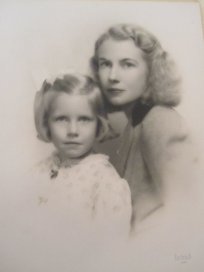
Me and mama by Bachrach I was a young child during World War II. As I look back I realize this was a time of great change in American society. Not only were we fighting a large scale war in far away countries, but we were also changing the way things were done at home, especially if one lived in the country as opposed to the city. By living in the country I mean living where if you wanted to purchase anything that was not delivered to the door, you needed a car. Of course there were various catalogs, however for everyday shopping most of what we bought we purchased from the local stores. The internet did not of course exist.
Because like most people we had only one car my mother could not get out to shop all that often. My father worked as a salesman and he usually needed the car to get around. In addition, gas was rationed so no one used it thoughtlessly or took trips just for the fun of it. On Sundays, all the stores were closed. That pretty much left Saturdays and the occasional afternoon when my dad would work at home catching up on paperwork, for my mother to shop anywhere we could not walk to. Living where we did, that would mean a couple of miles trek, and with my short little legs that would have been unrealistic.

Milk was delivered, and ice for the icebox with the pan that accumulated water underneath that had to be emptied regularly. Eventually the milkman added bread to his supplies. In addition there was a woman who walked from town to town lugging a large suitcase with all sorts of small items for sale. She sold what might be termed “dry goods.” The dictionary definition for dry goods is “textiles, ready made clothing, and sundries.” She always stopped at our house. It was exciting for me when she did.

I can still see her coming into our living room and opening her big suitcase. In it were needles and thread, buttons, handkerchiefs and occasionally something rare in those days: nylons. They had seams, and were shear unlike the cotton stockings that were available. My mother would buy thread, pretty hair ribbons for me, and sometimes cotton socks. In the winter the peddler woman sold woolen gloves and hats. In the summer she might have carried the sun bonnets my mother insisted I wear to protect my fair skin.

How different the world is today. The end of WWII brought in a new era in so many ways. How little understanding children growing up today must have of what it is like to buy from a peddler woman, a strap over her shoulder, clutching the handle of her suitcase as she walked from town to town with her notions and dry goods. I don’t remember when she stopped coming and we went instead to the big stores in Beverly to shop. It could have been around the time we got an electric refrigerator to replace the zinc lined icebox by the kitchen door. When one is small, time dissolves into timelessness, and memory delivers images not dates.


Josephine’s Wonderful Sugar Cookies

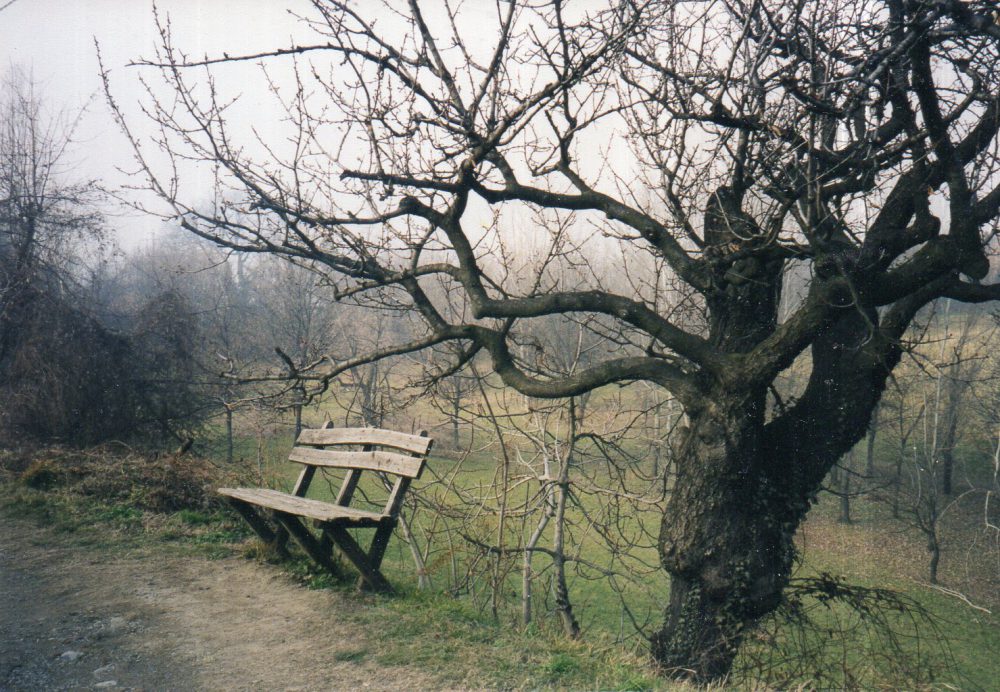
Waiting (the bench)070


Although she could, and at times did, Nonny, my grandmother, preferred not to cook for herself. However, when Josephine was willing, and that was most of the times I stayed with Nonny, she came to live in and to cook as well do light housework. Sometimes they got on and sometimes they didn’t, which is why at times my grandmother had to do her own cooking.

Josie, as she was called, was first generation Irish, and she had a real temper. However, my grandmother was always glad to have her come back to work for her because she prepared great food. My grandmother ate four good meals a day, breakfast, lunch, tea and supper. While she was somewhat stout, she wasn’t what I would call extremely overweight. I’m not sure what she did with all those calories. Perhaps she had a good metabolism.

Josie did her cooking on a large black iron stove that was fueled with lumps of coal that had to be added frequently. The oven was beneath the four burners on the top of the stove. I cannot figure out how she managed to do the wonderful baking she did in that oven, or how she could regulate the temperature of the stove top so that she didn’t burn everything she cooked. I don’t think I could ever do that, nor would I like to try.

At tea, my grandmother always had buttered English muffins toasted over an open burner and home made cake or cookies. I loved Josephine’s sugar cookies and begged her for the recipe. She never used one, so she couldn’t tell me how she made them. One day I persuaded her to let me watch her as she made them. I carefully wrote down what I saw her do. When I made them from my guesses, they came out pretty well. Almost as good, that is, as Josephine’s.

Over the years I’ve made them a lot. When my children were in school I made them for bake sales or special events. If you don’t need them all, you can freeze part of the dough for another time. Children love to help and it’s nice to have another pair of hands. Preheat the oven to 400 degrees, grease up to 4 cookie sheets. Ingredients: 2 cups butter (1 pound), 3 cups sugar, 3 eggs, 1 Tbs vanilla, 4 tsp baking powder, 1 tsp salt, 4 cups flour, 1/2 cup milk. Topping ingredients: plain sugar, cinnamon and nutmeg, colored sprinkles, chocolate sprinkles, etc.

Method: In electric mixer, cream butter, sugar, until fluffy. Add eggs one at a time and beat well. Beat in vanilla. Add baking powder, salt. Beat well. Add 1 1/3 cups flour, 1/4 cup milk, beat well; add 1 1/3 cups flour, rest of milk, beat well, then rest of flour, beating well. Drop by heaping teaspoons on greased sheets. Flatten with a fork dipped in cold water or a glass dipped in sugar. Sprinkle with sugar, plain or mingled with spices, colored sugars or sprinkles. Bake at 400, 5 to 7 minutes. They bake fast, so watch them. The recipe makes 12 to 24 dozen depending on how large you make them.

Time and Time Again


Time has always fascinated me. It has been the subject of a number of my poems as well as some of my columns in the past. One aspect of it that interests me greatly is the variation in how fast or how slowly it can seem to pass. For instance, if I were to be holding my breath, a minute can seem quite a long time, yet if I were to be reading an interesting book, many minutes can pass very quickly and without making any impression on me at all.

I received my first watch for my eighth birthday. I was thrilled. So thrilled that I forgot to take my new watch off that evening and climbed into the bathtub still wearing it. It was an inexpensive one and not waterproof. I was devastated. My parents were always accusing me of being careless and here again was proof. It was several years before I was given another watch. This time I was a good deal more careful with it.

Once watches were a utilitarian tool people wore–on the wrist, on the belt, on a chain, or around the neck. Most adults had two, a plain one for every day and a fancy one for special occasions. In those days they were fairly expensive. While today, there are expensive watches, they are worn more often as a status symbol. For most of us, as a result of electronic devices, watches have gone from a necessity to an ornament.

Time seems elastic. When I am driving to a destination at some distance, it seems to take longer to get there than it does to come back. How strange! The distance is the same; absent traffic jams or other problems why should one way seem longer than another? One possible answer is that I am retracing my steps on the way home thus there is no question about how to get there. Still this time disparity seems to be true whether or not I have been somewhere many times.

The way time passes seems to be primarily subjective. Objective time is when I set the timer to remove the tea basket from the teapot, or to take something from the oven because it is done. Here there is no question of subjective time because it is ticking away on the timer and I am simply relying on that to tell me what to do next. I don’t even think about how long or how short that time will take. Yet if I am pursuing a deadline, time may be of the essence and so pass subjectively.

Although there were hourglasses or candles for short term measurement, for centuries people told time by the sun. Until the 19th century there were no standard time zones. They were set up in 1883 to make it possible to catch a train on time. There are those who say there is no such thing as time. That it is a purely human invention. This may or may not be true. Mystics have said that all time exists at once and we merely move through it. There seems to be no way to prove this. However in the future as it has in the past, the subject of time will no doubt continue to intrigue scientists and philosophers as well as me.                                    Tasha HalpertPeace Villae Bridge 2


Growing Up By Myself

Bed Friends 1

When I was growing up I lived a couple of miles from a small seaside town on a large property that belonged to my Great Aunt Alice. I didn’t have any siblings until I was almost nine. Virtually an only child, I was surrounded by busy adults and often told to stop bothering them and find something to do. A voracious reader, when I wasn’t nose deep in a book, I played games of pretend, making believe I was someone other than a lonely child in an isolated neighborhood with only herself to rely on for amusement.

I had quite a collection of teddy bears, dolls and other stuffed animals. When I was small I was sure they came alive at night. This belief was influenced by Johnny Gruelle’s Raggedy Ann and Andy books. These innocent stories about a group of toys that had adventures were written in the early 1900s and became even more popular in the 30’s and 40’s. In these stories, ice cream cones grew on trees, cupcakes and hot dogs could be plucked from bushes and lemonade and sodas were available in puddles and brooks.

Raggedy Ann’s magical woods full of “fairies and elves and everything” held all sorts of fun inventions that I yearned to experience for myself. I loved the stories and used to watch my toys to see whether they too might have adventures while I was sleeping. Sometimes I thought I spotted them in different positions than I had left them, though I could never be sure.

Later I moved on to books by Robert Louis Stevenson, Alexander Dumas, and Edgar Rice Burroughs. Then I wanted to be a pirate or have exciting adventures when I became a grown up. I made bows and arrows out of handy branches and tied string to my father’s hoe and rake to make a hobby horse. If my father needed his rake he knew where to look–in my lilac bush “stable.”

My family believed in fresh air and I spent a lot of time all year round out of doors in nature. Where we lived I was fortunate in having a large open area to play in There were all kinds of trees to climb and large fields of tall grass that I made into my private jungle. My pretend life was much more interesting than my actual one. The world I lived in as a young child was without TV or any form of electronic toy or game. I had to use my imagination to conjure up my entertainment.

I wonder if my childhood led me to grow up looking at the world from a different perspective than most. Steeped in nature and in the creativity of my mind, its sights and sounds enhanced my imaginary life. Today I perceive links and patterns everywhere. I find significance in synchronicity and receive messages from the nature around me. The world was and is alive for me in a way today’s youth may not discover. With the current focus on electronics, most children will not have my opportunities. I learned to listen to and observe nature and found there a sense of companionship and of comfort that is with me still.

Me and My To Do Lists

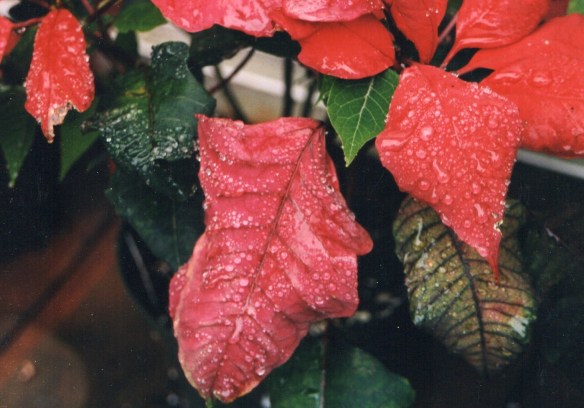
Poinsetta and water drops036My friend and I sat over breakfast at a restaurant near where I live. “I find myself getting very forgetful,” she told me. We commiserated a bit. I assured her that if it were not for my lists I would never remember what I had to do. I’ve been making them for as long as I can remember. I know that my grandmother made lots of lists. My mother told me that when she stayed at my grandmother’s home one year, she often found herself almost tripping over them. Nonny, as I called her, used to leave them on the floor so she would be more apt to see them.

I don’t need to write many as she did, nor to drop them on the floor. I get along very nicely with my two main lists. I keep one in the kitchen where I write down whatever food I plan to prepare, the next necessary errands, and the various household tasks it is time to do. I keep the other on my desk. That one reminds me of what I need to do on my compute–whether emails I need to write or assignments I must complete. It tells me when my deadlines are due, and what bills it is time to pay or what cards I need to send and to whom. Actually, these are not my only lists, just the permanent ones. As I cross things off I rewrite them and throw away the old pages.

I also keep grocery lists, health food store lists, and lists of other items i need to purchase. These are vital! When it was time to send out invitations to my birthday party I made a list of the people I wanted to invite. I also now have a list of the Christmas gifts Stephen and I received, and the people who gave them to us. I need that to write my thank you notes. My short term memory is not what it used to be, however it hasn’t been that good for some time. I am told this is nothing to worry about and is part of normal aging.

I also use my lists to practice recycling. Whatever comes my way that is a one sided piece of paper gets folded in three, torn into strips, and clipped together to form a pad to make my lists on. It is only a small gesture, yet every effort to conserve counts, no matter how insignificant. I also believe that any attempt to be mindful of the environment carries an impetus to help increase the totality of what will I hope and trust one day lead to greater participation for all in the conservation of planetary energy and resources.

I admire those who say they do not need lists in order to remember things. I prefer to use what mental energy I have to be observant, to remain in the present moment, and to notice when I need to participate in some way in the ongoing scene. If I have to waste time and energy remembering what I need to buy at the grocery store I may not have the mental focus to notice the hawk circling the highway above me or the interesting shapes of the trees’ bare branches thrusting their patterns against the blue of the winter sky.


Gazing Back, Looking Forward

Waters Farm View 3  Having lived in the town of Grafton for more than twenty five years, I can both remember how things were and see how they have changed. Often as I drive the streets of this town I am aware of places that were once bare of buildings and are now well populated. It is an interesting feeling: In my minds eye I see trees that once shaded sidewalks now vanished, succumbed to blight or old age; I note houses once one color that are now another. I have memories of roads where I used to walk that were near where I once lived. The past and the present mingle in my mind as I pass through the familiar places.

Janus, the Roman god for whom January was named was honored as the guardian of doorways. He is pictured with two faces, one looking forward, one back. It is interesting to note that they are joined. The past, the present and the future are not separate. Looking back on the year now past gives me perspective as well as a sense of continuity, as does looking forward. As I get older the past, the present and the future blend even more into one. I occasionally need to sort things out and the New year is a good time for this.

There is much that I have accomplished over the past year: columns written, manuscript readied for publication, countless meals prepared, recipes tried, new friends made. Some projects I planned did not turn out as I had anticipated; others turned out to be even better than I thought they would. There have also been significant losses for me this year: friends I treasured that have moved on either in this life or to the next. I still feel connected to them, yet they are receding into the past. I am also pleased to have made progress in changing certain negative habits and building others that are more positive.

It is my hope to keep learning and growing for all of the years I have to live in this lifetime. Because I believe this is important to my quality of life, I work at constantly recreating myself. Toward that end I like to try different things I haven’t done. It is also important to me to review and to renew those I have done in the past. If something doesn’t work for me, I’ll set it aside and move on, yet I may return to try it again. Among other planned projects I want to get back into drawing, illustrating one of my earlier tales. I also have a bunch of sorting to do, and a book of poems to put together.

Perhaps this is the year I will finally go through those notebooks I have been keeping from many years past and mine them for gems I have forgotten or left behind. Certainly I know I will write new stories and new columns, and surely publish at least one new book as well. As I look back and forward, for that which is helpful that remains from the past I say thank you, and for that which was stressful and is now over, I say the same. Having looked back with gratitude, I now look forward with optimism and the knowledge that a new year awaits.