Heartwings Love Notes 2018 Four Seasons of Beaut

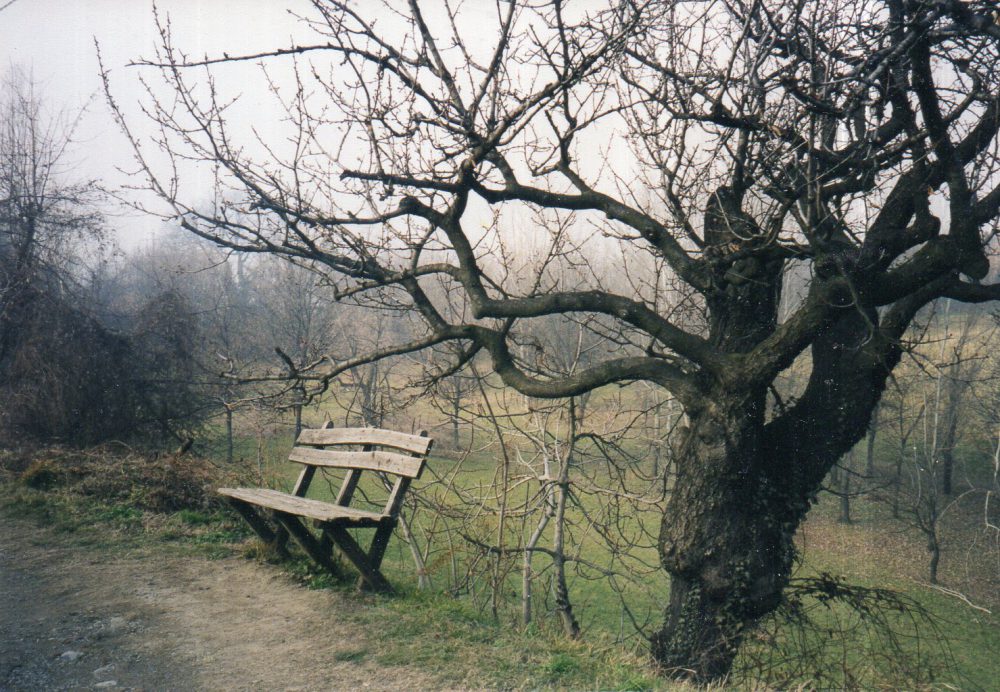
Heartwings says, “Take the time to look around you, especially when you are in nature.”

From the age of seven or eight onward, I often accompanied my father, a horticulturist as well as an arborist, when he visited clients. To this day my eye is drawn to the needs of trees as I pass them or visit with their owners. I have a great regard for the beauty of trees in every season.

Trees have always been special to me. I spent many days climbing and perched in them, reading or drawing. One of my greatest delights as a child was to sit in the big Beech tree toward the middle of my great aunt’s estate where I grew up, to read. I was a voracious reader and devoured books, especially tales of adventure. One of my very favorites was The Swiss Family Robinson, about a shipwrecked family that built and lived in a tree house.

I was fortunate in growing up surrounded by nature. The property where we lived was first developed by my great grandfather, an amateur horticulturist with a great interest in flowers and trees. In his large garden he grew a variety of vegetables, in other, smaller ones, flowers.

My father and mother gardened as well. My practical mother grew vegetables, my romantic father grew roses and many other kinds of flowering bulbs and annuals. My love of nature grew as I did. I wrote poetry about it at an early age. Sometimes I created little booklets for my mother. Happily for me, she saved them and gave them back some thirty years later.

Because I was an only child until I was eight and a half, and we had no close neighbors with children near my age, I spent much of my time alone. I didn’t really mind this; I made my own fun by playing out imaginary scenarios based on my reading. The property we lived on was large, and I could wander it safely. Now, some eighty years later, though still in the same state, I live far from where I grew up. Yet the nature of my childhood still takes my eye and inspires me.

Driving the roads where I live, I am delighted in every season by the trees and the gardens I pass. The loveliness of the spring, summer and fall in New England is equaled by the graceful bare branches of trees in winter, stretched across the sky.

 Beauty is where we find it, and if we are of a mind to seek it, it is everywhere. The wildflowers in their season that spring up by the side of the road are wonderful to see, as are the bright dandelions that grow in various cracks and crevices as well as on lawns where they are allowed. Drops of dew or raindrops that linger in spiderwebs or stretches of weed patches catch the light and glisten where that marvelous artist, nature, puts them. When I take the time to look, in every season there is always something to be seen, and I am ever grateful.

May you find beauty each day, and be grateful for what you find.

 Blessings and best regards, Tasha Halpert

PS If you have stories or experiences to share, or comments or questions for me, I’d be so happy to read them. It is a joy to hear from readers. Thank you for reading and know that  I appreciate you.

Heartwings Love Notes 2017 About Those Resolutions

Heartwings says, “Here’s something to think about for those resolutions.”

When I was thinking about the new year coming, and New Year resolutions, I came to a realization: Much of what I might think to choose concerning the making of resolutions is actually something I think about doing all the time, anyway. In other words, at this point my would-be resolutions are part of an ongoing daily practice. Perhaps this might be true for others as well.

What I now experience probably began at the time when I first encountered Yoga. That was back when I was in my late twenties with five children. I was very stressed and having trouble sleeping. Knowing how stressed I was, a good friend gave me a book on Yoga. I remember the author, Richard Hittleman.

The book is long gone from my library; however, it was a relatively simple text that focused primarily on the exercises, with good illustrations. I found it to be helpful, and events unfolded from there, ending up with my becoming a yoga teacher for a number of years. I attended many classes and took teacher training as well as studied Yoga philosophy. I learned and grew from this, and eventually I developed my daily practice.

Practice is something one might think of as what a musician or an athlete does, or something to be repeated until one knows it by heart. A practice can also be something one incorporates into one’s everyday life or lifestyle. In my case the kind of meditation I learned from yoga, even after my career as a teacher ended, became something I began to do daily. From it I acquired the skills of mindfulness and as well as ways to reduce stress and discomfort. Together with my husband Stephen, I began teaching that. as well.

Ultimately, all this evolved into an ability to stay in the present moment, at least most of the time, as well as to find out when I wasn’t there. And this is what I mean by a practice. Which is why I don’t necessarily go for the idea of New Year’s resolutions. I am already working on what I might consider using.

There seems no reason to make a list and try to follow what I am already practicing on a daily basis. I wonder if when readers look at their potential resolutions, they might discover the same for themselves. How we choose what to resolve is going to most likely be things we need to be doing or want to be doing anyway. If we thing we need to make a special effort, we might make that the resolution. For instance we might say, “I resolve to keep on keeping on.” I believe that way we might have more success.

It is often said that the resolutions of most do not last past their first month. If instead of separating our resolutions from everyday life we see them as part of our ongoing experience, they might even last out the year.

May your New Year celebration be happy and your happiness endure.

Blessings and Best Regards, Tasha Halpert

Heartwings Love Notes 2006 My Cherished Toy Remembered

Heartwings says, “Learning to let go is important to one’s happiness.”

When I was a young child, my very most favorite toy was my teddy bear. He had arms and legs that moved freely up and down, and fur-like outsides. His eyes were not sewn on, but were made of glass and stuck in on long pins. His paws had a velvet covering, and his nose and mouth were embroidered in black thread. His “fur” was a light grey. Over time some of it rubbed away. I took him with me everywhere I was permitted to, and I always slept with him at night. Mysteriously he was usually on the floor by morning, something I never could understand until later on, when I was told that I was a restless sleeper.

Over time he acquired wear. The velvet on his paws thinned, his fur grew worn in some places. One of our dogs chewed on his left ear, making it raggedy, so I added a blue beret I had in my doll clothes collection to cover it. When I was in the first grade, I took him to school one day. When the beret covering his ear slipped away, my classmates made fun of him. Needless to say, I never did that again. When I was in the second grade, my parents took me south with them. We lived down there for several months, while my father worked on an assignment for his business. My school work was continued, and my mother taught[TH1] [TH2]  me every day.

While we were living in Florida, we took a trip to an extensive garden somewhere in the everglades. My legs grew tired, and I sat to rest on a bench with my teddy. As we were driving home, I suddenly realized my teddy bear wasn’t with me. My heart sank. I begged my parents to turn around and go back. My pleas were to no avail. They were adamant.  I never saw my teddy again. In today’s world most children have more say, and their wants are given more attention. The majority of parents today would have made a strong effort to retrieve the cherished toy. To be sure, things have changed in the past eighty years, and certainly for the better in that respect.

Some years ago, a kind friend made me a lovely grey teddy. Dressed in a pointed turquoise hat and cape he lives in my bedroom, where I enjoy his presence each day, though he does not share my covers at night. My original teddy is enshrined in my memory, where I can still see him vividly in my mind’s eye. With his brown glass eyes and his worn yellowish grey fur, I envision him on a bench in the Everglades, perhaps talking with a bird or two. Or maybe he is not there any longer, but was found and treasured by another small child who gave him a good home and even took him to bed at night.

May you have cherished memories to visit now and then.

Blessings and best regards, Tasha Halpert

PS Do you have a story of your own to share with me? I so enjoy hearing from readers. Please do write and make my day. Tashahal@gmail.com Or hit reply, I’ll answer you.


 [TH1]

 [TH2]

Heartwings Love Notes 2001: Eating Humble Pie

Heartwings says, “Humble pie is an acquired taste.”

As a child, I was clumsy and uncoordinated. Being tall for my age may have had something to do with it, however I also have poor proprioception. That means I lack awareness of the space around me. For instance, it’s easy for me to bump into things or kick them, or worse, stumble over them. Lacking in coordination, I did badly in most athletic situations. I played goalie in field hockey because I didn’t have to run. The problem with that was I felt guilty whenever the opposing team scored a goal. Sports really was my least favorite physical occupation.
Then I studied yoga. I began with a book which a friend gave me when I told him I was having trouble sleeping. I studied the pictures, followed the text, and found I was indeed sleeping sooner and more soundly. Next someone I knew announced she was teaching a series of eight yoga classes, which I eagerly took. Fortuitously, I discovered another teacher, signed up for her classes, took her teacher training, and became one of her teachers. How proud I was of my abilities and how good I felt about my new career.
Then I had an accident to my neck. Because many of the important postures put pressure on my neck, I had to give up both teaching yoga and doing it for myself. I was very disappointed. However, there was nothing I could do about it. By this time anyway, with five children, motherhood had become a fulltime occupation. I still meditated regularly and used some of the relaxation exercises I had learned to help me through my busy days.
I prided myself on all that I could get done. My days were full, yet my ability to cope and remain calm was something I cherished. Things went on like this for many years. The children grew up, my life changed, I was now married to a man who, unlike my former spouse, loved to entertain. We started an inner peace center, teaching meditation and classes. I never knew how many people we might host at any given meal. I was proud to be able to feed them at a moment’s notice. Spending hours in the kitchen was no problem; I loved cooking for people.
Many years passed. I found myself slowing down. I found I had acquired Parkinson’s disease. I got tired faster; I could no longer spend long hours preparing and cooking food. Slowed steps made trips to the grocery store tiring. I had to rely more on frozen foods and mixes. Again, I found myself having to cope with no longer being able to do what I used to do. This included mending and other activities requiring dexterity. Once proud of my ability to surmount obstacles, I have to ask for help with them. These days, I’ve had to get used to eating large helpings of humble pie. However, somehow I’m getting used to the taste.

May you enjoy whatever you need to deal with as you learn and grow.

Blessings and best regards, Tasha Halpert

PS Please share any recipes you have for Humble Pie, I so enjoy hearing from my precious readers. Please email me at tashahal@gmail.com. Enjoy past Love Notes at my blog: httpl://tashasperspective.com.

Heartwings Love Note 2000: It’s About Time

This Love Note marks a milestone: Number 2000 in total over a period of many years, at 52 a year. You can do the math how many that is. I am eternally grateful to my readers and to the invisibles who have had a hand in the Notes’ creation.

Heartwings says, “Waste not, want not; use whatever time you have wisely.”

When as a child I visited my grandmother in her summer home in Beverly farms, I would stand by the big cuckoo clock in the hall to see the bird emerge. I loved it! I even remember being very little and someone lifting me to see the bird up close. My dear grandmother would even advance the hands to make it sound the hour ahead, just for me. Perhaps that was the beginning of my fascination with time and clocks. All these years later, its passage remains a mystery.

 I remember as a child waking up on sunny summer mornings and thinking about how I had a whole day to play, and what fun that would be. Indeed, the hours stretched out and brought me much joy as I amused myself. An only child until I was eight, I had developed a good ability to entertain myself. I was never lonely, though I was mostly alone unless an adult was interested in playing with me, and mostly they weren’t, so my time was my own.

Now, some eighty years later when I wake up on any morning, whatever the time of year, I go over in my mind what I need to get done, not to mention what’s left over to do from the day before. (Usually, I had planned more than I could accomplish.) Then as I get ready, beginning with my exercises, I prioritize my “to do” list. It’s simpler than it used to be. Eighty years holds a world of change, and hopefully I have learned what’s important.

Children tend to live as human beings; adults as human doings. And time is at the center of the action in either stage of life.  It seems there is only so much of it—sixty seconds make a minute, or so they say. However, how do you feel after holding your breath for sixty seconds or laughing for the same amount of time? Do they feel the same? That’s the odd thing about time. It’s supposed to measure the same, yet it does not, at least in my experience feel that way. Another example is going somewhere versus coming back, which feels much shorter, clocks to the contrary.

Stephen and I have always collected interesting clocks. Our small apartment is full of them. Most of them are synchronized, more or less, within five or so minutes. Several display the accurate time, and others may lag a bit, depending on the age of their batteries. However, I know which ones are correct. Also, I like seeing what time it is whenever I feel like it, even without wearing a watch—mine is currently in need of batteries. I’m not sure I get any more done by looking, but I do like to know. Recently I came across a study that showed that the heart’s activity influences our perception of time as it passes. Time is a conundrum it’s fun to explore.

Enjoy whatever time you have and don’t try to save it at the price of your joy.

Blessings and best regards, Tasha Halpert

How do you feel about time? Do you take your time? Or do you find there’s never enough? How’s your time management. Write and tell me about your relationship with time. I so love to hear from readers. Please write me at tashahal@gmail.com. You can see more love notes on my website www.heartwingsandfriends.com, or see my blog at https://tashasperspective.com.

Heartwings Love Notes 1098 Where Can It Be

Heartwings says, “Putting things back where they belong is important.”

As a child I was taught to be tidy. Emily, the practical nurse my parents hired to help care for me when I was around two or so, tried hard to make sure I learned to put my toys, and later, my clothing away. She was with us until I was around eight years old when she left to get married and have a family of her own. Unlike my mother, she was patient and physically affectionate.

I am not faulting my mother in any way. Her behavior was molded by her upbringing. While kind and a good mother, she grew up with strict German parents who did not encourage demonstrative behavior. Even as a grandmother she was reluctant to accept or to give physical affection. Fun and fond behavior was not a priority, neatness was. 

Once I was married and had children of my own, I did my best to be as tidy as I could. This grew more difficult with each addition to the family, which eventually added up to five children. I didn’t have a lot of time to devote to being neat or organized. My mother often criticized me for my “messy house,” and it never seemed to occur to her that there was a good reason for this. I thought it was more important to enjoy and care for my children than to be neat.

Neatness does have virtues beyond looking nice. Having things in order means when I need to find something, I’ll know where it is and can find it without any difficulty. That is why the saying, “a place for everything and everything in its place,” has been my guideline as long as I can remember. For instance, I try hard to keep all of my tools where I can easily reach them and as close as possible to where they will be used. Being a systematic Scorpio, I have sectioned off the shelves in my pantry by assigning them to what I can make or do with the contents.

However, unfortunately this works as long as I am the only person putting things away. Also, there often is more to be put away than the shelves can conveniently hold. This results in items get shoved to the back, effectively disappearing from view and becoming unavailable. So, although I no longer have little children to run around after or an eagle-eyed mother judging my attempts to be tidy, I struggle still with my tidiness conundrums.

The current state of my health doesn’t help either. Despite Stephen’s great help, much does not get done. There are days I simply only have enough energy to cook meals and see to my immediate emails, not to mention attend doctors’ appointments. Prioritizing becomes important, and as it was once so it is again: I do what is important and let the rest go.

Reaching and Grasping

Heartwings says, “It is very helpful for one’s reach not to exceed one’s grasp.”

Reaching for things is somewhat more challenging for me than it used to be. I am often faced with the need to ask for help. Fortunately, Stephen is usually available, and though he has also shrunk, at least he is much taller than I am.  Sadly, I have diminished from five feet four inches to five feet one and a half or maybe two. In addition, I have lost flexibility. Asking for help is getting more necessary, and I am getting more used to doing that. It seems there is always more to be learned.

In a yoga class and lecture that I attended many years ago now—yet somehow it seems just a year or two have past, the visiting sage told us this. “My mantra is I know nothing; I want to learn.” I balked at first at the seemingly negative affirmation. Affirming I know nothing? That didn’t sound right. But affirming I wanted to learn, did. So, I gave the whole sentence some thought.

Eventually, light descended upon my brain, and I finally understood. This sentence describes what is called Beginners Mind. What that means is that at the beginning I expect to learn, so it is important not to cloud the mind with what I think I might know. When I think I know something, my mind does not generally seek more information.

If I think I have grasped whatever it is I need to learn, I most probably will no longer reach out further with my mind. It is more important than you might think for your grasp to exceed your reach. Because there is always more to be learned, whether it is the how-to of a project, the pitfalls, or else the simple understanding or a further interpretation of what something might mean. We cannot always know how much more there is to know. 

When I look at each day with a beginner’s mind attitude, there are wonderful conundrums that arise. They give me something to think about other than the dismayingly negative tales of misbehavior that often comprise the daily doings of the world at large. The arguments and disagreements people have that stoke violence could so often be resolved by a better understanding or even a simple agreement to disagree.

For me the world I live in is filled with interesting experiences to be explored with discoveries to be made along the way. Perhaps because I am a poet, I especially delight in finding beauty that has simply created itself. The lovely weeds right now along the roads, waving in the breezes from passing cars, are a delight to be seen. The delicate Queen Ann’s lace, mingled with the tall, graceful Artemesia are probably destined eventually to be cut down, yet each day they remain, they fill the eye that gazes upon them with their beauty. I am grateful to be able to see them and to find something so special within my grasp.

May you be able to look upon life with a beginner’s mind.

Blessings and best regards, Tasha

PS Do you have comments, questions, or stories to share? I would love to hear from you, and I find great joy in your correspondence.

Heartwings Love Notes 1095 Whatever Happened to Elbow Grease

Heartwings says: “There’s lots to be said for elbow grease.”

I was chatting with a friend of mine who is an energetic cleaner. “You don’t use any cleaning products with chlorine?” She asked me.  “How do you get things clean? No harsh chemicals? No oven cleaners?”

I know she can scrub endlessly away at something until it sparkles, and she thinks I’m a bit strange because of the products I use. I pointed out to her that vinegar, baking soda and salt can clean almost everything and result in no harm to the environment.

“Then you’ve got to scrub so hard to make them work,” she complained.

“Whatever happened to elbow grease?” I asked her with a laugh. “You go to a gym and pay money to exercise. When I do my housework, I get many of the same benefits.” She shook her head and changed the subject. I smiled to myself and thought about the money I save by not purchasing expensive, harsh, ill smelling, cleaning products. I use things I find right on my pantry shelves, plus a select few I buy at my market.

If you prefer commercial products, you can purchase environmentally sound cleaning products at your health food store and these days at some enlightened supermarkets. There are a few more that are available everywhere and legitimately good for the environment, like Murphy’s Oil Soap which smells wonderful and harms nothing, and good old Bon Ami—hasn’t scratched yet. I also discovered a little baking soda and a bit of scrubbing do away with tea stains in my mugs. Vinegar cleans the toilet and kills germs. It stays clean longer too. Pour vinegar and sprinkle with baking soda on your oven floor. Leave over night and wipe up for a clean oven in the morning.

I don’t mind a little extra scrubbing. I am beginning to see all housework as a form of benevolent exercise. Apparently, I am not alone in my thinking as I recently read something to the effect that those who analyze such things now include time spent cleaning and scrubbing as a valid form of exercise. This is good news for those of us who once thought housework was a necessary evil. Now it can serve two purposes and become a necessary good. Those who are pressed for time who have children at home might persuade them of the virtues of washing the floors as an alternative to tedious soccer practice. Although I’m pretty sure that to most children over the age of eight, almost anything is preferable to housework,

Along with Bon Ami, keep a shaker of baking soda on the edge of your sink and use them instead of an ill smelling scouring powder. Try sprinkling baking soda on your rugs overnight and vacuuming it up in the morning. You’ll be surprised how clean things will smell. And remember, elbow grease is not only free, it reduces calories and trims the arms and chest as well. Powerful stuff, elbow grease!

Hope you have a good supply!

Blessings and best regards, Tasha Halpert

PS Do you have any good cleaning tips or suggestions? It is such a treat to hear from readers. Thanks in advance for your thoughts.

Heartwings Love Note 1093 The Kindness of Strangers

Heartwings says, “When you look with kind eyes, it helps you to be kinder.”

Recently, I sat in a movie theater for nearly three hours. When the film ended, I stood up to find the restroom. While there were some railings near my seat, as I headed for the exit corridor, there was only a wall to help me steady my steps. My balance was challenged even as I used my cane. “Let me help you,” came a voice next to me. “Take my arm.” A short, kindly woman extended her arm to me.

She walked down the long corridor with me, at the rate of my slow steps very patiently, until we reached a ladies’ room. Only it was not the usual one but a special locked family room. Again, she waited with me as an attendant fetched a key and let me in. I kept thanking her. Every time I said how grateful I was, she shook her head and dismissed my words. When I came out, she was gone. My husband told me she had waited to tell him where I was. Sadly, I never learned her name.

The Dalai Lama tells us his religion is kindness. Focused in this way, kindness becomes a way to practice one’s spirituality. Of course, this is not confined to Buddhism. Christianity’s Jesus tells us to “Do unto others,” and other religious and spiritual paths have their versions of this kind of behavior as well. For most of my life, I have tried to practice kindness as often as possible.

The other day I was exiting a parking lot when a huge truck stopped in front of me, attempting to make a turn into the plaza across the street. After waiting for the cars to finish passing, it turned. There was a huge line of cars behind it, and I resigned myself to a long wait. But no, the person behind the truck waited for me to pull out and go. I gave her a big smile and a wave. What a blessing I received from that stranger on the road.

It’d one thing to be kind to those we love and cherish. It is to be hoped that we will give freely to dear friends and family. On the other hand, I was brought up to avoid strangers, to fear interaction with them, or at the least to be cautious around them. No one suggested being kind to them. I have never been inclined to follow this approach.

To be sure, being kind to strangers may or may not bring an immediate or any reward, yet that is not the reason to be doing it. Being kind is a good way to expand the heart and to build compassion. I have met with much kindness in my life and I have done my best to return it whenever I could as well as to initiate it. It costs little to nothing to be kind, and it adds to the sum of compassion in the world.

May you be as kind as you can be, always.

Blessings and best Regards, Tasha Halpert

Would you share a kindness from a stranger story with me? I so enjoy it when you share your stories. Comments and suggestions are welcome too.

Heartwings Love Notes 1084: Memories of My Mother

Heartwings says, “Holidays often generate memories of days gone by.”

There was a large cedar chest in my parents’ bedroom.  In it my mother kept items that were special or precious to her. As a youngster I was fascinated by its contents as well as what she kept in the drawers of her vanity and her shoe closet. The four vanity drawers held odds and ends, except for one that had evening handbags. These were fancy and often glittery. She had quite a collection.

My parents lived during a time when men and women ‘dressed for dinner.’ What that meant was long, formal evening gowns for the women and elegant trousers with a dinner jacket or even a tuxedo, for men. I can still see my mother, dressed in a lovely gown, sitting before the mirror of her dressing table, putting on her makeup and brushing her blond hair. She would be looking into the big mirror set between the two sets of drawers, as my dad tied his bow tie and put on his cummerbund.

Sometimes my mother would open up her cedar chest and I would get to see what she kept inside. Among other items, it held two costumes I never saw her wear. One was a colorful skirt and cropped top she wore in a picture someone had painted of her. There was a design of some kind on the cloth and perhaps it had been made for a dance performance. The other was a white skirt and top with many ruffles she once wore for Spanish dancing, accompanied by castanets.

Much of her time was spent tending our family—ultimately there were four of us; I was the eldest. We lived in a cottage on the property of my great aunt Alice. She also tended a large “victory” garden, growing most of our vegetables during the summer. She canned them, too, and again I have an image of her standing over a steaming kettle, lifting jars in and out.

She made the jelly we had with chicken on Sundays, too. In addition, she plucked and cleaned that chicken herself. She had not grown up in a household that did these tasks, and I admire her greatly for her ability to adapt to a very different lifestyle than the one she was used to when she met my charming, handsome father. We also kept chickens, and somehow had acquired a few bantams that included a white cockerel that strutted around crowing. My mother loved animals and the little hens would perch on her shoulders. Our goat, Ebony, was another of her favorites.

Of course, I have many more memories. Mothers’ Day has prompted me to remember and to share with my readers some of my memories from a time long gone by, when life was simpler, though of course I did not know that then. It’s odd how little we can tell while we pass through a time, compared with our        perspective on it in the years later.

May you have pleasant memories to share of times gone by.

Blessings and best regards, Tasha Halpert

P.S. I’d love it if you’d share your memories of your mother with me. Be well and enjoy each day to the fullest.