Rejoicing in the Advent of Spring

dogwood blssoms 2Spring arrives in a dilatory fashion. Like fall, it is a back and forth season. In addition, some years spring arrives early, sneaking up on us and forcing us to get out our warm-weather clothes much sooner than we think we are going to need them. In another year like this one, we begin to feel weary of our winter wardrobe and yearn for the spring clothes still put away in closets or storage places. There is no telling when the weather will change. Spring is a fickle season, whether daily or yearly. I have written a lot of poetry about the way spring behaves.

I am fond of fall. I have written a lot of poetry about that season also. It is actually my favorite of the four. As it begins I delight in the cool crisping of the air, especially welcome after the moist heat of August. However, fall does not have the same kind of excitement to it that spring does. Fall colors are loud and obvious. The autumn brilliance blares from the hillsides like the brass in an orchestra. Spring is delicate; violins and flutes, with an occasional clarinet announce the softly evolving colors that slowly permeate the landscape. Where fall is blatant, spring is subtle.

These days as I drive along the roads between towns I enjoy watching the ends of the tree branches slowly green and redden, highlighting their tracery against the sky. There is a maple outside my bedroom that’s the first thing I see when as I open the curtains. Lately I have been watching the ends of the twigs turn green and then begin to unfold into maple flowers. I know these will in turn eventually fall and produce the seeds we call maple keys. Do children still peel the ends open and stick them on their noses as I remember doing?

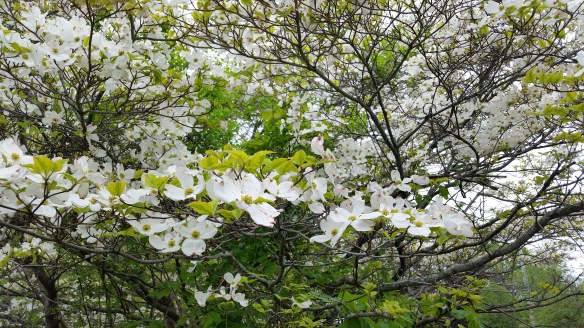
Spring is an opportunity to get out and enjoy a walk. It is a treat to amble along the sidewalks of my town’s neighborhoods and see the flowers springing up in the gardens around town. Daffodils and jonquils, hyacinths and tulips abound with their lovely colors. The magnolia trees with their glorious pink and white flowers along with the dogwoods that come into bloom make me feel almost giddy with their generous bouquets of blossoms. How happy the bees must be to put an end to their long winter nap and emerge into activity.

The blooming of the lovely spring trees and flowers is also apt to stir up allergies in those who are vulnerable to them. This makes the spring season a lot less pleasant for some. Stephen and I have been fortunate to have the help of homeopathic remedies that alleviate the discomfort and sometimes even eliminate it. Still, the loveliness of the season may be some consolation to allergy sufferers. I am so glad to see the arrival of spring. Early or late no matter how long it has taken once it gets here all is forgiven, winter is forgotten, and we can rejoice in the glorious beauty of spring.


A Rare Day In June

Roses


As I drove around doing errands my eyes kept being drawn to the beautiful blossoming trees and bushes on the local lawns and roadsides. The town I live in is truly filled with beautifully kept homes and gardens. People here take pride in the appearance of their homes and everywhere you drive in Grafton there is beauty to be seen. As I drove I thought how eloquently the green grass, the freshness of the leaves, and the tidy gardens spoke of the loveliness of the beginning of summer. It is nearly time for the solstice. June 21 will bring the onset of the long hot bright days of June, July and part of August.

When I was a child I could hardly wait for these wonderful summer days: free time, swimming, sitting in my favorite tree reading, all these activities and more awaited me. As a young adult with my children in tow, on any sunny day I headed for the beach, meeting friends and chatting over iced tea as we watched over our little ones. However, as an elder, I confess that I cringe at the prospect of these long, hot days. The heat of the summer hours robs me of my ability to think and makes it harder for me to sleep at night. I have to lurk indoors with the air conditioner going, hurrying out of the house for an exercise walk either first thing in the morning or later on toward sunset.

Too, the sun is not as benign as it used to be. The thinning of the atmosphere due to global warming has increased the potency of the sun’s rays, necessitating cover-ups and hats, not to mention sunscreen and sun glasses. Remember rushing out to get a tan at the beginning of summer? The “healthy tan” we all used to crave is less desirable now. It’s almost as though we need to go back to Victorian times when pale skin was a sign of beauty. Now it could be a sign of care for one’s health. I remember when I was in college skipping a class I disliked to sit out on the porch roof with my friends so we could “work on our tans,” as we used to say. The idea was to increase the effect of the sun with tanning lotion rather than block it with sunscreen.

I regret that the onset of the summer heat and more especially the humidity takes more out of me than it used to do. I’d love it if I had a personal air conditioner I could wear around my neck that would provide me with a cooling breeze when I need to be refreshed from the heat. Even so, there are some delights that nothing can spoil. Yesterday, as I walked past a wild rose bramble my nose caught the sweet scent of the tiny white blossoms snuggled into some trees by the side of the road. I stopped and inhaled, taking time to smell these very special June treats. The present moment joy is what matters, not the prospect of discomfort, and at least I do have the benefit of the air conditioner in our apartment. Indeed, what is can possibly be so rare as a day in June when it brings me gifts like the wafting glory of these tiny June treats.

Tasha Halpert


Spring Is Making Its Way

Blue flowers and stone wallWhen spring comes, like the creatures in the woods and fields, I feel as though I am beginning to wake up after a time of hibernation. I want to get out doors and spend more time in the light. I welcome the brightness that comes in through the windows even though it also shows the accumulation of dust that is so easy to miss in the dimmer light of winter. I get out of bed more eagerly, most likely because the sky is brighter when I do. Spring also brings me memories of what it was like for me when I was a child and the seasons were more defined by what we ate as well as what we did.
Growing up I spent much of my time out of doors. My mother believed the fresh air was good for me. As well she wanted me to be active rather than sit with my nose in a book. Whenever the weather was relatively decent, neither raining, snowing nor windy and cold, I was sent out doors to play. I grew up in the country on a property that belonged to my great aunt Alice, with a good bit of land to it. Thus I could wander to my heart’s content in the fields and marshes that surrounded her large house and our cottage.

When the spring came and the ice receded from the marsh, I would trek about looking for interesting objects that the sea might have delivered during a winter storm. Once I discovered a large log, perhaps three feet or more in diameter that formed an interesting place to play. Another time I found a pane of glass with a lovely blue design on it that was yellow on the underneath. Thinking back I can see it still. It was probably once part of a picture frame. Sadly one day it disappeared, as did the log I liked so much.

Spring also meant there was more daylight time after school to play out of doors. As I wandered around, I made up all sorts of stories in which I imagined myself having some kind of an adventurous part. Although I had no one to play with I was good company for myself, and my active imagination helped me to create all sorts of fun. I was alone but never lonely. Being on our own property I was completely safe as well. It seemed to me that I had a little kingdom all my own to enjoy. Spring brought new opportunities for adventures as well as the chance to be by myself with no one to tell me what to do.

My brother lives in the house we grew up in and whenever I visit with him I marvel at how much smaller the property seems to me now. Too, the days seem far shorter than they did when I was a child, when Saturdays especially seemed to hold endless hours in which to enjoy myself. I greeted the advent of spring with joy because it meant I could get out and explore the surrounding fields and marsh in search not only of adventure but also of signs of the new growth that spring would bring to share with me.

Taking Account of the Gifts of the Moment

fall-leavew-and-light

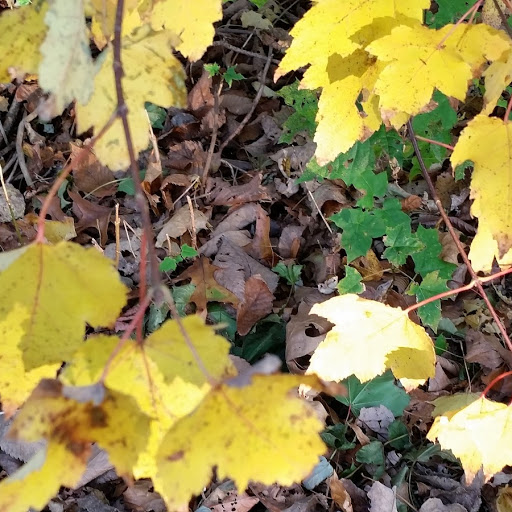
          The maple tree outside my window has been late in turning. I worried the leaves might fall off before they changed color. Then one morning as I pulled the curtain aside I saw they had indeed made their transition to gold. Later in the day the sun shone through them and the brilliance of the leaves was a sight to behold. I stood gazing at them, grateful for the beauty of that moment and of the very special loveliness that is fall in New England.

I feel fortunate to have grown up in this beautiful part of the country. Fall has always been special to me. I remember as a child collecting bright leaves and ironing them between pieces of waxed paper to preserve their colors. I did the same with my children when they were small, and we would hang the leaves up in a window to let the light shine through them. When I went thorough my mother’s correspondence amongst the letters was one from me with some colorful leaves. Being in Florida she said she missed them, so I sent her some.

Lately driving on the country roads near where we live I find it difficult to keep my eyes on the road. The scenery is breathtaking. The foliage of the trees makes billowing waves of color; the rounded mounds of the distant leaves heaped one upon the other simply take my breath away. How easy it might be to get lost in my inner dialogue and miss this.

My mind, like most has a way of getting busy with thoughts concerning what is or is not to be done, or has or hasn’t been finished. Lately I’ve improved. I used to find myself making lists in my head and missing out on a lot of what I might have appreciated had my eyes had been focused outward rather than inward. Once I got into the habit of noticing what my mind was doing it became easier to tame its tendency to run away with my attention and keep me from seeing what was happening around me.

When I take the time to look there is always something interesting to see. Naturally when I am driving I must keep some of my attention focused on what I am doing. Providentially, while looking to the road itself I see what is in front of me. Too, when I am with someone if I pay attention to what he or she is saying or how they are feeling instead of thinking about what I am going to say next, it is much easier to be fully present and aware of my companion.

I’m coming up on a birthday this month, and what I realize about getting older is that it gets easier each year to be patient, to be aware, and to be present insofar as I am able. For this I am thankful. I may never know what I have missed in the past when my mind wandered off and took my attention with it, yet I can make it a practice to keep myself in the here and now. That way I can appreciate whatever there is to be enjoyed in any given moment.

Take care for each breath and love each heartbeat, Tasha


Goodness of the Local Harvest

plums-1My mother grew vegetables and fruit and canned them for use during the winter and spring. I remember her on the hot days in August and September, lifting the glass jars out of their steaming water bath in the large canning pot in our small kitchen. Once cooled, the jars went to line shelves in the basement. During winter and spring she had all kinds of vegetables and fruit to choose from. Eating locally was common in those days because food that grew in faraway places was not available. Canning diminished with the advent of freezer chests. Consuming food in New England that was grown in Mexico, China or other distant countries was unheard of.

It is such a treat to eat locally. There is no comparison between food that is grown near where I live and that which has traveled hundreds, even thousands of miles to reach the market where I shop. Fresher, healthier, and minimally processed, locally grown food is better for me and for those I love. It tastes better too, though I am happy that my year round diet is not restricted to it. I am no purist, and I am grateful for fresh produce available all year round.

I love eating local fruit during the summer. Sadly, the frost in February decimated the local peaches as well as most of the plums. I look forward every year to purchasing them at our local farm stand, eating them whole, and occasionally baking with them. Now, provided they survive any difficult winter weather, I must wait another twelve months until they are available. The ones in the supermarket look good, yet I pass them by. Eating whatever nature has to offer locally at the time is it is offered is important to me. However I cherish the opportunity to be a locavore, as it is called, in season.

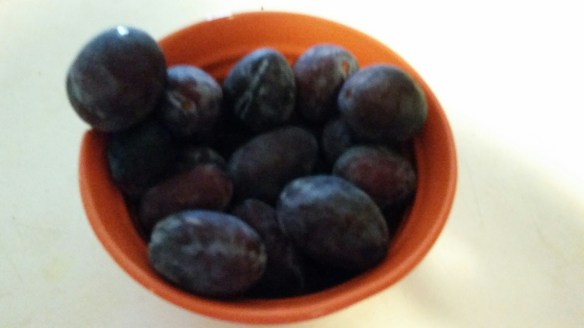
That is why when I spotted the very special small prune plums at the farm stand. I exclaimed aloud in my happiness. The kind proprietor said they were a special lot, rare and most likely all she would get. I bought a couple of pounds on the spot, then later in the week at another visit I bought all that was left of the rest. They tasted wonderful. I was reminded of the use of the word “plum” to describe something rich and/or desirable. These were “plum” good, and I received a “plum” when I discovered them.

All too soon the season of harvest bounty will draw to a close. According to the owner of the farm stand, the yellow squash is almost done. We enjoyed some of the last of it recently this way: I peeled and finely chopped some ginger and half a large onion. I sautéed these gently in light olive oil until onions were fragrant and transparent, added some garlic sliced thin, and then the young, thin skinned squash, sliced very thin cut in three or four inch lengths. This cooks quickly, maybe in ten minutes more. You can mix some thinly sliced zucchini with the yellow squash to good effect. Add basil leaves if available, or thyme. I have given no quantities because this is best made to suit your own taste.

Summer Through the Years

Diana's Pond ReflectionsAs a child I so looked forward to school vacation and the freedom it brought from discipline, homework and schedules. Whenever weather permitted, my time was spent out doors wandering around the rather large property where my parents and I lived. It belonged to my Great Aunt Alice, whose father had built the grand house she lived in now, as well as the cottage originally intended for the gardener. That was where I, and later on my brothers and sister lived. There was a broad, open field to roam in, trees to climb, and a small marsh bounded by a dyke that kept out most of the distant seawater.
Wildflowers grew in abundance, insects buzzed and birds called. There were trees to climb, and I also spent time high in their branches, reading. I called it my tree house and brought pillows to the platform I had wedged into my favorite tree, a big beech. Summer was a time to play. The property held plenty of room for my imagination to conjure up all kinds of adventures like the ones in the stories I read: Tarzan, Robert Louis Stevenson’s tales, and the legends of Greek heroes.

Time passed and I was a young mother. Summer meant days at a nearby beach watching my children play in the sand and splash in the waves. Fortunate to be able to stay home with my children, I hung the laundry in the sun, worked on my tan, and took the them to the local church fairs, the annual carnival, and whatever other amusement the season offered. We had picnics and explored the highways and byways of surrounding towns. Later there were softball and then baseball games they played in to attend. The work of motherhood became a kind of play in summer.

Fast-forward to a different kind of summer life, with a swimming pool to clean and care for and a large garden that took me almost as much time to look after as the children did. Still it was a delight to share the pool as well as the garden with visitors. I didn’t mind the weeding too much, or pruning the shrubs. It was an adventure to tackle the wild rose vine I planted for its delicious scent, without realizing the consequences of its rampant growth. I never knew how many would be sitting down to any meal, because people came and went as I practiced my hospitality. Summer held a different kind of play.

My summers have changed again. With age comes less tolerance for extreme conditions. My bones enjoy my home’s warmth in the cold but not its heat in the muggy weather. I appreciate air conditioning far more than I used to, and I spend much more time indoors than I did in the past. While the long summer hours of light are enjoyable, the effect of the heat on my mind is not. Labor Day signals summer’s closing. Once I welcomed its beginning with open arms, now each year I am more appreciative of summer’s end.

Spring Has Truly Sprung

Spring blossoms, white          When I was a child in grade school, each year our music teacher organized May Day celebrations. Every class participated, and a May Queen was selected from among the girls in the ninth, the topmost grade. The younger children had their own maypole. I found it hopelessly confusing. You had to go over one and under the next as you wound your ribbon around the pole, weaving it into the others until there was only a little left. After rehearsals, much to my relief I wasn’t chosen to do it.

There were dances and songs–I still have a printed paper program from then in a scrapbook made for me by a devoted relative. The songs were of British origin and invoked the days of “lasses and lads” who met and parted though the specifics were a mystery to my young mind. No one talked of the fertility symbols or the meaning behind the rituals centered around the day we were celebrating.

The first of May is the midpoint between the Vernal Equinox and the Summer Solstice. Nature is pushing forward. The increase of the light from now forward reflects the brightness of the days that begin their most obvious decline around the first of August. In the northern hemisphere there are many celebrations associated with this date. They reach far back in the history of humanity, symbolizing our connection with the earth and its fertility.

Most recent is of course the “May Day” workers’ celebrations of the former Soviet Union. My mother and I were in Moscow on that date twenty six years ago. I remember the colorful flags hanging everywhere, and the crowds of people in Red Square. However, from far back in human history, May Day has been one of the great spring celebrations of Europe and the British Isles. It is associated with fertility for both crops and farm animals, promoted through ancient rituals, many of which involved fire.

In these modern times we believe more in fertilizer than in fertility rituals. Few people these days will dance around a maypole–an obvious phallic symbol, or go off into the woods with a partner to insure that the fertility of land and pasture will continue. There is no need. Supermarkets are stocked all year round with almost every seasonal vegetable and fruit–no need to wait until June for strawberries or fall for apples. Those who have never experienced this timing cannot miss it, but in some ways I do.

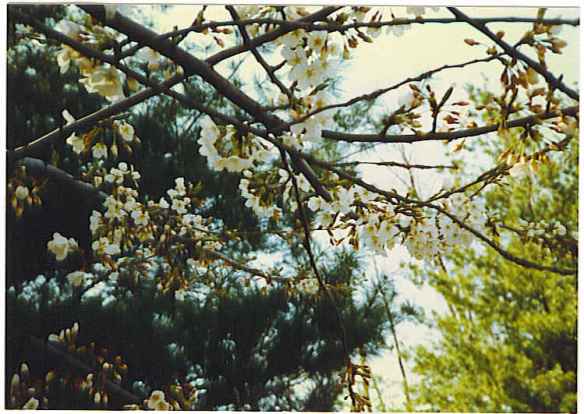
Yesterday Stephen and I drove along a wooded country road in the sunshine. The light illuminated the unfolding blossoms of the trees clustered around it. The cloudless blue sky above and the sunlight filtering through the branches above us lifted our hearts and filled us with joy. Summer with its own delights is in the wings; spring is on the stage revealing its special beauty now. It seems important to take time to notice this delicate time of unfolding.

Dandelion Days

dandilionforwishingThe first flowers I remember picking were dandelions. Proudly I brought them to my mother, who lovingly thanked me. I have memories of making dandelion flower crowns with her. We’d slit the stems, slide a flower through, and repeat until the crown or wreath was large enough to wear. Dandelions are the first flowers many children are allowed to pick. They are such pretty little bright spots, and unbeknownst to many, such good medicine It seems a pity that people feel they have to eliminate them.
Those who want pristine green lawns eradicate dandelions, never realizing that instead of poisoning these cheerful yellow suns, they could pick them and make a wine that tastes of summer, a bread, or other baked goods, or use the leaves in a salad, a stir fry or combined with other greens in a juicer. Dandelion leaves have excellent food value, and are a healthy, desirable spring vegetable. The roasted, ground roots make a coffee like drink.

Children love the yellow flowers; parents faced with eliminating stains from the milky juice, not so much. Homeowners might like to know the long roots actually benefit the lawn: they aerate the soil, keeping it from becoming compacted and unable to absorb nutrients. Susun Weed says there is enough vitamin A in a dandelion leaf to rival store supplements. As well there is vitamin C and many helpful minerals. It is also a mild, effective natural diuretic. If your lawn is away from the road, you can safely use your dandelions many ways.

Here is my recipe for Dandelion Deluxe: Ingredients: ½ cup chopped onion, 4 cloves of garlic minced or chopped fine, 1 small summer squash chopped small, 4 cups dandelion greens, olive oil. Method: Prepare greens while you sauté onion, garlic and summer squash in a olive oil. Remove roots and tough bottom stems. Wash very well. Cut up with scissors. Steam in a small amount of water until they wilt down. Strain water and set aside. Add chopped greens to sautéed vegetables and cook until stems are tender. You serve as is or you can mingle into your food processor for a different taste. Drink the healthy cooking water, your body will thank you.

Dandelion Wine: Age for at least 6 months. It will continue to mellow. Ingredients: 1 Qt Dandelions, yellow part only. 4 Qts. boiling water, 3 Lemons, 3 oranges, 4 Lbs sugar, 1 Pkg. yeast. Method: Pour boiling water over blossoms, set for 24 hours in a warm place. Slice fruit and remove seeds. Cover with sugar; set for 24 hrs also. Then strain blossoms and pour liquid over oranges and lemons. Add 1 package any yeast. Pour into ceramic or stainless steel. Let stand 4 or 5 days. Strain, let stand one more day. Bottle, then cap with small balloons. Leave until the wine stops “working” and balloons collapse. Cork and store 6 months or more. Then sip. It tastes like summer. Recipe makes 5 bottles.

Tasha Halpert

Growing Up By Myself

Bed Friends 1

When I was growing up I lived a couple of miles from a small seaside town on a large property that belonged to my Great Aunt Alice. I didn’t have any siblings until I was almost nine. Virtually an only child, I was surrounded by busy adults and often told to stop bothering them and find something to do. A voracious reader, when I wasn’t nose deep in a book, I played games of pretend, making believe I was someone other than a lonely child in an isolated neighborhood with only herself to rely on for amusement.

I had quite a collection of teddy bears, dolls and other stuffed animals. When I was small I was sure they came alive at night. This belief was influenced by Johnny Gruelle’s Raggedy Ann and Andy books. These innocent stories about a group of toys that had adventures were written in the early 1900s and became even more popular in the 30’s and 40’s. In these stories, ice cream cones grew on trees, cupcakes and hot dogs could be plucked from bushes and lemonade and sodas were available in puddles and brooks.

Raggedy Ann’s magical woods full of “fairies and elves and everything” held all sorts of fun inventions that I yearned to experience for myself. I loved the stories and used to watch my toys to see whether they too might have adventures while I was sleeping. Sometimes I thought I spotted them in different positions than I had left them, though I could never be sure.

Later I moved on to books by Robert Louis Stevenson, Alexander Dumas, and Edgar Rice Burroughs. Then I wanted to be a pirate or have exciting adventures when I became a grown up. I made bows and arrows out of handy branches and tied string to my father’s hoe and rake to make a hobby horse. If my father needed his rake he knew where to look–in my lilac bush “stable.”

My family believed in fresh air and I spent a lot of time all year round out of doors in nature. Where we lived I was fortunate in having a large open area to play in There were all kinds of trees to climb and large fields of tall grass that I made into my private jungle. My pretend life was much more interesting than my actual one. The world I lived in as a young child was without TV or any form of electronic toy or game. I had to use my imagination to conjure up my entertainment.

I wonder if my childhood led me to grow up looking at the world from a different perspective than most. Steeped in nature and in the creativity of my mind, its sights and sounds enhanced my imaginary life. Today I perceive links and patterns everywhere. I find significance in synchronicity and receive messages from the nature around me. The world was and is alive for me in a way today’s youth may not discover. With the current focus on electronics, most children will not have my opportunities. I learned to listen to and observe nature and found there a sense of companionship and of comfort that is with me still.

And God Bless the Caterpillars by Tasha Halpert

And God Bless the Caterpillars

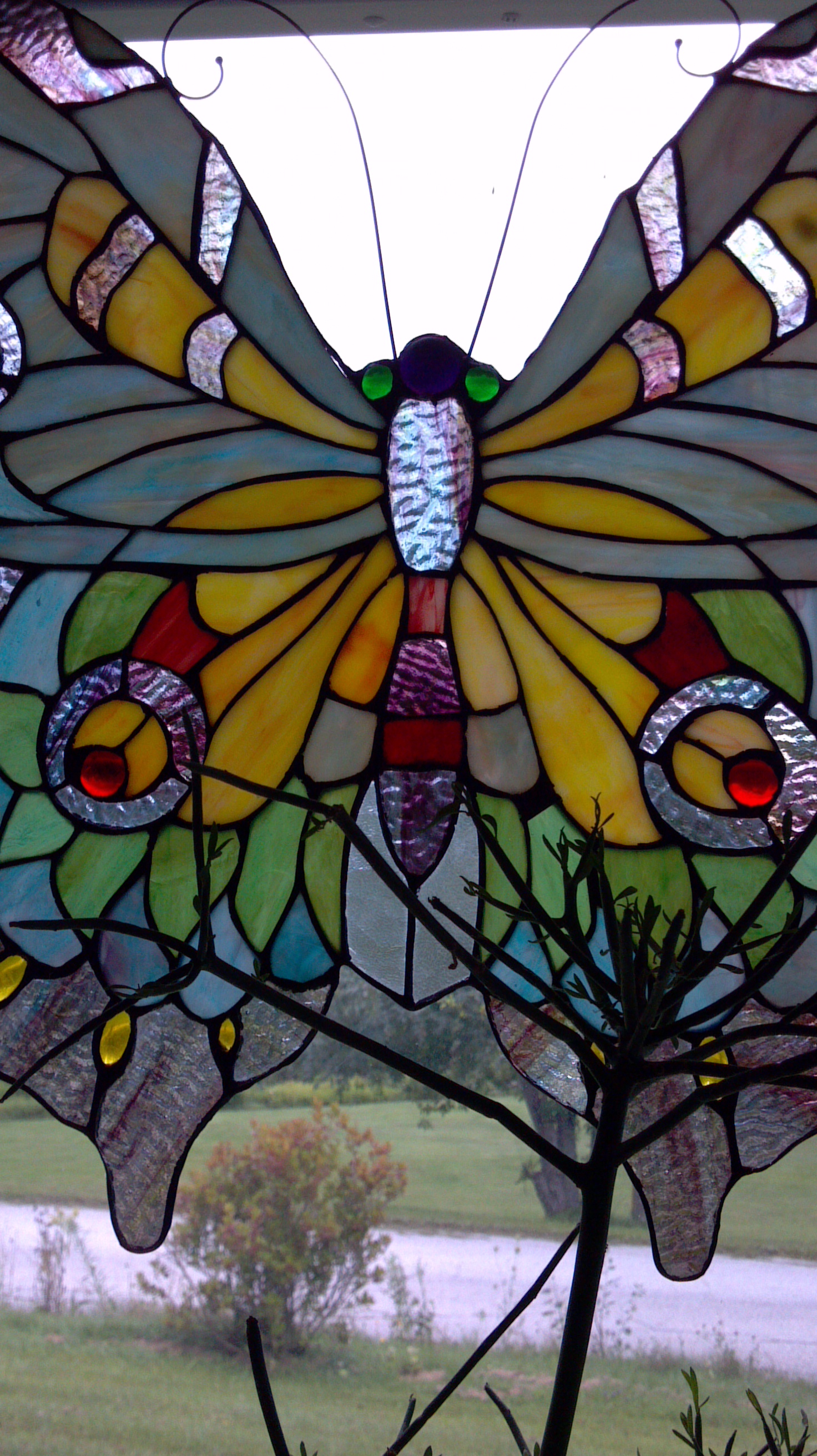
LLisa's butterfly My dandelion headed five-year-old is saying his prayers. He includes the caterpillars in their jars on the window sill. We had filled the jar with what we hoped was the appropriate leaves for food and twigs to climb, and each night we prayed for them. The time was 1968, and my son was one of five, active bright friendly loving children.

The caterpillars munched, spun cocoons on the twigs, and were quiet. We waited in vain for butterflies to emerge. Together we concluded that caterpillars did not do well in captivity and perhaps it was better for them to go free. Lessons on many levels were learned from the experience. I don’t know whether my son remembers the caterpillars, but he is now a grown man with a strong sense of curiosity, a fine capacity for observation and a desire to do some good in the world. The eager child lives on in the man.

One day the family visited someone who had guinea pigs. Naturally the children were fascinated and the pet shop that sold us our first pair agreed to buy back progeny. I was delighted at the opportunity to give the children a first hand lesson in biology, and all went well until we elected to do a breeding experiment. Unfortunately our breeding program coincided with a glut of guinea pigs at the pet shop. My living room filled up with boxes holding a total of fifteen furry squeakers and any time the refrigerator door opened, a chorus of squeals filled the house.

In the process my oldest daughters found out first hand that one cannot always rely on original solutions but must plan for contingencies, and of course they had graphic experience in where babies come from! Now that they have had their own children, they have fostered the same sense of adventure in their offspring and have carried on the same love affair with nature.

Nature is a great teacher of many things, and the care with which it is arranged has a significant message for us. We are part of the cycles of emergence, growth, and return to the whole. We circulate life energy the way a tree does. Once we believed we were in charge but this conviction is eroding with our recognition of the results of that belief. Our attunement to the part we play in the natural order of life seems to me to be more important than ever to our growth as healthy, positive human beings.

Parenting seems best learned by experience. Children are resilient. With goodwill, grace and good luck most of us will succeed in raising well adjusted children. Doing what we most enjoyed with our youngsters often results in happiness for all, but observing and participating in the processes of nature can easily and quickly return us to the joys of childhood as well as bring us pleasure in the present.

Looking together at snowflake crystals, searching for seashells, tenderly weeding small gardens—the days of my companionship with my children are cherished memories. I learned as much from them as they did from me. Nature is a great teacher and I am grateful to her for the lessons I learned as well as the beauty I have received. I am proud, too, of my children for their positive attitudes and approach to life, much of which was learned at Mother Nature’s knee. And I say with my son, God bless the caterpillars, God bless them all.