 My brother and his wife just moved to Illinois, leaving behind the home we both grew up in on the North Shore In the next town, there is a square dedicated to our grandfather who died in World War One. Every year the parade stops in the street by the square. His name is on a pole in front of the fire station there, and they put a wreath on it each year in his memory. When I was a child my grandmother used to bring a big bunch of carnations to place inside the wreath. In later years my brother always attended the ceremony and participated. Now he will no longer be able to do so. Still he will have many years of memories, dating back to his boyhood.
Memories are wonderful things. I take great pleasure in many of mine, and I can open and enjoy them any time I wish. When I was a little girl living in Manchester by the Sea, my family shopped for our groceries in the village, as well as sundries from a small shop that carried a variety of small useful things we used often. For larger purchases my mother drove to Beverly, where there was a large department store called Almy’s, as well as a Woolworth’s and a Grant’s. However, for fancy goods like wedding presents my parents shopped in Salem, the next town over, at a store that glittered with silver and jewelry, called Daniel Lowe’s.
The Daniel Lowe’s building has transformed and Salem has become a tourist mecca for seekers of magical items and New Age accoutrements. Beverly too is much changed. Almy’s is long gone, as are the 5 and 10 cent stores I enjoyed. Even the bakery that later on I shopped at with my children, who remember it still for its delicious cookies, is no more. Yet the stores of my childhood live on in my memory, ready for me to walk through and gaze again at their counters holding a mixture of the practical and the precious.
People I have known who have vanished from my active life also remain for me to recall. Those who are amongst the living I can send a Christmas card to. Those who no longer walk the earth occupy a kind of photo album available to my memory. I turn the pages sometimes and think with pleasure of the experiences we shared, and how I enjoyed them. I am grateful for these and for the time we spent: my grandmother with her endless card games and trips in her ancient automobile, dear departed neighbors from an earlier place we lived in Grafton, and more.
As Memorial Day approaches, I think not only of the people but also the places and even possessions of the past. They are gone only from the physical part of life. They live on in my memory as in the memories of others who may have known of them. One of the fun experiences to be had in gathering with family or old friends is the memories to be shared and enjoyed together. Memorial Day encourages me to think not only about my dear departed, or even those who gave their lives that I might be free, but of the sweetness of those memories. As in my mind I see these faces and these places, they seem to me to be like flowers I place upon the granite memorials of that and those who have departed.
 Do you take satisfaction in what you may have accomplished? Or do you tell yourself you could have done whatever it was better, or done more? Most of us have a critical voice inside that will not let us be satisfied with what we may have done, even though we may well deserve it. That critical voice can originate early in life from a parent, a teacher, or a boss. Now it has become a part of us as adults, and it robs us of the joy we might take from our satisfaction. To be satisfied may actually take courage, the courage to admit we have done something worthwhile.
 When I was growing up it was my responsibility to care for the chickens. In the winter what that meant was carrying a heavy bucket of water from our house the thirty or more yards to their coop. The spring I was twelve the wetlands near the coop flooded and there was plenty of water right there. I took advantage of it. However, something then happened to the chickens. They began dying. Apparently, they had somehow caught a disease.
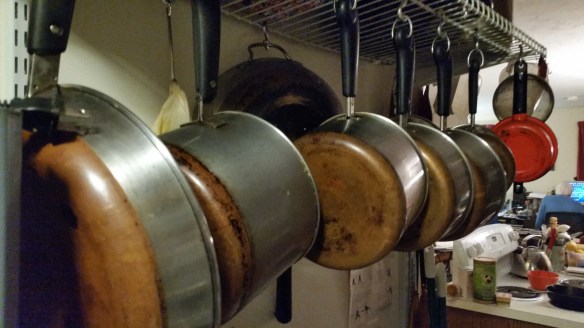 In the fifties, when I was a young mother with two small daughters, my friends and I often gathered in one another’s kitchens for visits and chitchat. One day one of my friends looked at me, shook her head and said, “You are so brave, hanging your copper-bottomed pots for all to see without polishing them. Most women wouldn’t dare.” I smiled at her. “It doesn’t seem important to polish them,” I told her. “I’d rather play with my children or read to them.”
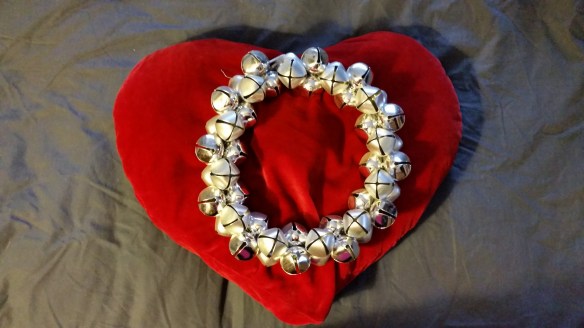 When I was growing up it was the custom for valentine cards and gifts to be sent unsigned. I believe this was a tradition that dated back many years. The custom of celebrating Valentine’s Day goes back even further, to ancient Rome. It originated in a festival of the time called Lupercalia, after Lupercus, a nature god of the Romans who resembled the Greek god Pan. It also has roots relating to Juno Februata, honoring Goddess Juno. Then, young boys and girls drew lots to see who they would be partnered with for the year which began in March. The Christian church opted to keep the holiday and rename it, calling it after a saint who may or may not have existed.
 I’ve never been a competitive person. Usually a sense of competition kicks in around the age of four, when a child gains a clear understanding of “me” and “mine.” Even then there is often a desire to share unless the child is surrounded by competitors. When I was growing up competition was the rule and the idea of a game that required cooperation instead was unknown. I did not enjoy the competitive world I grew up in.
 I took the red and white baking dish out of the drawer under the oven and set it on the counter. An image of the person who had given it to me rose in my mind, and I sighed. We had been friends for many years. Now however she had joined the angels that she so often spoke of. Her faith was strong and she shared it on occasion though not intrusively. A colorful character, she was always fun to see and over the years she had given me other gifts I cherished.
 Pay a visit to the Museum of Russian Icons in Clinton MA and you will see a wonderful variety of angels as well as many saints. Ancient and modern icons from Slavic countries, collected over decades by the founder, Gordon B. Lankton, line the walls of this wondrous building. Their programs and exhibitions are special too, and their gift shop holds many interesting and often inexpensive items you will not find elsewhere. As you peruse the rooms, angels of every description, as well as saints gaze at you with farseeing eyes.
 Pujakins