Making My Own Music

A musician by avocation, from the time I was a young child I was usually involved in some kind of music making. I’ve always loved to sing, and I can remember singing to my mother when I was quite small. At my grade school, weekly music classes the teacher played the piano as we sang British folk songs and music from Gilbert and Sullivan, typed and collected into a loose leaf notebook. Later the same teacher gave me private piano lessons. These ended after two years for two reasons: I found the practice songs to be boring and my mother, an amateur musician and child prodigy on the violin, disliked my fumbling attempts at learning the piano. She didn’t even like it when I played around on the piano keys, making my own music for myself. She would scold me for “making noise” as she called what I thought of as music.

Later I sang in various choruses at various schools and then in my church choir. To my delight one year my then husband bought me a guitar for my birthday. I began teaching myself to play. There followed a number of years playing and singing in coffee house, at hootenannies, and then professionally for parties and special occasions. I even volunteered at the local hospital, playing for the patients every week or so. My mother seemed pleased that I was following in the family musical tradition. Encouraged by her, and a poet by inclination I began to write my own songs. The melodies were simple, reminiscent of the many folk songs and hymns I had sung over the years.

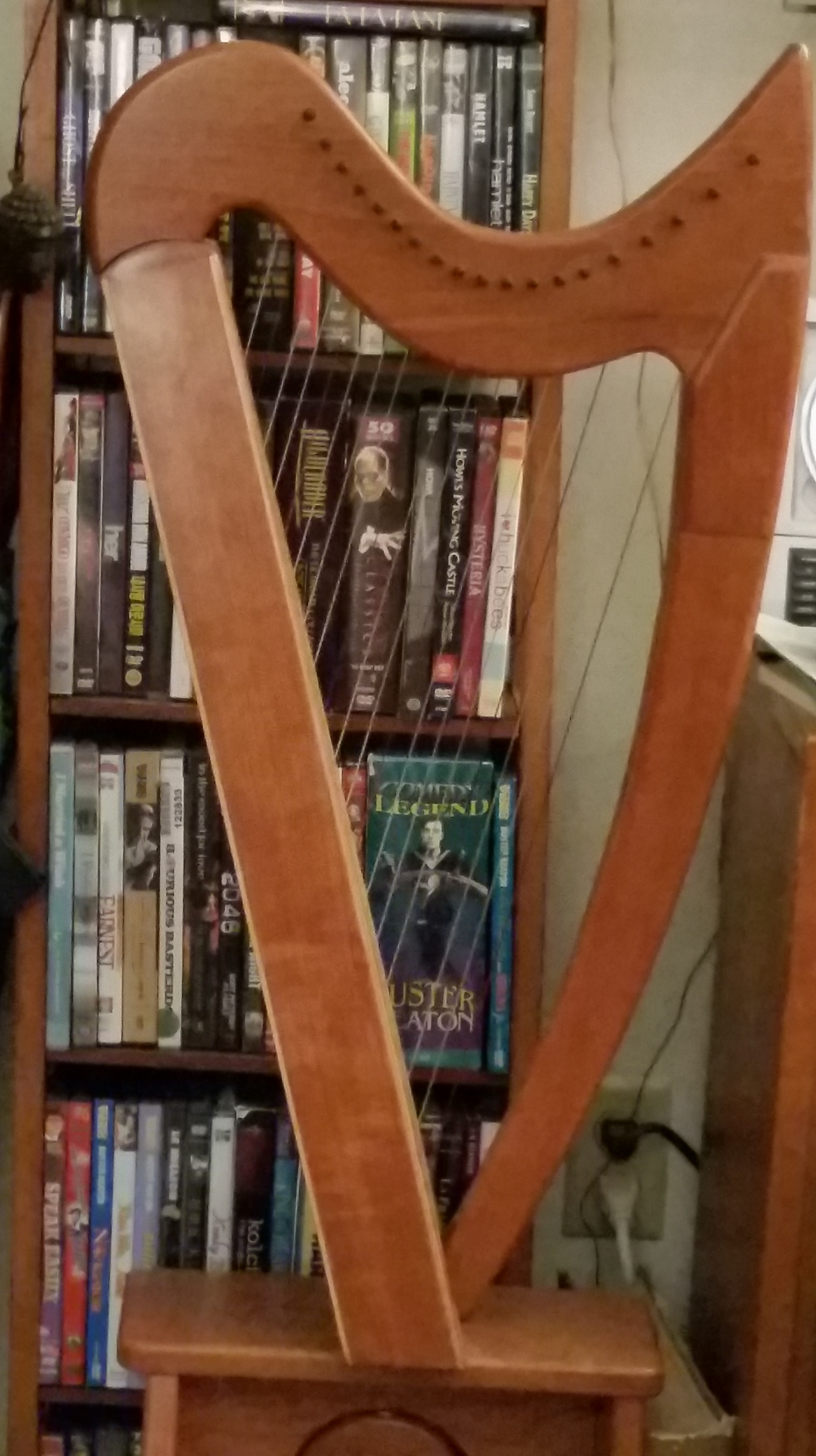
Although I enjoyed playing the guitar, from the time I was a young child the idea of playing the harp had attracted me. However the many strings of the large harps looked difficult compared to the guitar and surely transporting one would be a nightmare. Then I injured my shoulder and because of the position required for me to play it, had to retire my guitar. After reading many articles on the importance of keeping the older brain alive, and disliking the recommended suggestion to do crossword puzzles, I decided to try a smaller folk harp. Searching the internet I discovered a lap harp with a playable nineteen strings and purchased it from the maker along with a book to learn from.

I spent a respectable amount of time teaching myself the initial songs and techniques. As I advanced, the lessons became increasingly difficult. I realized I was losing interest in playing. I felt frustrated and began to neglect my harp, even allowing it to get out of tune. My mother’s former diatribes from the days I used to play on the piano rather than practice my lessons had come back to haunt me. Then one day I realized I didn’t have to play actual songs, I could do ass I liked. I could just enjoy myself, making musical sounds; I could play for fun. I began to do that. Spontaneous tunes emerged in my head and then from my fingers. Now playing my harp has become a treat and the music I make from my heart has become a daily joy.

Home Cooked Food Feeds Body and Spirit

Fall Reflections 15As we drove down the highway to an appointment I noticed how the trees by the side of the road were beginning to look somewhat different. The ones with leaves that had not yet begun to change looked tired. Their color was no longer the vibrant green of summer. The ones that had begun to turn were just starting to color up, making a tentative venture into the opening notes of fall. The recent spate of warm days may have confused the trees or delayed their color, however, cool air will soon prevail and bring out the glorious brilliance we in New England are so fortunate to see each year.

While I still serve salads in the fall and winter, as the weather grows cooler I focus on warming foods. Cabbage is a great favorite in my household, both for its nutritional value and for the way it keeps so well in the ‘fridge, always ready to eat raw as in my cabbage salad, or cooked. Red cabbage, in particular with its vibrant color and hearty flavor is a very useful fall and winter vegetable. The following recipe is adapted from one I first saw on a video called Two Fat Ladies. The two women traveled the length and breadth of England collecting recipes for local foods. While many of their recipes were not anything I would care to reproduce—being too elaborate, too rich, or using ingredients I might not easily find, this recipe for red cabbage is easy and tasty, as well as economical. According to the Internet, one cup of chopped red cabbage has 33 percent of the recommended daily intake of vitamin A. The same portion of green cabbage only has 3 percent.

I have made it in a crock-pot, which reduces the need for stirring. However I also often cook it in my black iron frying pan. It doesn’t smell like overcooked cabbage, either, even though it needs to cook for at least 3 hours on the stove or much longer in a crock pot. It is delicious the day it is made and even better the day after. I always make a quantity because it keeps well and is handy for a quick supper. Serve it with hot dogs, sausages, or even hamburgers.

Ingredients: 1 medium red cabbage, 2 raw onions, 2 apples, 1\4 cup brown sugar Or 4 tablespoons apple cider, 2 tablespoons balsamic vinegar, 2 tablespoons olive oil, 2 tablespoons butter, salt and pepper to taste. Method: Using a sharp or serrated knife, slice cabbage as thin as you can, being sure to discard the core and any very thick rib slices. Peel and slice onions and apples, being sure apple slices are not too thick. Sauté onion in butter and olive oil until soft. Add these to the crock-pot, or combine in the frying pan with the cabbage, apples, vinegar and cider. Cook in the crock pot for around 6 to 8 hours or in the frying pan for 3 or 4, stirring at least once an hour or more if you like. Serve or refrigerate to reheat, and enjoy!


Pleasure Can Take Many Forms

As regular readers of my column know by now, my mother really did not like to cook. She did what she had to do to feed her family. However, at least as far as I can remember preparing meals gave her no pleasure. Nor did she want my father to cook because, she said, he burnt everything. Perhaps he was impatient or perhaps he wasn’t watchful. I don’t know because I never saw him in the kitchen except to mix cocktails.

The only household chore I ever knew him to do was to polish the silver. My mother refused to do that and I do not blame her in the least. It is a dirty, tedious job. My father however seemed to enjoy it. I have a memory of him in an apron made from black and white striped mattress ticking material, vigorously polishing some of the lovely silver items he had inherited or been given by family members.

I on the other hand have always derived great pleasure from preparing food, baking, and providing meals for loved ones. For years I collected recipes. In the 80’s I wrote a cookie cookbook as well as a completely refined sugar free general cookbook with many recipes I had created. In those desserts I used only honey or maple syrup. Now even that kind of baking, along with a lot of other recipes I enjoyed making over the years, is history.

Recently I was diagnosed with a medical condition that requires severely restricting my carbohydrate intake. This has resulted in a major upheaval in both my eating and my cooking. In addition to sugars I have had to stop eating rice, pasta and potatoes. Thus I have had to eliminate many favorite comfort food recipes. I can no longer eat the Chinese fried rice I specialized in, the home fried potatoes or the shrimp scampi I enjoyed making as well as eating.

Then along came some difficult news. This caused a reaction I did not expect. I found myself in a depressed state and developed new aches and pains. I kept asking myself why was this happening? Then I realized I had been limiting most of my pleasure to cooking and eating. This is not to say I wasn’t doing fun things or having enjoyable experiences other than with food, however, I had concentrated principally on food related pleasure. I no longer regularly practiced other experiences I found pleasurable, like playing my harp or coloring.

Pleasure can rebalance the body’s ph and help keep us healthy. So now I am working to discover ways besides eating and cooking to give myself pleasure. In so doing I have rediscovered hobbies from the past like embroidery and begun to watch favorite old TV shows we have on DVD. I am spending more time with my harp, simply playing for the pleasure of it rather than working to learn tunes. I got out my coloring books and blank paper pads and began to color and as well as to draw. As time goes by I expect to enjoy new pleasures as well and look forward to discovering them. Meanwhile I already feel better.

Christmas Expectations

kathys-christmas-wreathsI remember one Christmas my parents gave me four or five board games. The difficulty was, I had no one to play them with. My parents didn’t play children’s games; we lived in the country and there were no kids in the neighborhood; and my schoolmates lived in other towns. Gas being dear—this was during WW II–people did not drive their children around for play dates. My usual Christmas presents were clothing or things I needed. Great Aunt Alice gave strange presents—one year she gave me a wood burning kit that was difficult for me to figure out how to use. I looked forward to stocking presents; they were more fun. Best of all was when I got old enough to play Santa along with my parents and participate in filling their stockings.
I had a small book of the poem by Clement Moore that I always enjoyed rereading at Christmas. Eventually I knew most of the poem by heart. “The stockings were hung by the chimney with care, in hopes that St. Nicholas soon would be there.” These verses have given us all an image of Santa and how he does things that has remained with us through many generations. We expect that he will wear a red suit, come down the chimney, arrive on a sleigh with reindeer, and so on. Cookies and carrots for the reindeer are part of our expectations for his Christmas Eve visit. Presents under the tree on Christmas morning are another. Does Santa always wear a red suit? Or can Santa dress in ordinary clothes?

“Santa Claus is coming to town,” as the song goes, and, some warn you’d better be good or else. “He’s making a list,” as the song goes. There used to be talk of Santa leaving a lump of coal or something else that is undesirable in the stocking of children who were not good enough to deserve toys. One of the original Santas—St. Nicholas, provided dowries for young ladies who otherwise would not have been able to get married. Some cultures used to include a kind of negative Santa called Black Pete, who tagged along to punish or otherwise be unkind to those whose bad behavior merited it. Must gifts be a reward or can they simply be a sign or love from the giver?

The advertisements on television create enormous expectations. The shining allure of the latest toy or newest communication device creates desires that may lead to major dismay if they are not forthcoming. What may be lost in the light of all these expectations is the unexpected, unadvertised gifts that this time can bring: the peace of loving hearts gathered together and the good will that comes from sharing. The opportunity to participate in the love and merriment that is part of the holidays is the real blessing, the actual present to be gained at this time. Those who are too focused on their expectations may well miss out on this, the real gift of this season.

Tasha Halpert


Goodness of the Local Harvest

plums-1My mother grew vegetables and fruit and canned them for use during the winter and spring. I remember her on the hot days in August and September, lifting the glass jars out of their steaming water bath in the large canning pot in our small kitchen. Once cooled, the jars went to line shelves in the basement. During winter and spring she had all kinds of vegetables and fruit to choose from. Eating locally was common in those days because food that grew in faraway places was not available. Canning diminished with the advent of freezer chests. Consuming food in New England that was grown in Mexico, China or other distant countries was unheard of.

It is such a treat to eat locally. There is no comparison between food that is grown near where I live and that which has traveled hundreds, even thousands of miles to reach the market where I shop. Fresher, healthier, and minimally processed, locally grown food is better for me and for those I love. It tastes better too, though I am happy that my year round diet is not restricted to it. I am no purist, and I am grateful for fresh produce available all year round.

I love eating local fruit during the summer. Sadly, the frost in February decimated the local peaches as well as most of the plums. I look forward every year to purchasing them at our local farm stand, eating them whole, and occasionally baking with them. Now, provided they survive any difficult winter weather, I must wait another twelve months until they are available. The ones in the supermarket look good, yet I pass them by. Eating whatever nature has to offer locally at the time is it is offered is important to me. However I cherish the opportunity to be a locavore, as it is called, in season.

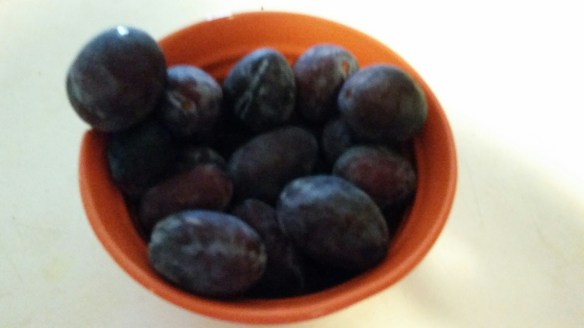
That is why when I spotted the very special small prune plums at the farm stand. I exclaimed aloud in my happiness. The kind proprietor said they were a special lot, rare and most likely all she would get. I bought a couple of pounds on the spot, then later in the week at another visit I bought all that was left of the rest. They tasted wonderful. I was reminded of the use of the word “plum” to describe something rich and/or desirable. These were “plum” good, and I received a “plum” when I discovered them.

All too soon the season of harvest bounty will draw to a close. According to the owner of the farm stand, the yellow squash is almost done. We enjoyed some of the last of it recently this way: I peeled and finely chopped some ginger and half a large onion. I sautéed these gently in light olive oil until onions were fragrant and transparent, added some garlic sliced thin, and then the young, thin skinned squash, sliced very thin cut in three or four inch lengths. This cooks quickly, maybe in ten minutes more. You can mix some thinly sliced zucchini with the yellow squash to good effect. Add basil leaves if available, or thyme. I have given no quantities because this is best made to suit your own taste.

The Wisdom of Waiting

Pictures downloaded from my camera 2. 156


Children are notoriously impatient. I was no exception. The car ride into Boston for holidays was excruciating, especially as dad had to take traffic ridden Route One and what was then the Sumner Tunnel. Sitting still for any length of time whether in a car or on a couch was difficult for me. Today, given the current parenting advice I might be labeled with some alphabet letters and perhaps given medicine. However in those days life was simpler and that kind of behavior wasn’t considered abnormal.

Because of this my most disliked punishment was not a spanking but being made to sit on the piano stool for fifteen or more long minutes. In addition I would be, “put on silence,” Which meant no conversation with anyone. It was difficult for me to learn to sit still. Once I when I was the only child at a very tedious adult afternoon tea I manufactured a case of hiccups so as to get some attention. My parents caught on to what I was doing and put a quick stop to it. Patience training begins early.

Fast forward to today: On Friday a few weeks ago, a big cardboard box appeared in the hall. Despite its weight, I lugged it in. “I think our exercise machine has come,” I told Stephen. “Good,” he said, “lets open it later.” He was busy as was I. Saturday and Sunday came and went. There were things to do and places to go. Occasionally one of us would say perhaps we might open it, yet it was never quite the right time.

On Monday a dear friend came for lunch. I mentioned the arrival of the exercise machine. “Can I see it?” she asked. “Sure,” I said, “no time like the present.” I opened the cardboard carton and started to lift out the machine. It wasn’t completely assembled. “Oh, let me help,” said our kind friend. She looked it over, lined up the parts, followed the instructions, and in very little time had it all done and in good working order.

How glad I was that we had waited. I’m sure we would have had to spend most of a day figuring out what went with what, where, and how. My clever friend had it put together in no time. There is wisdom in waiting for the correct moment, for that is when success is attained. The moment itself cannot be hurried, nor can its arrival be predicted. No amount of wishing or searching can affect this. Sometimes patience practice can be frustrating.

For example, no matter how hard we looked, Stephen and I found every place we’ve lived in Grafton by stumbling over it. Because none of our deliberate searches brought good results, we were forced to be patient. The practice of patience, like the practice of a musician, needs to be lifelong. Eventually it can be seen simply as a challenge rather than as a tedious bore. However, one must be patient because that ability comes only with plenty of practice.

A Little at a Time


My Buddha by the sink

My mother was an artist. She went to art school and studied sculpture as a young woman. Later when my brothers were both in school she studied painting at the Boston Museum of Art. She had a studio over the garage where she occasionally worked. She also kept her art materials there along with lots of interesting women’s magazines. I loved to go up and read them. From them I learned many helpful household hints. I still remember one that told how to change a bed by walking around it only once. I used to do that. Now Stephen and I make ours together.

It may have been then or it could have been later on in my life that I came across the twenty minute system for accomplishing lengthy tasks. The article suggested allotting twenty minutes daily or whenever convenient, to a chore that was normally postponed because it might take too long or be otherwise tedious. When I tried the suggestion I was pleasantly surprised to see that it worked. One example was that instead of cleaning out all the bureau drawers, or every shelf in the pantry at once, take twenty minutes to clean and tidy one, stop and do another on another day.

At one time I practiced this technique quite frequently, however it slipped into the mists at the back of my mind. Recently I was reminded of it. What happened was this: For a very long time I had postponed cleaning out the refrigerator. Week after week each time I wrote out a new to do list, that particular task was at the top. Still I found reasons not to. Then I noticed how sticky one of the racks on the refrigerator door was. I decided to clean it off then and there. Because there were many small jars to be removed, washed off and replaced, it took me about twenty minutes or so to complete the task.

As I shut the refrigerator door I remembered the household hint from so long ago and laughed. The next day I cleaned off the second shelf of the door. Several days later I washed off the whole bottom shelf of the refrigerator. Today I cleaned the oven, and so it goes. Each task that takes around twenty minutes to complete adds up eventually to a thorough cleaning and tidying. I will probably go through my bureau drawers next, and perhaps after that a couple of other tasks I can think of that need attention.

I remember hearing someone say once that when he thought about what he had to do, it always seemed far more daunting than it turned out to be once he actually began to do it. The same holds true for me about the time spent doing something. Dividing a task into smaller segments works much better for me these days than trying to get it all done at once. As well, it spreads out over all the different times spent, the feeling of satisfaction I get from my small yet necessary accomplishment.

Tasha Halpert


Hospitality by Tasha Halpert

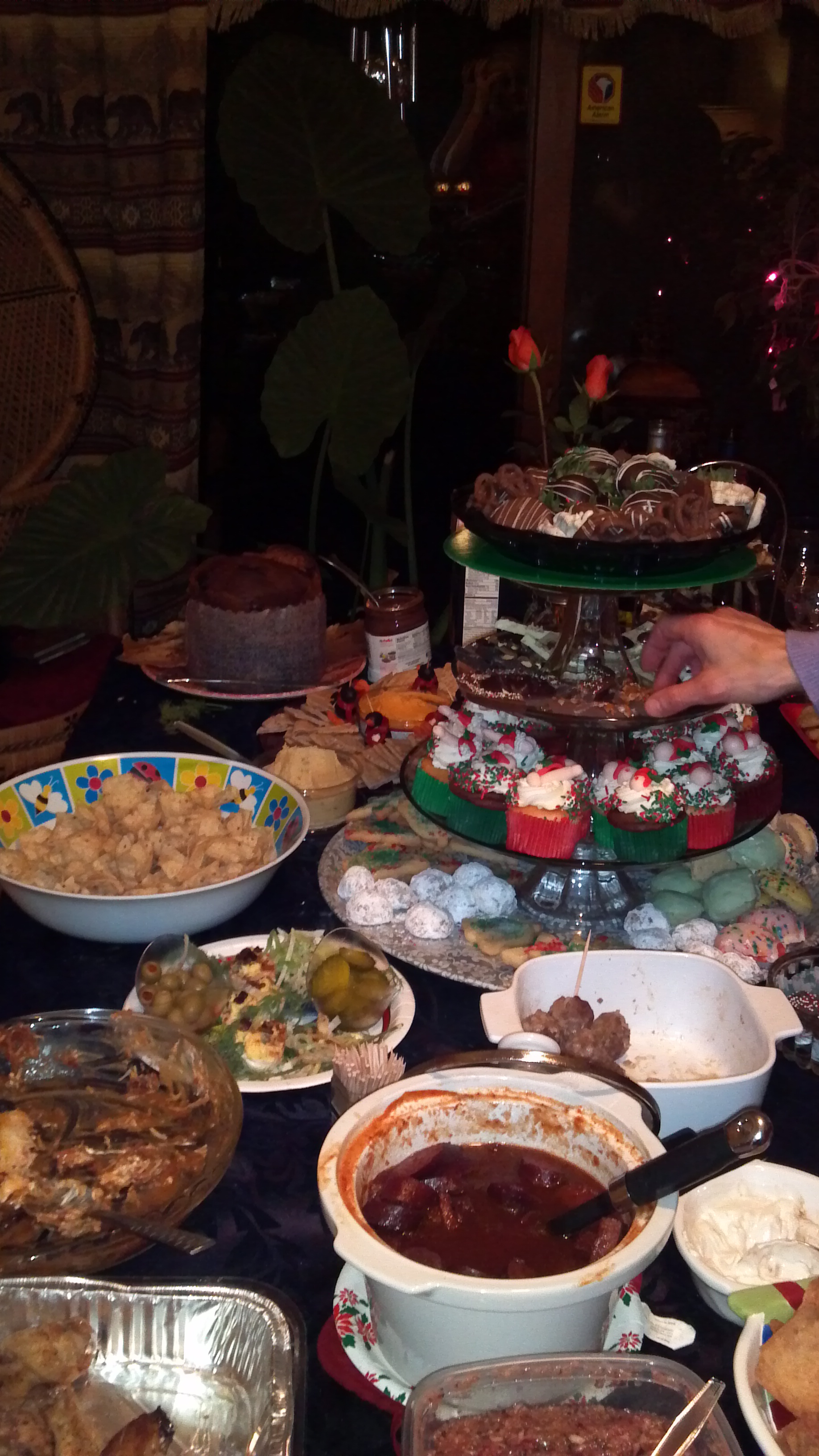
Deb's party food 2As she does whenever she comes to the States, our friend from Denmark was visiting us. Over a lunch I had enjoyed making for us all, we had fun catching up on our recent activities. She was exclaiming over the food, saying how good it was and how happy she was to be with us. “I love cooking for my friends,” I replied. I do. It is one of my favorite occupations. Stephen and I both enjoy entertaining friends, and making meals for them is a big part of my joy.

She commented that she too enjoyed cooking for her friends. She then went on to say that her experience here in the States was that when they were entertaining, many people seemed to prefer taking people out to eat rather than preparing food for them at home. She said that in Europe it was more common to prepare dinner for their guests at home and less common to take them to a restaurant. I thought this was an interesting commentary, and I wondered what it indicated about Americans.

Around the holidays, the newspapers overflow with advertisements for meals to which you are supposed to bring your whole family. Alternatively, supermarkets and other providers of food advertise “home cooked” meals delivered to your door. My parents would never have considered eating anywhere for the holidays but at the home of a relative. Eating out was only for very special occasions, perhaps to celebrate a victory or a special anniversary.

Thinking back on my childhood years I remember that when my parents entertained it was usually relatively spontaneously and for cocktails before luncheon after church or dinner. Afterward our guests either went home or to a restaurant. My mother did not like to entertain and seldom had people for dinner parties. She had had a lot of that as a young child in her parents home and had been as it were inoculated against it. Her mother had given her all sorts of jobs to do related to making ready for guests, none of which she particularly enjoyed.

Her father had been in he diplomatic service in Germany prior to World War II and they had lived all over the globe. Her mother had entertained at lavish dinner parties with food prepared by a cook or catered. To my mother fell the task of setting the table, arranging flowers and so on. Later she and her two sisters would be called upon to perform musically for the guests. No wonder she disliked parties.

My first husband didn’t care to entertain either. We had one big party a year. it. My cooking was confined to the family. I have found it wonderfully different with Stephen. He has always loved to entertain and there have been many times in our lives together when I never knew how many would be sitting down to dinner. Because I have plenty of supplies on hand, this has never bothered me. To be sure, I enjoy dining out, especially as someone’s guest, however I am very happy to eat loving prepared home cooking.

Smelling the Lilies

Star Lilies 4       Of all the flowers with delightful scents, there are three that are favorites of mine: Lilies, Roses, and Hyacinths. So it was that when I was shopping in Trader Joe’s last week and saw the Star Gazer Lilies for sale I could not resist buying a small bunch and bringing them home. As I had hoped they would they have filled our small apartment with their wonderful scent.

As I sit here writing my column I am breathing it in. As I do, these colorful lilies with their glorious perfume remind me over and over again how important it is to give to myself as well as to others. It has taken me more than a few years to recognize the importance of doing that. My dear mother called such thinking selfish. She was raised in a home where children came last, after guests, parents and other adults. To think of oneself first, if at all, was not encouraged.

There was no intentional cruelty involved in this attitude. It sprang from a different way of seeing the world and of acting on that viewpoint. There is a strong behavioral edict that sprang from traditional thinking that it is better to give than to receive. While it is good to give, there are psychological reasons that were not taken into account by this edict that need to be addressed. In addition there is the question of balance versus imbalance to be considered.

I was raised in much the same way. I remember once being surprised when a friend said that we must be home by four o’clock for her children’s TV program. That the wishes of children were something to consider was a new thought for me. As a young mother it never occurred to me that children’s choices were anything to be considered.

In the years since then I have done a lot of learning. A most important lesson of my lifetime has been that if I do not give to myself I will not have much to give others. My cup must have something in it before I can give from it freely. My giving must be in balance with my receiving. What I have discovered, sometimes the hard way is that if I give only to others and not to myself I develop unconscious resentment that can lead me to act unkindly, or be overly critical without meaning to. This can creep up on me and I need to make sure I notice it when it happens.

From the time I was small being kind has always been very important to me. Thus it has become vital that from time to time I assess my behavior to make sure I have been giving to myself enough to balance my graciousness to others. It is not always easy to remember to give to oneself. It often initially feels so good to give to others that it is easy to forget to include oneself. As I inhale the perfume of the wonderful lilies I am reminded again of how grateful I am for this gift I gave to myself, and of how glad I am that I bought them.

Text and Photo by Tasha Halpert

In An Orderly Fashion

Column VistaIn An Orderly Fashion

Remember fire drills? There are even some of my readers who might remember such a thing as a bomb drill. When the bell clanged we were always told to “proceed in an orderly fashion.” I suppose that meant lining up and staying in line so the teachers or whoever was shepherding us could keep track. In an orderly manner usually meant no talking, and certainly no fooling around.

I think about this phrase sometimes when I am dithering about my apartment working to get things done. Being a writer I spend most of my time at home and can make my own schedule. This has its positive and its negative points, because I do not have the same parameters necessitating order as someone working outside the home, however I do need to make my own order.

There is priority, there is the immediate demand, and then there is what I hope to get done. Each day presents its challenges. I can only do my best. For instance, take the insistent telephone. say I am about to begin a task when it rings. Stephen would tell me to ignore it, and my experience is that if I do it will only create another difficulty I haven’t anticipated. I answer the phone, conduct whatever necessary conversation and go back to what I was doing. Meanwhile, I may have lost the thread of the process and need to begin again.

It may be that I am called away while I am cooking. I ought to know better than to leave the stove unattended. However having had years of training as a mother to answer the immediate need of the moment, I have a tendency to rush over to do what seems to need doing. In the meantime, something boils over on the stove and that necessitates a huge cleanup.

When I plan ahead it seems to help. When I set out on a series of errands it works better if I think about the best arrangement for doing them. This works fine unless I forget my grocery list and either have to go back for it or try to remember what was on it. Stephen suggested I put the list in my purse and keep it there. I explained why I don’t: when I wish to add to it, I have to find it and write down the new item– if I don’t forget what it was in the meantime. It’s far easier to keep it on the counter.

I am all too easily distracted from my orderly progress. Sometimes this is simply my own fault. In the midst of doing what I intend to do I remember what I meant to do and didn’t, go do that, and meanwhile think of something else that needs doing. When I finally return to my original task it may have become more difficult or more complicated. The other day I realized that there is no such thing as an orderly fashion in my life, there is only keeping track as best I can and being content with that.

Text and Photo by Tasha Halpert