A Wreath of Remembrance

winter-red-and-green          The season of lights, as this time of year could be called, holds many holiday traditions and celebrations. In my home we combined my mother’s German heritage with my father’s American one. We opened our larger gifts from friends and family on Christmas eve, while the stockings that held presents from Santa were opened on Christmas morning.

My mother had played the violin since she was a young child. On Christmas Eve after a light supper of finger food and sweets we gathered around the piano and she played carols while we sang. Silent Night was always sung in German. To this day I more easily remember the German words to this familiar carol. I remember once as people knelt for Christmas eve communion in the Episcopal church I attended then, singing it as I played on my guitar.

Recently as I listened to the wonderful Holiday concert presented by the Claflin Hill orchestra in Milford a rush of remembrance from other times and places swept over me. An image of my mother with her violin tucked under her chin standing by the piano in our dining room playing Silent Night floated into my mind. I felt nostalgic tears prickle behind my eyelids. As the strains of the lovely music flowed on, so did the memories.

My mother loved the lights and other decorations people put on and around their homes for the holidays. I remember one year we drove around together looking at the sparkly holiday homes. I could feel her joy as well as my own as together we appreciated the colorful displays of lights. Another memory surfaced of when my eldest was nearly a year old. Whenever we were in the car on a December evening I would hold her up to the window to see the glowing lights. Her first words at almost a year were her version of mine: “Pitty Light.”

Holiday memories are often tied to music. One year I was to be in the Christmas Pageant at my school, and sing a solo. I had come down with a sore throat and could barely croak. Somehow I got through it. I remember squeezing my best friend Sally’s hand, tears streaming down my face as I sang the best I could. Too, I remember how in the 2nd grade I was to play a little angel in another pageant and my parents took me with them to Florida, leaving the day of the play. I was so sad. Happily I also remember sitting in another school auditorium listening as my own children sang solos in their concerts.

Now many years have gone by, and many things are different. Each year brings new traditions into the mix, new opportunities to add memories and images to be woven into my wreath of remembrance. Old and new merge into a timeless sense of inner joy that brightens and burnishes the present moment. Although many familiar faces may no longer be visible at my table, or certain traditions available to share in the same way, these remain part of my holidays, and they bring their share of joy to the celebration.

By Tasha Halpert

Holiday Customs Make the Time Special

debs-mantle           My parents did not believe in getting too excited about Christmas until much closer to the date than most do now. They didn’t do a lot of shopping either, until closer to the time. I have heard some say they have all their presents bought and wrapped before December first! I remember ordering special things from the catalogue that came to the house some time around Thanksgiving, and feeling excited when my simple gifts arrived. As a child I only gave to my parents and later to siblings. Once I got to play Santa too, shopping in the dime store or Grants in Beverly for stocking presents was a great treat.

Despite the fact that these days Christmas catalogues come in the mail long before Thanksgiving, giving gifts is only one of the many rituals and traditions associated with the holidays. We had a few very simple ones, and my parents didn’t make a big deal out of decorating. These days most of us have much to do as the holidays approach. There are the cookies and other special foods to think about. The entertaining of friends and family is another ritual. Many businesses have staff parties and a lot of people entertain in their homes. These gatherings are not confined to the holidays themselves but take place throughout the time from Thanksgiving to the New Year.

The traditions and customs of the holidays have been accumulated over the centuries from a variety of different countries. In America now more than ever we have a melting pot of nations. While many of us grew up with primarily European customs derived from a combination of pagan, Christian, and Hebrew stories, myths and historical remembrances, the addition of African American, Spanish, Indian, Asian, Middle Eastern and related peoples from other parts of the world has enhanced our holiday observations.

Like Christmas tree ornaments taken each year from attic or basement, today’s families pick and choose what to keep, which to use, and what to discard. The little paper cutoouts children made in kindergarten, the funny ornament Aunt Bessie gave us, the fragile glass bird carefully passed down from generation to generation are all part of the decorating rituals. Fashions may change and what looked cute once may look rather dated in the light of a new generation. The same is true of observances and rituals.

Regardless what we choose to do or not to do as the holidays come around, what really matters is the meaning of the act, the memories associated with it, and the good feeling it brings to the heart. For some it’s midnight mass and singing carols that warms and enlivens, for others it’s the Chanukah, or the Yule or Solstice feast that brings gladness and renews the spirit. At the darkest time of the year, as we participate in them, the bright memories that surround our holiday customs bring a sense of light and joy to the heart.

Tasha Halpert


Christmas Expectations

kathys-christmas-wreathsI remember one Christmas my parents gave me four or five board games. The difficulty was, I had no one to play them with. My parents didn’t play children’s games; we lived in the country and there were no kids in the neighborhood; and my schoolmates lived in other towns. Gas being dear—this was during WW II–people did not drive their children around for play dates. My usual Christmas presents were clothing or things I needed. Great Aunt Alice gave strange presents—one year she gave me a wood burning kit that was difficult for me to figure out how to use. I looked forward to stocking presents; they were more fun. Best of all was when I got old enough to play Santa along with my parents and participate in filling their stockings.
I had a small book of the poem by Clement Moore that I always enjoyed rereading at Christmas. Eventually I knew most of the poem by heart. “The stockings were hung by the chimney with care, in hopes that St. Nicholas soon would be there.” These verses have given us all an image of Santa and how he does things that has remained with us through many generations. We expect that he will wear a red suit, come down the chimney, arrive on a sleigh with reindeer, and so on. Cookies and carrots for the reindeer are part of our expectations for his Christmas Eve visit. Presents under the tree on Christmas morning are another. Does Santa always wear a red suit? Or can Santa dress in ordinary clothes?

“Santa Claus is coming to town,” as the song goes, and, some warn you’d better be good or else. “He’s making a list,” as the song goes. There used to be talk of Santa leaving a lump of coal or something else that is undesirable in the stocking of children who were not good enough to deserve toys. One of the original Santas—St. Nicholas, provided dowries for young ladies who otherwise would not have been able to get married. Some cultures used to include a kind of negative Santa called Black Pete, who tagged along to punish or otherwise be unkind to those whose bad behavior merited it. Must gifts be a reward or can they simply be a sign or love from the giver?

The advertisements on television create enormous expectations. The shining allure of the latest toy or newest communication device creates desires that may lead to major dismay if they are not forthcoming. What may be lost in the light of all these expectations is the unexpected, unadvertised gifts that this time can bring: the peace of loving hearts gathered together and the good will that comes from sharing. The opportunity to participate in the love and merriment that is part of the holidays is the real blessing, the actual present to be gained at this time. Those who are too focused on their expectations may well miss out on this, the real gift of this season.

Tasha Halpert


Full of Thanks and Grateful to Be So

family-dinner-2

A Family Gathering several Years Ago

Thanksgiving is a nonsectarian holiday that most of us can celebrate. I remember in school it centered on the Pilgrims. In first grade we made pilgrim hats and talked about how they lived. Today as a result of our treatment of the indigenous peoples since the first US Thanksgiving, the stories I grew up with have changed somewhat. However since time began harvest festivals similar to our Thanksgiving have been universally celebrated. Throughout the history the expression of gratitude for whatever constitutes our abundance endures.

I wasn’t always aware how important it was to be grateful. To be sure, I was brought up to say thank you when given a gift and often to write a letter of acknowledgment to the giver. However, having an actual attitude of gratitude, as the saying goes, was foreign to my thinking. I can remember my mother saying things like: “Finish your liver, there are children starving in China who would be happy to have it.” Of course, the thought that goes with that is, well send it to them then, however that would have been considered a rude remark and would have merited disciplinary action.

As a child, like most I took my safety, my freedom from hunger and cold, and my warm surroundings for granted. I was sheltered from the knowledge of others’ circumstances; then, the only source of outside information besides the newspapers was the radio. I knew much less about the world than children with access to TV and the Internet do today. Whether that makes one more or less apt to be grateful is moot. It might make an interesting study. However most probably even today gratitude is something we become aware of only as adults. It is very easy for children to take their blessings for granted.

My change of heart began with a simple prayer given me by someone I met only briefly yet who had a profound effect on my life. I was complaining about my circumstances when she corrected me. “Rather than bemoan what you don’t have, rejoice over what you do.” She suggested I repeat three times a day, “Beloved Lord I do greatly thank Thee for the abundance that is mine.” The phrasing can be changed to suit those who have a different belief system to honor whatever higher power they may acknowledge–Divine Providence, the Goddess, Mother Earth and so on.

Oddly once I began to do that, my abundance began to grow and has continued to do so. On another occasion I briefly met a wise woman who among other things, told me to take nothing for granted. I took her advice to heart. As I have continued to be grateful even for simple gifts and to acknowledge my little blessings, they have continued to expand. Eventually I even learned to be grateful for difficulties and disappointments because of the opportunities to learn and grow they provided. At this Thanksgiving as always I will sit down at the table with a heart full of gratitude, and for this I am exceedingly grateful.

Tasha Halpert

Cherish Every Moment with Loved Ones

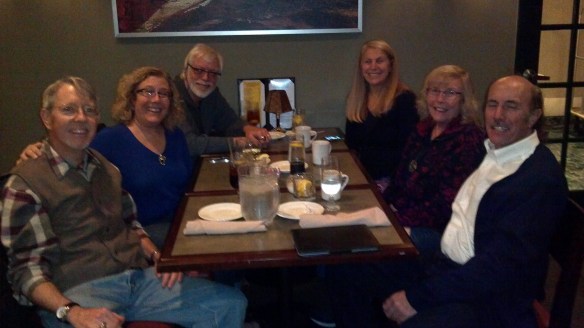
tashas-birthday-party-at-dianasI remember going to church with my mother on Sundays, and how uncomfortable the kneeling benches were. She was a devout Catholic and thought God would punish her if she didn’t go faithfully. As a result we went to my father’s church, an Episcopalian one on special holidays only after we went to early mass at my mother’s church. My fondest memories of her are centered on Christmas eve when she played her violin and we sang carols in front of our tree.
While I do have many memories from my childhood I wish I had more. I can remember my late mother telling me stories about things that happened or that I did that I had no memory of, but that she had cherished herself. Children do not realize that things will change, that what is will not be there forever and must be noted or it will be lost.

The other day Stephen and I were out with my daughter and her fiancé for dinner and a movie. As we sat over pizza afterward, I thought to myself how wonderful this all was, and how much I was enjoying it. I reminded myself to cherish the moment. We never know when something will end, or at least change so that it is no longer available. I did not always feel this way; it is something I have learned from experience.

When my children were little I was a busy mother with five young ones and a husband who traveled on sales calls. When I look back on our lives together I realize my mind was too filled with thoughts of all that I needed to do to be present with them and what they were doing. I know I missed much of what I would cherish now if I could remember it. This is a lesson that can only be learned from experience.

I realize how much I may have missed in my life by not being present. A friend once said to me, “I always take special care to enjoy myself at your home because then when things change I will have no regrets.” We moved away and she went back to South America; we have lost touch. Most likely I will not see her ever again, yet because of what she said she has a presence still in my heart. When I see again someone that came to our home years ago for gatherings or classes and remembers us, and it makes me glad.

Recently I have lost a sister and a sister in law to death as well as a number of friends and acquaintances. At no time did I know when last I was with that person that I would not set eyes on her or him ever again. I am aware more than ever that when I am with someone I know, and especially someone I love that it is vital to be mindfully present, or I will miss out and regret that I did not take advantage of the time I had with him or her. Change is the law of life; nothing stays the same. Every moment is precious, most especially when we are with those we love.


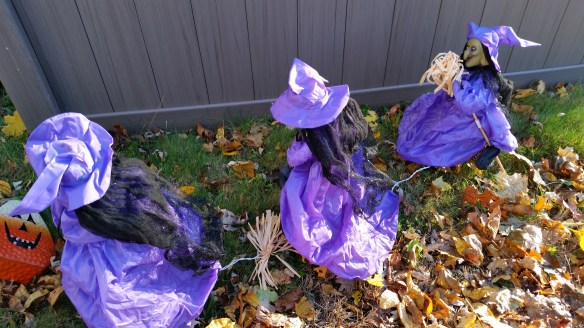
An Appropriate Costume

halloween-three-little-witches


As a young child growing up in the country I was accustomed to seeing death. Baby chicks perished; Ducklings drowned; something attacked my rabbits and the ones that hadn’t died were too wounded to survive and had to be killed. Several of our dogs and cats suffered their demise in front of our house. I understood death as a natural part of life and nothing to be feared. Until I was in college no significant adults of my acquaintance passed on except my Great Grandmother when I was only four.

Halloween wasn’t a big deal when I was small. What I remember was the occasional party, with games, and carving pumpkins. We lived in the country and without a neighborhood to go trick or treating, I wasn’t taken anywhere to accumulate candy. Besides, my mother didn’t approve of eating candy; it was bad for the teeth. Later on, however I enjoyed dressing up my children and taking them around to the neighbors.

Where I live now Halloween costumes will soon proliferate as children roam the sidewalks for trick or treat,. Dressed as ghosts, scarecrows, or pirates or masked as the current political figures the wearers follow a tradition that goes back many centuries. Halloween in the United States is somewhat similar to the Mexican Day of the Dead. It comes from a long tradition of honoring those who have moved on from their bodies to the wider life of the spirit.

It was once believed that on October 31 the spirits of the dead could inflict harm or at least return in some way to communicate with the living because the veil between this world and the next is thin. Then some hoped to consult spirits of the dead, believing they could tell where treasure was buried, or what the future held. Some remnants of fear remain from then, though they are not taken seriously.

My grandmother passed on when I was in college and hers was the first dead body I ever saw. It did not frighten me. She had been prepared for burial and set out in her living room prior to the funeral the next day. That evening as I approached her body I realized it wasn’t my grandmother, that it was just clothes she had worn once and now no longer needed. Death did not then nor does it now seem to me to be something of which to be frightened. Life is more than a physical experience.

Halloween costumes can serve as a reminder that there is little to fear from the transition called death. A change of clothing is appropriate to a change of form. Just as I can’t fit into my baby garments or the clothes I wore for my first day of school, I can expect someday to outgrow this body, and to discard it for clothing suitable for the form I will then inhabit. While the unknown is always a little unnerving to contemplate, whatever happens whether in this life or the next is an adventure to which I look forward.

The Importance of Responsibility

light-through-the-leaves-2          I don’t remember how old I was when feeding and watering our chickens became my responsibility; something tells me I was around eight. I also had to rake their droppings from the shelf beneath the rod they perched on. I didn’t really like this, however if I wanted my allowance, I had to. They provided us with eggs and occasionally meat. I didn’t care for eggs, and I wasn’t very fond of the live chickens, however I did enjoy roast chicken on a Sunday, (purchased, not from our flock) served up with the crimson jelly my mother made from apples, cranberries and quinces from my great grandfather’s trees.
My mother considered me irresponsible. Perhaps her expectations were too high for my abilities. Or maybe she didn’t start me off a little at a time, learning by doing small tasks. When children are growing up it is important to give them responsibilities. Even a small child can do simple tasks. If the child is forgetful or perhaps deliberately tests the parent by ignoring his or her duties, it is the responsibility of the parent to follow up on the discipline with reminders as well as consistent persistence. That’s part of the responsibility of parenting. It also helps with self-discipline later on when the child is grown.

As an adult I find there are times I have to make a decision as to what is and what is not my responsibility. When I see trash on the sidewalk or paper towels on the floor of a restroom, I wonder if it is my responsibility to pick up after someone else. At home do I put away my husband’s clothes as well as mine or leave them for him to put away? Who is responsible for what in a household is often divided along lines of familiarity. Growing up, who mowed the lawn, took out the trash, checked to see if the door was locked at night?

I remember my mother saying at a certain time in the evening, her father would wind the grandfather clock and that would be his signal for her current boyfriend to depart. We didn’t have a grandfather clock to wind, however my father was responsible for the houseplants and flowers in our home. All summer he would carefully arrange fresh flowers in vases, some from his garden, some from my grandmother’s. My mother was responsible for the cooking, for the purchase of food and for what and when we ate. She also carved the roast or chicken we had on Sundays because she thought she did a better job of it.

The word responsibility implies a response to something. If I am aware of a an important duty, like paying my taxes, being sure to vote, stopping at stop signs, or even washing my hands after I sneeze, cough or go to the bathroom, then I respond by acting. I take responsibility for that which is my personal obligation to society or to myself. However there is this gray area where I need to make decisions: do I try to help if my help may not be wanted? Do I act when my action may not be what is needed? Taking responsibility for what I do or do not do requires me to think and think again.

Tasha Halpert

An Unanticipated Adventure

maine-reflections-3-15tasha-and-flowers


Growing up I preferred tales of adventure to almost any other kind of book with the exception of fairy stories. Biographies bored me as did many of the titles on the summer reading list. Give me a book by Robert Louis Stevenson, Jules Verne or Alexander Dumas and I was content to curl up in a comfortable spot and plunge myself into the wondrous world the author created. My own adventures were often something I got scolded or even punished for. Being a girl I was not encouraged to be adventuresome.

Recently, without meaning to, I did create myself an adventure. If I had thought about it, I wouldn’t have put the new scissors I’d found in the storage unit into the suitcase I was taking with me on my return flight. If I had put them into the checked luggage, I wouldn’t have been stopped and had my carryon opened and examined. When the security guard measured the scissors and put them back in the old red nylon suitcase that had belonged to my mother, I breathed a sigh of relief and prepared to gather my belongings. Then he took a bit of white material and ran it around the inside near the zipper.

Suddenly I was asked to take off my shoes and told I would be patted down. A female guard went over my body, informing me each time what she would be doing. Knowing I had nothing to fear, I simply allowed the experience to unfold. My daughter was worried, however we had arrived early so were in no danger of missing our flight. At one level I was laughing inside at the thought that an elderly great grandmother could be considered dangerous. However, I remained calm, knowing that giggling might not be regarded as appropriate.

Finding nothing, they asked me if I took any medication. I said no, but the suitcase had belonged to my mother. Then they mentioned nitroglycerine. I remembered that my mother had told me she took something for her heart. That cleared it all up. I got to put on my shoes and collect my belongings. Feeling relieved, I left the security area behind. Apparently even after many years in storage an old suitcase could carry traces of heart medicine and in these days of terrorist precautions come across as a threat.

My daughter and I had just spent almost two whole days processing the contents of a storage unit that had been unopened for twelve years. It contained the contents of my late mother’s art studio. We separated out a considerable amount of material that will form the basis for a retrospective exhibit to be curated by my youngest daughter, herself an artist. My mother was a professional with much art and many exhibits to her credit. If she had not shunned the limelight she might be a household word. I wondered if from her perch in heaven she looked down at my dilemma and giggled. I think it would have amused her that her adventuresome daughter had though unwittingly, created herself an adventure.

Goodness of the Local Harvest

plums-1My mother grew vegetables and fruit and canned them for use during the winter and spring. I remember her on the hot days in August and September, lifting the glass jars out of their steaming water bath in the large canning pot in our small kitchen. Once cooled, the jars went to line shelves in the basement. During winter and spring she had all kinds of vegetables and fruit to choose from. Eating locally was common in those days because food that grew in faraway places was not available. Canning diminished with the advent of freezer chests. Consuming food in New England that was grown in Mexico, China or other distant countries was unheard of.

It is such a treat to eat locally. There is no comparison between food that is grown near where I live and that which has traveled hundreds, even thousands of miles to reach the market where I shop. Fresher, healthier, and minimally processed, locally grown food is better for me and for those I love. It tastes better too, though I am happy that my year round diet is not restricted to it. I am no purist, and I am grateful for fresh produce available all year round.

I love eating local fruit during the summer. Sadly, the frost in February decimated the local peaches as well as most of the plums. I look forward every year to purchasing them at our local farm stand, eating them whole, and occasionally baking with them. Now, provided they survive any difficult winter weather, I must wait another twelve months until they are available. The ones in the supermarket look good, yet I pass them by. Eating whatever nature has to offer locally at the time is it is offered is important to me. However I cherish the opportunity to be a locavore, as it is called, in season.

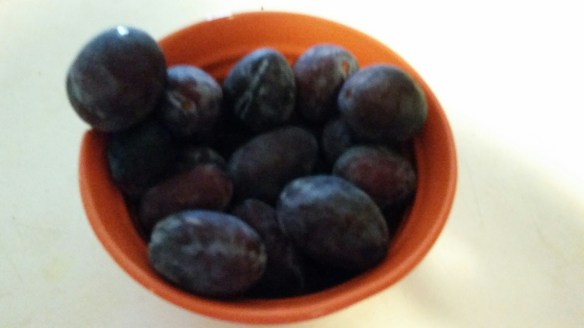
That is why when I spotted the very special small prune plums at the farm stand. I exclaimed aloud in my happiness. The kind proprietor said they were a special lot, rare and most likely all she would get. I bought a couple of pounds on the spot, then later in the week at another visit I bought all that was left of the rest. They tasted wonderful. I was reminded of the use of the word “plum” to describe something rich and/or desirable. These were “plum” good, and I received a “plum” when I discovered them.

All too soon the season of harvest bounty will draw to a close. According to the owner of the farm stand, the yellow squash is almost done. We enjoyed some of the last of it recently this way: I peeled and finely chopped some ginger and half a large onion. I sautéed these gently in light olive oil until onions were fragrant and transparent, added some garlic sliced thin, and then the young, thin skinned squash, sliced very thin cut in three or four inch lengths. This cooks quickly, maybe in ten minutes more. You can mix some thinly sliced zucchini with the yellow squash to good effect. Add basil leaves if available, or thyme. I have given no quantities because this is best made to suit your own taste.

Summer Through the Years

Diana's Pond ReflectionsAs a child I so looked forward to school vacation and the freedom it brought from discipline, homework and schedules. Whenever weather permitted, my time was spent out doors wandering around the rather large property where my parents and I lived. It belonged to my Great Aunt Alice, whose father had built the grand house she lived in now, as well as the cottage originally intended for the gardener. That was where I, and later on my brothers and sister lived. There was a broad, open field to roam in, trees to climb, and a small marsh bounded by a dyke that kept out most of the distant seawater.

Wildflowers grew in abundance, insects buzzed and birds called. There were trees to climb, and I also spent time high in their branches, reading. I called it my tree house and brought pillows to the platform I had wedged into my favorite tree, a big beech. Summer was a time to play. The property held plenty of room for my imagination to conjure up all kinds of adventures like the ones in the stories I read: Tarzan, Robert Louis Stevenson’s tales, and the legends of Greek heroes.

Time passed and I was a young mother. Summer meant days at a nearby beach watching my children play in the sand and splash in the waves. Fortunate to be able to stay home with my children, I hung the laundry in the sun, worked on my tan, and took the them to the local church fairs, the annual carnival, and whatever other amusement the season offered. We had picnics and explored the highways and byways of surrounding towns. Later there were softball and then baseball games they played in to attend. The work of motherhood became a kind of play in summer.

Fast-forward to a different kind of summer life, with a swimming pool to clean and care for and a large garden that took me almost as much time to look after as the children did. Still it was a delight to share the pool as well as the garden with visitors. I didn’t mind the weeding too much, or pruning the shrubs. It was an adventure to tackle the wild rose vine I planted for its delicious scent, without realizing the consequences of its rampant growth. I never knew how many would be sitting down to any meal, because people came and went as I practiced my hospitality. Summer held a different kind of play.

My summers have changed again. With age comes less tolerance for extreme conditions. My bones enjoy my home’s warmth in the cold but not its heat in the muggy weather. I appreciate air conditioning far more than I used to, and I spend much more time indoors than I did in the past. While the long summer hours of light are enjoyable, the effect of the heat on my mind is not. Labor Day signals summer’s closing. Once I welcomed its beginning with open arms, now each year I am more appreciative of summer’s end.