Eggs are Delicious, Nutritious and Versatile

Cooking with heart Though I’ve never had it or made it myself, I remember Goldenrod Eggs–a dish made with hard boiled eggs that my mother served at luncheon parties. The eggs were carefully hard cooked—never boiled as this turns the yolks green. The whites were chopped up and stirred into a white cream sauce. This was spread over toast with the crusts cut off and made into triangles. The yolks were then pressed through a sieve and sprinkled over the top of the creamed whites.

This was a pretty dish yet far too labor intensive for me. Besides, I prefer hard boiled eggs cut up and made into egg salad or stuffed—but not by me. I can’t get the whites out of the shells easily. However in the days when I was little there was more time for cooking because life was simpler and less hectic. In addition, women like my mom had luncheons in their homes because her friends were home with their kids too and did not have to go out to work.

Easter brings thoughts of eggs, coloring them, cooking them, eating them. As a child I disliked eggs intensely. They were always served me in an egg cup with the top off the shell. I didn’t care for the taste much. Still, whether I wanted to or not I had to eat them because I couldn’t leave the table until I did. For some reason our egg spoons were silver which quickly tarnished from the yolks of the eggs, and this somehow made the experience even worse. It was many years before I was able to eat eggs with pleasure.

To prepare dishes with eggs requires careful timing. For garlic fried eggs with parsley—our breakfast favorite, slice garlic into butter, break eggs over it, cut parsley over them, wait until they are just set, then turn off the stove and turn the eggs over to finish cooking lightly. This insures that the whites are firm and the yolks cooked yet a little runny. Separating raw yolks from whites, is now simple since I learned the trick of holding the yolk in my hand as the white slips through my fingers. My Lemon Cloud Pudding is easy to make doing this.

I have fond memories of sharing a simple lunch of warm hard boiled eggs peeled and mashed with a little mayonnaise, some salt and maybe some chopped parsley with my best friend as our little ones played together. How tasty the eggs were with some saltine crackers and a cup of tea. In those days I dyed my eggs with pellets of color from the supermarket. Some years ago I tried dying them with onion skins. They turned lovely purple and red colors.

This is an ancient way to do them: Save up your papery onion skins. Tie them around your eggs with string and simmer the eggs for 20 minutes. Very beautiful and fun. To make a tasty egg salad, mash yolks and whites together, add mayonnaise to taste and some of your favorite mustard. Add ground dried garlic, chopped parsley and curry powder if desired. Serve with crackers, toast, bread or just lettuce and a fork.  This is good for any meal, especially for one of after Easter leftover eggs.

Want an autographed copy of my new book Up To My Neck In Lemons? Send me a check for $15 Postage included, to P.O. Box 171, North Grafton, MA 01536,  and learn about lemons–actual, poetical and metaphorical. Make your life’s lemons into lemonade and enjoy my book a sip or so at a time.

Living My Life in a Timely Manner

Dragonfly

Sometimes I wish I could return to the time of my childhood when there seemed to be so much more of it: The long golden days of summer, the wonderful week of school vacation, the stretch of the weekend as I got home from school on Friday. It seemed to me that there was plenty of time to get everything I wished to do done. My days stretched out to be filled with my imagined adventures, the books I loved to read, and my toys.

I don’t remember feeling pressed for time as a child.  I’m sure the grownups were however that didn’t communicate itself to me. I do remember how long it took me to learn to tie my shoes. I was three, or maybe four and my fingers didn’t work as well as they might have. I can still see my small shoes as I bent over them, fumbling with the laces until I got it right. Time wasn’t something I thought about. It wasn’t my job to do that. As an adult, however, it has become so.

One dear friend has accused me of being “time challenged.” She was politely informing me that I was usually late, or at least perhaps often so. I confess it’s true that before leaving my home I may do a few things that seem necessary to me with the result that I leave at the last minute and may actually get where I’m going a little late. This annoys my husband so I work to improve.

You think after the many years we’ve been married he’d know I am apt to shave things close to the bone when it comes to time. He prefers to get to performances, lectures, appointments or church at least a half hour early. He says it’s because in his teen years he was a reporter and liked to get to events early because it was more interesting then and the habit stuck. He says he also likes to get a good choice of seats, which I admit is a good reason.

However the way I see it, that half hour could have been put to so much better use. It always seems to me that there are many things I could have gotten done at home before leaving, while instead I must sit in a waiting room,  pew or theater seat twiddling my thumbs as people come and go, the choir rehearses or I watch the ads on the movie screen. Being on time requires a certain amount of self-discipline, to be sure, and it is also polite. However arriving at a party or someone’s home half a hour early may be inconvenient to the host or hostess.

Because I find it fascinating as a subject, I’ve written a lot of poetry about time. I find it to be a strange accordion, expanding and contracting according to its own rules. Sometimes I look at the clock and think I have a whole hour to get everything done. Then I look again what seems to me fifteen minutes later, only to discover forty five have passed and I didn’t get half of what I planned finished. Perhaps time does challenge me, still, it’s a learning process and I do enjoy learning.


Want an autographed copy of my new book Up To My Neck In Lemons? Send me a check for $15 Postage included, to P.O. Box 171, North Grafton, MA 01536,  and learn about lemons–actual, poetical and metaphorical. Make your life’s lemons into lemonade and enjoy my book a sip or so at a time.

The Expectations of Christmas Time

           I remember a few of the Christmas gifts I received as a child. My favorite was a large brown teddy bear around two and a half feet tall I called Bruin. He became the head of my teddy bear family of five. Another was a wood burning set from my Great Aunt Alice. I never could figure out how to use it. One of my most memorable was a gift from my Uncle Oliver, also the giver of the bear: a large balloon in the shape of a Zeppelin tied with a big red ribbon.

           For whatever reason, instead of placing it under the tree, he set it on the radiator in the front hall. In the middle of dinner there was a loud bang. We ran into the hall.What remained was an empty red ribbon bow and piece of burst rubber. My expectations were dashed. The teddy bear he gave me on another Christmas later may have been his way of apologizing. I don’t remember having expectations as to what I might receive. Most of my gifts were practical.

           The Holiday time carries a big burden of expectations. People are expected to be nicer, to be kinder to one another, perhaps even more forgiving of errors and mishaps.”It’s Christmas,” people say, and that is supposed to be a reason to behave in ways one might not otherwise. I’m not saying that this is a bad reason; it is good to be thinking kindly at this time of year. However, we don’t need to make it a given or to be critical of those who are not.

           Another set of expectations revolves around the giving of gifts. To whom do we owe a larger gift and to whom a token? Is a card enough or need we send or give an actual physical present? Even the difference between an online card and an actual one might be a consideration. Our expectations of what is appropriate, what we”ought” to do may govern our actions and present a need for decisions about what to do, as well as stress us out.

           Perhaps most of all, however, it is our expectations of ourselves that are the most difficult to deal with. There is much to be done and it all must fit into the time we have, regardless of the fact that life does not come to a halt at Christmas time. In addition to the holiday activities we still need to do the cooking, working, shopping and so on that we do anyway. It’s enough to take the fun out of the celebration. We often feel guilty if we can’t manage to do it all with grace and good humor.

           Yet we and others might better benefit if we take some time for ourselves. If we use a gift bag instead of wrapping paper, send a card instead of an actual gift or even offer to take friends out for a treat at a later date or offer to babysit their children, we downsize the stress. Less stress means more holiday spirit,and diminished expectations mean less guilt. We need to remember that what we really celebrate now is the coming of a child of Light, or the Light itself,into a world that needs it. Expectations aside, we can remember the true meaning of this season is about the gift of joy to all of us, from all of us.

The Eyes of Perception

Corner Reflections medBecause I was very different in my interests as well as my life circumstances from that of many of my classmates I was badly bullied in grade school. However what was worse was that I had no good way to respond to my classmates’ unkind behavior. It wasn’t until I discovered meditation that I acquired a way of controlling not only my reactions and responses but also of avoiding the potential complications of thoughtlessly spontaneous and perhaps provocative words and actions.

As I grew in my ability to see what was in my mind and/or heart before I made things worse for myself, I also discovered ways to make my life much happier and less complicated by negative thoughts and emotions. Some believe that meditation is a form or religion or at least connected with it. However it is actually a form of exercise for the mind. As physical exercise preserves the body, so meditation practice helps to preserve the mind.

Is my glass half full or half empty? Believe it or not, that depends on the nature of the thoughts I have concerning both the glass and what is in it. Am I looking with feelings or thoughts of fear of emptiness? Am I anticipating or being grateful for what is in the (metaphorical) glass? My days go better when I am aware of what is going on within me.

Since nearly fifty years ago when I began practicing meditation, I have become able to be much more aware of my thoughts and feelings. It is a great help to my ability to remain calm and aware during difficult circumstances. I’m still working to remain conscious of my inner processes, and I expect to do so for the rest of my life. Working on the mind is like doing scales on the piano. A good musician must keep on practicing.

When I find myself dreading an activity or event, I can remind myself that fear is False Evidence Appearing Real. My “glass of hope” will then appear to me to be half full rather than half empty. When I feel a sense of joy as well as of gratitude concerning whatever might be approaching, I will have a “glass half full” of optimistic feelings. This approach has the effect of helping me to get the best from whatever does happen, even if that differs from my expectations. The same is true concerning what someone might be saying to me: I can better monitor my responses and reactions.

When I am mindful—aware of what is going on in my mind and heart, I have more control over what I do or say next. If I am able to anticipate my words or my inner reactions to what is happening or to what someone is saying, I am better able to control them. Thus I can to avoid potential mistakes as well as difficulties. In addition, when I am able to take advantage of my perceptions, I may ward off the far larger problems that might otherwise evolve were I not able to see clearly or to be prepared with positive words or actions.


Daylight Savings and Me

Pictures downloaded from my camera 2. 156When I was a child I’d wake up on a weekend morning thinking happily how I had two whole days off from school! I’d think about all the delightful things I would do–depending on the weather, and what fun it was to have two whole days to do it in. Time for children is much different than it is for adults, as any parent can tell you. Trying to get a child to hurry when there is something more interesting to do is quite a task.

Regardless of the fact that humanity invented clocks most likely in order to coordinate movement, time has become a tyrant for many. Isn’t it odd that something we invented has so much power over us? Then to further complicate matters, someone came up with the idea of Daylight Savings. Several someones are actually responsible, beginning with Ben Franklin who thought it up originally, though no one actually implemented the idea until the 20th century.

This readjustment we go through every spring and fall is fast approaching. Stephen rejoices: he feels the hour stolen from him in the spring is being returned. I notice my timing is off, and all of a sudden I have an hour less of daylight to use for anything I might have planned. Plus mealtimes are disjointed for a while. Stephen is resentful that “W” took three more weeks from standard time and tacked it onto daylight savings. He can be quite vocal about it.

What is daylight savings? It’s not as though we can bank any of the minutes or hours we might wish to “save.” When I spend time, I can’t take it out of my wallet and plunk it down on a counter. Time is slippery stuff and my experience with it is that there are occasions when it speeds by and those when it drags, yet it’s all the same objective time. Ever notice that from a subjective standpoint going somewhere seems to take more time than returning home? Yet the amount of miles traveled as well as the minutes or hours spent remains the same.

Unfortunately for Stephen’s feelings, my habit has always been to try to pack as much as I can do into whatever time I have. Much to his annoyance because he prefers to leave and arrive early, I also have a tendency to try to do more than is reasonable in whatever time there is before we leave. Or else I plan too much for what is realistic and then regret what I have to leave undone. To me time is more precious than money. It is possible to save or spend cash to one’s satisfaction, however that cannot be said about time, which despite our illusions to the contrary, we cannot actually control.

Regardless how true this may be, I seem unable to avoid finding one last thing to do before the allotted time is up. Why this is I am not sure. I do believe it is a habit that would be better broken than continued. Meanwhile I will work at this the best way I know how.


My Grandmother’s Zinnias

Born in 1879, My paternal grandmother’s life was as different from mine as possible. Prior to World War Two she had visited Italy almost annually. She loved it there and even sent money to help out the family of her gondolier—the equivalent of a taxi driver for the canals of Venice. When I was born, she asked that instead of being called “Granny,” she be known as “Nonny,” a variation on Nona, the Italian word for grandmother. She was very fond of me, her first and only grandchild until eight years later when the first of my siblings was born.

She wasn’t a cookie baking, knitting “granny” sort. She was a forceful, energetic, woman whose hair remained a light brown with occasional gray roots between visits to the hairdresser, for all of her eighty years. She enjoyed my youthful company and we spent many afternoons playing card games or going to the various church fairs that occurred all during the summer months while I was growing up. She would give me money to buy pony rides and trinkets from the White Elephant table while she checked out what was being offered to the people attending the fairs.

For her, because she ran our local church fair for most of my childhood, these were a kind of business trip. One year she had a circus theme and hired an elephant. It was brought from upstate New York for the day. I remember riding on its back in a howdah. The elephant spent the night in our garage, though I was not allowed to visit it, I remember hearing i trumpeting. She enjoyed life and participated in it to the fullest. I loved it when she shared bits of her life with me. It was a very different one from the one I knew, as different as mine was from today’s grandchildren.

She was a passionate gardener and grew lots of flowers as well as vegetables in a number of gardens presided over by Mr. Patch, an Irishman with a squeaky voice. I remember that he wore overalls and seemed always to have a gardening implement in his hand. There were two narrow flowerbeds beside the gravel walk that led to her front porch. Each and every year they were lined with Zinnias. I can see them even now, so bright and strong, like her. I never heard her complain or bemoan her condition. She was an inspiring example of strength and fortitude as well as generosity.

While some of her attitudes and opinions were old fashioned—she believed that a “lady” ought not to have a job or work for money, she kept up with current affairs and read three newspapers daily. She also did volunteer work and gave generously to charity. As I advance in age I have grown to appreciate her more than ever. She loved life. Born in a time before automobiles, during the twenties through thirties and forties, she drove her Pontiac through every state in the union. She passed on in 1959. I feel fortunate to have had her in my life for as long as I did. She was a fine example of aging in a positive way, and as I too age, I am even more grateful to her.

Benefits and Liabilities of Aging

Sunfloer bowed downWhen I was little my grandmother used to take me with her to visit her friends. Among them were two sisters who had never married but lived together in a pretty home with a nice porch. They used to give me cookies and cambric tea–milk, sugar and a wisp of tea in a delicate china cup. My own mother was physically strong and after my father passed on lived alone and drove herself between Florida and Maine even in her eighties.
These and many elders of my early years presented an image of healthy, hearty behavior. My grandmother used to do fancy dives into the swimming pool of the beach club she occasionally took me to. My great aunt played golf and tennis and had silver cups to show for it. I had teachers with white hair who were wise and good natured. My life has brought me many examples of vital elders who carried on their lives energetically.

Just recently I attended a small reunion for my high school classmates. I was impressed with their fortitude and vigor. As we visited together I enjoyed renewing my acquaintance with theses women with whom in our teens I had shared time, space, and teachers. It was quite special to be with my contemporaries. I found that even after all these years we still had much in common besides our age and the school we had attended.

The life paths we had taken had varied widely, yet we all shared a dedication to improving the world and being of help when needed. Born when we were, we had grown up with different mores and rules of behavior than those of today. As a result we have had to make many adjustments. When people do not grow with the changes that accumulate around them, they become bitter and crabby. It seemed to me that none of us had.

No doubt we all had our share of aches, pains and limitations. At our age some of that is to be expected. However I didn’t hear anyone complain about their health even though one of us used a walker and another had both vision and auditory issues of a serious nature. One of the blessings of age can be the ability to deal creatively with one’s limitations. Patience can come more easily when one has lived a long time.

The benefits of accumulated years are a kind of grace that can make up for the increasing changes that as we age limit activities, not to mention movement. Speaking for myself, I would say that patience tops the list of these benefits—not only patience with others but also patience with myself. In addition, being able to wait out a difficulty, the knowledge that time helps heal as well as facilitate, and the ability to listen to and soothe those who live with greater immediacy and impatience are some of the benefits I cherish as I grow on in years.

The Mystical, Delicious Peach

peaches-3529802_640

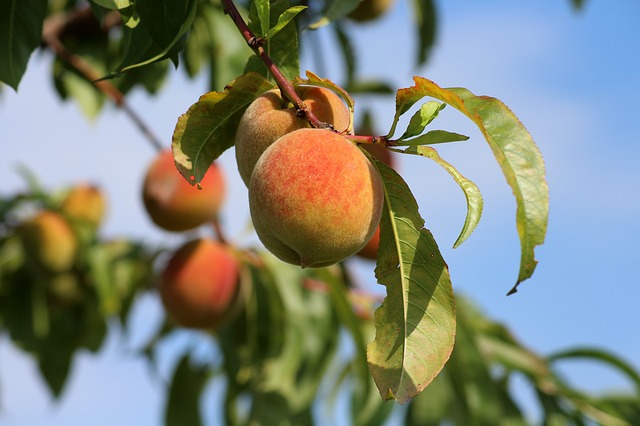
The peach has wonderful mythic associations. It is a Chinese symbol of immortality, and it is often prominently displayed in depictions of the sage Lao Tzu. There is also a legend that a famous Chinese heroine Ho Hsien-Ku who lived in 7th century BC was transformed into a fairy by eating a supernatural peach. They said ever after that she lived on a diet of moonbeams and powdered mother-of-pearl.

According to Paul Beyerl in A Compendium of Herbal Magick, in Shinto legend, Iznagi, a primary male deity, visits the Underworld where he defeats demons pursuing him by throwing peaches from the land of Light and the Land of Darkness at them. Beyerl adds that the peach is considered by the Taoists to be a sacred food.

I have a lovely amethyst carved pendant from China termed a “peach stone.” According to The Magic in Food, by Scott Cunningham carved peach pits are given to Chinese children as amulets against death. Sprays of peach-blossoms are placed over the front door during the Chinese New Year to guard Chinese homes against negativity. Symbolically they bring the blessings of longevity or perhaps confer immortality. He also suggests that as they have been in China for centuries, with appropriate visualization, peaches may be eaten to induce health, happiness and wisdom.

Every Summer I buy my peaches from a nearby farm stand. The owner always has local ones, ripened on the tree in the sun. They taste like heaven to me, and I understand why they might be considered the fruit of immortality. When I feel ambitious, I buy more than I can eat right away, peel and cut them, add a few drops of lemon juice or a sprinkle or two of sugar, and put them in bags in the freezer so we can enjoy them during the winter.

Versatile peaches can be eaten raw or cooked, as a condiment with meat or chicken or as a sauce over muffins or plain cake. Peaches in cobblers or pies, jams, muffins or even peach shortcake are all wonderful ways to enjoy this delicious fruit. Personally I like them best ripe and unadorned with anything more than the sunlight that warms their lovely plumpness.

I can remember my mother putting them up in canning jars. She would pour sugar syrup over them, then lower them into a big kettle of boiling water. Stored in the basement pantry closet, how good those peaches tasted during the long winters of my childhood. They were such a treat, especially when they were served for Sunday dinner over vanilla ice cream

Try this simple peach sorbet. Fill a plastic baggie or pint container with peeled chunked peaches sprinkled with lemon juice or a bit of sugar. Freeze them until solidly frozen. Have ready a simple syrup using two cups of sugar to one cup of water, stirred until melted, cooled and refrigerated. To serve two combine 2 cups frozen peaches with ¼ cup simple syrup, and 1 Tbs lemon juice. Process until you have soft serve ice cream and serve right away.

Being of a Saving Nature

Kathy's Kitchen BasketsYankee thrift originated long before the pilgrims arrived on these shores. Being of a saving nature is a key to survival in tough times no matter when or where they occur. In today’s opulent, throwaway society times thrifty behavior isn’t very fashionable, however, I am happy to practice my version of it. My mother, though not a Yankee, certainly was a great example of that kind of behavior. I try to emulate her, though I do not go to the extremes she did.

For example, the presence of my mother’s linen sheets from her wedding trousseau, still tied with their original pink satin ribbons was an intriguing mystery, first in her cedar trunk and then later when the house got added onto, the hallway linen closet. They had never been used and apparently were not supposed to be. My father used to say jokingly that she was saving them for her next husband. I never got an explanation about them from her.

In the same cedar chest in her bedroom at the foot of her bed she also kept a costume she had worn for some classes in Spanish dance. The exotic, colorful skirt and top, sprinkled with bangles, fascinated me. In one of her dressing table drawers she kept a wonderful collection of small, decorative evening purses she seldom used. I loved looking at them. My father would tease her about the several little cardboard bureaus in which she kept an assortment of things. She seldom if ever threw anything away.

My mother trod a fine line between saving and hoarding. I once was helping her tidy up the contents of a closet in their summer home. As we emptied it I teased her about the number of toasters and irons she had stowed away there. She informed me rather sternly that she had bought them at yard sales and was keeping them in case the one she was using failed to work. Her behavior may have been a result of her World War I childhood in Germany.

If you define hoarding as holding onto useless items for some reason that seems logical to the hoarder, she might be said to be one. When I visited her in Florida, after my dad had passed on she had a plethora of small shampoo and conditioner bottles from her travels with him lining her washbasin, along with empty cardboard toilet paper rolls stacked by the toilet. She never explained why she kept them.

I did inherit some of her saving nature. However my version of it is tied to what will prove useful in the future. I save leftovers and seldom have to throw them away because they combine nicely to make new meals. Small boxes that are good to hold gifts, padded envelopes that can be used again, tissue and wrapping paper, and more jostle one another for room in my hallway. When Christmas comes, or the birthdays of dear ones I don’t need to go to the store for packaging. However, I differ from my mother in one significant way: When my collections impede progress in the hall, I recycle to our local thrift store.

Don’t Shoot the Messenger, Pay attention to the Message

1-8-17-first-bird


I well remember trips as a young child to the A&P. The smells of the small supermarket in our town intrigued me. The fresh food in bins from which my mother would carefully select her vegetables and fruits gleamed with an allure that reflected my curiosity. In addition, the workings of the body have always interested me. As a child I used to mix up the medicines in my parents’ bathroom cabinet and feed them to my teddy bears. Beginning with my childhood I have had a lifelong fascination with food in general, our needs for it, and how we nourish ourselves or don’t, depending on what we eat and how.

So many of the ads I see on TV are for medicine, both prescription and over the counter. It makes me wonder if we are all really that ill or in need of fixing? Perhaps we are, yet I wonder too whether if instead of trying to alleviate symptoms with medicine, we might do better were we to pay more attention to how and why the symptoms have arisen we might do better were we to pay more attention to how and why they have arisen. I am speaking about digestive issues in particular, though others are equally as important.

Of course there are serious illnesses that require intervention and the use of various prescribed medicines. However there are other conditions that will respond well to changes in lifestyle and most especially to changes in dietary habits. I well remember how when I was only in my forties, someone a decade older told me how important it had been for her to reduce food intake as she aged. She told me she got by on two meals a day. Different people will do better with different plans, however reducing intake is key to helping us be healthier.

The symptoms of the acid reflux so many experience are often a result of overeating, eating foods we do not digest well, or eating poor food combinations. As we age, the production of our digestive enzymes diminishes. Many comfort foods we once enjoyed become at best indigestible or at worst dangerous to our health. Yet many of us continue to eat as though we were in our twenties and still growing. While trends in eating come and go, for instance (carbohydrates good, fats bad now reversed), one truth remains: what and how we eat are irrevocably connected to our physical, mental and emotional health and well-being, not to mention our weight.

What can we do? Chewing is vital. Busy with our lives and impatient of meals perceived as mere interruptions in our busy lives, many of us swallow food half chewed, washing it down with liquid. This does not allow for the incorporation of digestive enzymes, not to mention roiling the stomach with acid from feelings of haste. Instead we could slow down and taste the food as we chew. TV ads counsel taking this or that medicine. By so doing we are effectively killing the messenger: the symptoms that tell us we are doing something harmful to ourselves. When we pay attention to the message we can learn how better to treat our bodies and prolong our good health.