An Unanticipated Adventure

maine-reflections-3-15tasha-and-flowers


Growing up I preferred tales of adventure to almost any other kind of book with the exception of fairy stories. Biographies bored me as did many of the titles on the summer reading list. Give me a book by Robert Louis Stevenson, Jules Verne or Alexander Dumas and I was content to curl up in a comfortable spot and plunge myself into the wondrous world the author created. My own adventures were often something I got scolded or even punished for. Being a girl I was not encouraged to be adventuresome.

Recently, without meaning to, I did create myself an adventure. If I had thought about it, I wouldn’t have put the new scissors I’d found in the storage unit into the suitcase I was taking with me on my return flight. If I had put them into the checked luggage, I wouldn’t have been stopped and had my carryon opened and examined. When the security guard measured the scissors and put them back in the old red nylon suitcase that had belonged to my mother, I breathed a sigh of relief and prepared to gather my belongings. Then he took a bit of white material and ran it around the inside near the zipper.

Suddenly I was asked to take off my shoes and told I would be patted down. A female guard went over my body, informing me each time what she would be doing. Knowing I had nothing to fear, I simply allowed the experience to unfold. My daughter was worried, however we had arrived early so were in no danger of missing our flight. At one level I was laughing inside at the thought that an elderly great grandmother could be considered dangerous. However, I remained calm, knowing that giggling might not be regarded as appropriate.

Finding nothing, they asked me if I took any medication. I said no, but the suitcase had belonged to my mother. Then they mentioned nitroglycerine. I remembered that my mother had told me she took something for her heart. That cleared it all up. I got to put on my shoes and collect my belongings. Feeling relieved, I left the security area behind. Apparently even after many years in storage an old suitcase could carry traces of heart medicine and in these days of terrorist precautions come across as a threat.

My daughter and I had just spent almost two whole days processing the contents of a storage unit that had been unopened for twelve years. It contained the contents of my late mother’s art studio. We separated out a considerable amount of material that will form the basis for a retrospective exhibit to be curated by my youngest daughter, herself an artist. My mother was a professional with much art and many exhibits to her credit. If she had not shunned the limelight she might be a household word. I wondered if from her perch in heaven she looked down at my dilemma and giggled. I think it would have amused her that her adventuresome daughter had though unwittingly, created herself an adventure.

Driving Through the Past to the Future

grafron-photo-2          Children have little to no sense of the future, and they don’t have much of a past to remember. They live mainly in the present moment and that is why they might say, “I want it now!” because that is the time they know most about. For adults as they age, the past may tend to trail behind them like a long scarf. For them all too often it may be more vital than the actual present. The future may seem a vague, perhaps even fearful place to contemplate.
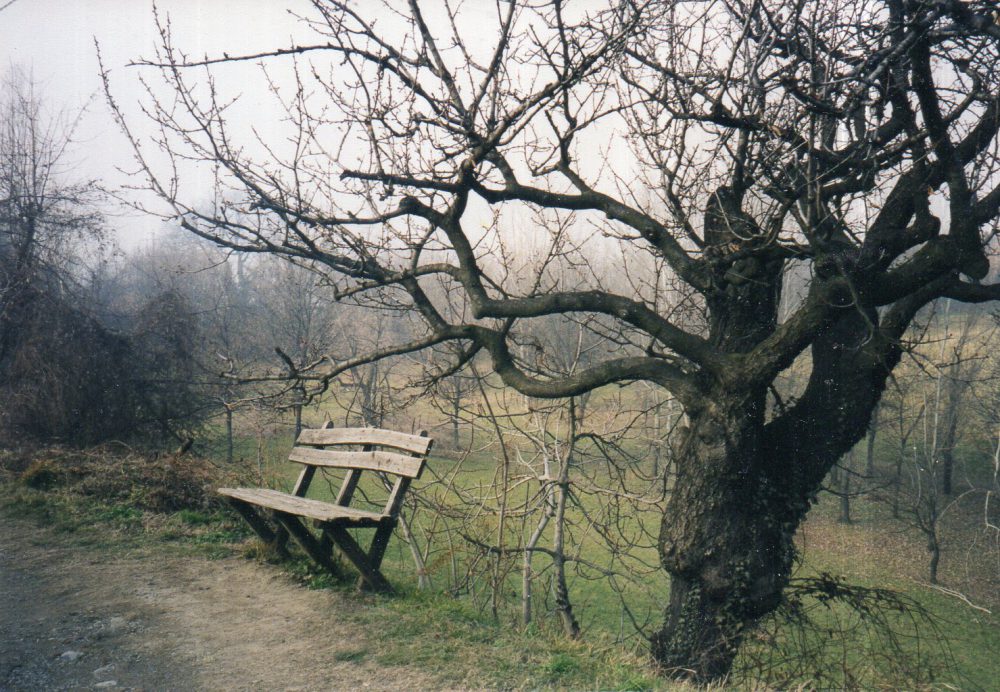
When I think about my childhood I have a collage of images: things I did, places I lived and played, those where I worked at learning. My adult past is far more present because it is more recent, especially the time I have lived here in Grafton. Because I have been in one place for twenty six years, my memories are attached to particular places. Some of these have changed others have not. All of them are in some sense present in my mind.

Recently, as I was driving through town on my way to the library, I looked around, remembering. When we first arrived here twenty six years ago, quite a bit was different. There was a furniture store where we bought our wicker porch set. There was a bookstore where we browsed and purchased a variety of books. There was a drug store with a marble soda fountain, where we found things to buy that we needed.

Some of the places I’ve mentioned have gone through several different transformations since. Yet my mind still holds the memory of what they looked like then. It’s almost as if in some way they still exist because I remember them so vividly. Yet it does not do to dwell to long on the past, or in it. If I become disappointed because the bookstore is no longer there, I cheat myself. I obscure the enjoyment of what is there because I am drenching it in regret.

As I drove through the past of my remembering, I was also driving toward the future. The years that we have spent here in this town have been good ones in our lives. Each place we have lived has held both difficulty and joy, sad memories and happy ones. I have no regrets about leaving any of them behind for where we are now. In my mind I can see, like an overlay, all the different times and places that have been and still are part of my life here.

The past and the future are not divided from one another; rather they are a seamless whole through which I travel at will. What is most important is to keep my eye on the present moment. If I don’t I am liable to lose my way or get into an accident. The present moment, while a product of all that has gone before, has its own uniqueness. It may bring me something I need to do in the future, or possibly something from the past that needs my attention. Either way, the present moment can help me to live mindfully and do the best I can.


Goodness of the Local Harvest

plums-1My mother grew vegetables and fruit and canned them for use during the winter and spring. I remember her on the hot days in August and September, lifting the glass jars out of their steaming water bath in the large canning pot in our small kitchen. Once cooled, the jars went to line shelves in the basement. During winter and spring she had all kinds of vegetables and fruit to choose from. Eating locally was common in those days because food that grew in faraway places was not available. Canning diminished with the advent of freezer chests. Consuming food in New England that was grown in Mexico, China or other distant countries was unheard of.

It is such a treat to eat locally. There is no comparison between food that is grown near where I live and that which has traveled hundreds, even thousands of miles to reach the market where I shop. Fresher, healthier, and minimally processed, locally grown food is better for me and for those I love. It tastes better too, though I am happy that my year round diet is not restricted to it. I am no purist, and I am grateful for fresh produce available all year round.

I love eating local fruit during the summer. Sadly, the frost in February decimated the local peaches as well as most of the plums. I look forward every year to purchasing them at our local farm stand, eating them whole, and occasionally baking with them. Now, provided they survive any difficult winter weather, I must wait another twelve months until they are available. The ones in the supermarket look good, yet I pass them by. Eating whatever nature has to offer locally at the time is it is offered is important to me. However I cherish the opportunity to be a locavore, as it is called, in season.

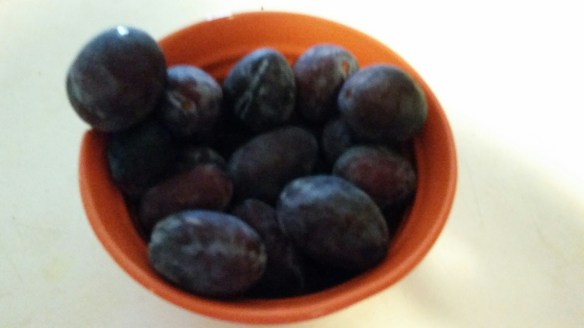
That is why when I spotted the very special small prune plums at the farm stand. I exclaimed aloud in my happiness. The kind proprietor said they were a special lot, rare and most likely all she would get. I bought a couple of pounds on the spot, then later in the week at another visit I bought all that was left of the rest. They tasted wonderful. I was reminded of the use of the word “plum” to describe something rich and/or desirable. These were “plum” good, and I received a “plum” when I discovered them.

All too soon the season of harvest bounty will draw to a close. According to the owner of the farm stand, the yellow squash is almost done. We enjoyed some of the last of it recently this way: I peeled and finely chopped some ginger and half a large onion. I sautéed these gently in light olive oil until onions were fragrant and transparent, added some garlic sliced thin, and then the young, thin skinned squash, sliced very thin cut in three or four inch lengths. This cooks quickly, maybe in ten minutes more. You can mix some thinly sliced zucchini with the yellow squash to good effect. Add basil leaves if available, or thyme. I have given no quantities because this is best made to suit your own taste.

Summer Through the Years

Diana's Pond ReflectionsAs a child I so looked forward to school vacation and the freedom it brought from discipline, homework and schedules. Whenever weather permitted, my time was spent out doors wandering around the rather large property where my parents and I lived. It belonged to my Great Aunt Alice, whose father had built the grand house she lived in now, as well as the cottage originally intended for the gardener. That was where I, and later on my brothers and sister lived. There was a broad, open field to roam in, trees to climb, and a small marsh bounded by a dyke that kept out most of the distant seawater.

Wildflowers grew in abundance, insects buzzed and birds called. There were trees to climb, and I also spent time high in their branches, reading. I called it my tree house and brought pillows to the platform I had wedged into my favorite tree, a big beech. Summer was a time to play. The property held plenty of room for my imagination to conjure up all kinds of adventures like the ones in the stories I read: Tarzan, Robert Louis Stevenson’s tales, and the legends of Greek heroes.

Time passed and I was a young mother. Summer meant days at a nearby beach watching my children play in the sand and splash in the waves. Fortunate to be able to stay home with my children, I hung the laundry in the sun, worked on my tan, and took the them to the local church fairs, the annual carnival, and whatever other amusement the season offered. We had picnics and explored the highways and byways of surrounding towns. Later there were softball and then baseball games they played in to attend. The work of motherhood became a kind of play in summer.

Fast-forward to a different kind of summer life, with a swimming pool to clean and care for and a large garden that took me almost as much time to look after as the children did. Still it was a delight to share the pool as well as the garden with visitors. I didn’t mind the weeding too much, or pruning the shrubs. It was an adventure to tackle the wild rose vine I planted for its delicious scent, without realizing the consequences of its rampant growth. I never knew how many would be sitting down to any meal, because people came and went as I practiced my hospitality. Summer held a different kind of play.

My summers have changed again. With age comes less tolerance for extreme conditions. My bones enjoy my home’s warmth in the cold but not its heat in the muggy weather. I appreciate air conditioning far more than I used to, and I spend much more time indoors than I did in the past. While the long summer hours of light are enjoyable, the effect of the heat on my mind is not. Labor Day signals summer’s closing. Once I welcomed its beginning with open arms, now each year I am more appreciative of summer’s end.

Acceptance of What Is Can Be Learned

Cabbage with holes           I began at an early age to learn my role as a would be peacemaker. My parents were both very special and wonderful people, yet they had a lot of differences and often had trouble bridging them. As the eldest and only child by a number of years I had a good deal of practice as a kind of go between for them when there were difficulties to be dealt with. In addition I often found myself with my hands over my ears while my parents attempted to resolve their differences at the top of their lungs. Loving both of them dearly, I was often at a loss as to how to make things better. Most of all I had to deal with my desire for things to be different, and my inability to make this happen.

Fast forward to the present. I recently found myself in the midst of a situation that was very uncomfortable, yet that I could nothing to change. Like all the other times in my life going back to when I was a small child and this was the case, it felt very similar. So in addition I had to deal with these echoes from the past as well as the experience of the present. My nature as a peacemaker, has always made it difficult for me to deal with conflict. This time, as I often do, instead of facing the situation that I was confronted with squarely, I kept wishing things were different.

To be sure that is a natural reaction. Few among us are willing to face a difficult situation without feeling regret as well as the desire to change it in some way to make things easier on everyone. Yet sometimes even with the best of intentions from all concerned, whatever is going on will continue. If I could have accepted this, I would have been better able to come to terms with what was happening. As it was, I had to work hard just to stay calm and keep from trying to help. I have been reflecting on this ever since.

The best that anyone can gain from dealing with a situation where one can do nothing is to allow for a greater sense of compassion to emerge in the heart. A wise woman once quoted me this ancient Hebrew saying: “If there were no grief to hollow out our hearts, where would there be room for joy?” As I have grown older and experienced more grief as well as regret, which is a precursor to grief, I have recognized that there is a treasure to be gained from it. Yet the treasure must be dug out from beneath the stubborn, unyielding crust of denial.

The denial can only be dealt with by my conscious acceptance of my inability to make anything different. As I accept what is and interweave it with threads of compassion, I can come to terms with my own sense of powerlessness, as well as with the pride that weeps over that, and the need to simply let go. The road cannot always be smooth. If there is no grit under the wheals, they will slip and slide without progress. The sandpaper that smooths the rough wood brings out the beauty of the grain. As I allow it to my heart can surely learn to grow.

A Saving Nature

Woodenspoon1

As far as I remember my dad wasn’t one to save things, quite the contrary. He was much more inclined to throw things out. On the other hand, I have a tendency to save anything I think might be useful or could be helpful in time of need—like extra food. I believe I inherited my saving nature from my mother. Once when I visited her in their weekend cottage in Maine I helped her clear out a closet. In the process I found at least three irons, and several toasters she had bought at yard sales and stored against future need. I kidded her about it and she told me quite seriously that they might come in handy one day, and she was happy to have them.

Another time, when I visited her in South Carolina where she lived after my father passed on, I was rummaging in her kitchen when I saw she had a number of broken items in her kitchen drawers. I asked her about them and she assured me that they could be fixed one day and used again. There was something even more useful in her bathroom. My parents loved to travel and wherever they went, my mother collected the little bottles of shampoo, conditioner, lotion and whatever else that were provided by the places they stayed. They were all lined up in rows on her bathroom sink, filling the entire flat part around the basin.

Perhaps for her they were souvenirs of her trips with my father because she never did use them. She also had rows of empty toilet paper cardboard tubes stacked next to the toilet. I didn’t ask her why because I am sure she would have had a good reason for why she kept them. A while ago I noticed I had quite a collection of little bottles saved from trips myself, and I decided that rather than purchase shampoo and conditioner I would use them. I didn’t want to be like my mother, hoarding something in case of need and then never getting to make use of it. I have come to realize that as we get older we must be careful not to take on our parents’ habits.

There is nothing wrong in being of a saving nature; however, to save something indefinitely is counter productive. When we were moving to our current apartment I discovered I had quite a lot of canned and boxed food that was out of date on the shelves of my former pantry. Now I realize I need to go through things more often to make sure I use what I have in a timely manner.

My father used to kid my mother because she had kept some linen sheets exactly as she had received them as a wedding present. He would ask her if she was saving them for her next husband. I have been thinking more about my mother’s habit lately and resolving to make use of what I have. After all, what she might not have realized was that once something is gone it may often be replaced by what is even better.

Tasha Halpert