Taking Account of the Gifts of the Moment

fall-leavew-and-light

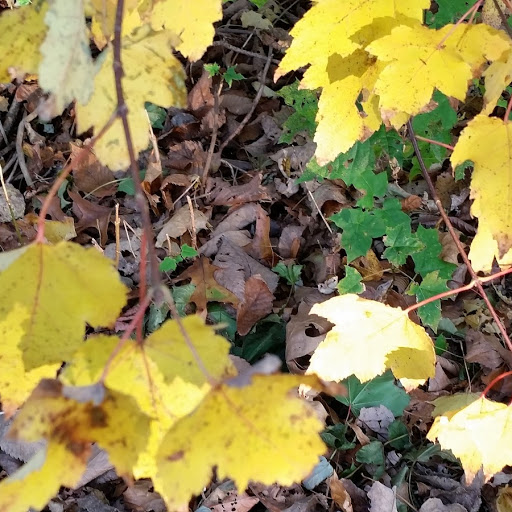
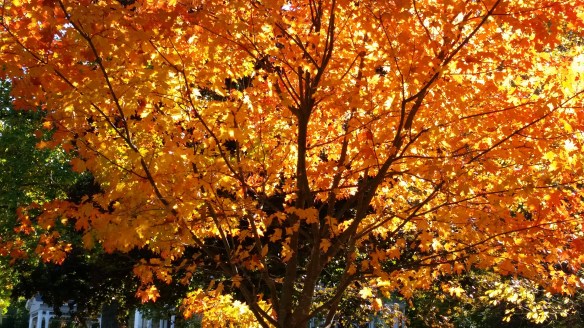
          The maple tree outside my window has been late in turning. I worried the leaves might fall off before they changed color. Then one morning as I pulled the curtain aside I saw they had indeed made their transition to gold. Later in the day the sun shone through them and the brilliance of the leaves was a sight to behold. I stood gazing at them, grateful for the beauty of that moment and of the very special loveliness that is fall in New England.

I feel fortunate to have grown up in this beautiful part of the country. Fall has always been special to me. I remember as a child collecting bright leaves and ironing them between pieces of waxed paper to preserve their colors. I did the same with my children when they were small, and we would hang the leaves up in a window to let the light shine through them. When I went thorough my mother’s correspondence amongst the letters was one from me with some colorful leaves. Being in Florida she said she missed them, so I sent her some.

Lately driving on the country roads near where we live I find it difficult to keep my eyes on the road. The scenery is breathtaking. The foliage of the trees makes billowing waves of color; the rounded mounds of the distant leaves heaped one upon the other simply take my breath away. How easy it might be to get lost in my inner dialogue and miss this.

My mind, like most has a way of getting busy with thoughts concerning what is or is not to be done, or has or hasn’t been finished. Lately I’ve improved. I used to find myself making lists in my head and missing out on a lot of what I might have appreciated had my eyes had been focused outward rather than inward. Once I got into the habit of noticing what my mind was doing it became easier to tame its tendency to run away with my attention and keep me from seeing what was happening around me.

When I take the time to look there is always something interesting to see. Naturally when I am driving I must keep some of my attention focused on what I am doing. Providentially, while looking to the road itself I see what is in front of me. Too, when I am with someone if I pay attention to what he or she is saying or how they are feeling instead of thinking about what I am going to say next, it is much easier to be fully present and aware of my companion.

I’m coming up on a birthday this month, and what I realize about getting older is that it gets easier each year to be patient, to be aware, and to be present insofar as I am able. For this I am thankful. I may never know what I have missed in the past when my mind wandered off and took my attention with it, yet I can make it a practice to keep myself in the here and now. That way I can appreciate whatever there is to be enjoyed in any given moment.

Take care for each breath and love each heartbeat, Tasha


Cherish Every Moment with Loved Ones

tashas-birthday-party-at-dianasI remember going to church with my mother on Sundays, and how uncomfortable the kneeling benches were. She was a devout Catholic and thought God would punish her if she didn’t go faithfully. As a result we went to my father’s church, an Episcopalian one on special holidays only after we went to early mass at my mother’s church. My fondest memories of her are centered on Christmas eve when she played her violin and we sang carols in front of our tree.
While I do have many memories from my childhood I wish I had more. I can remember my late mother telling me stories about things that happened or that I did that I had no memory of, but that she had cherished herself. Children do not realize that things will change, that what is will not be there forever and must be noted or it will be lost.

The other day Stephen and I were out with my daughter and her fiancé for dinner and a movie. As we sat over pizza afterward, I thought to myself how wonderful this all was, and how much I was enjoying it. I reminded myself to cherish the moment. We never know when something will end, or at least change so that it is no longer available. I did not always feel this way; it is something I have learned from experience.

When my children were little I was a busy mother with five young ones and a husband who traveled on sales calls. When I look back on our lives together I realize my mind was too filled with thoughts of all that I needed to do to be present with them and what they were doing. I know I missed much of what I would cherish now if I could remember it. This is a lesson that can only be learned from experience.

I realize how much I may have missed in my life by not being present. A friend once said to me, “I always take special care to enjoy myself at your home because then when things change I will have no regrets.” We moved away and she went back to South America; we have lost touch. Most likely I will not see her ever again, yet because of what she said she has a presence still in my heart. When I see again someone that came to our home years ago for gatherings or classes and remembers us, and it makes me glad.

Recently I have lost a sister and a sister in law to death as well as a number of friends and acquaintances. At no time did I know when last I was with that person that I would not set eyes on her or him ever again. I am aware more than ever that when I am with someone I know, and especially someone I love that it is vital to be mindfully present, or I will miss out and regret that I did not take advantage of the time I had with him or her. Change is the law of life; nothing stays the same. Every moment is precious, most especially when we are with those we love.


An Appropriate Costume

halloween-three-little-witches


As a young child growing up in the country I was accustomed to seeing death. Baby chicks perished; Ducklings drowned; something attacked my rabbits and the ones that hadn’t died were too wounded to survive and had to be killed. Several of our dogs and cats suffered their demise in front of our house. I understood death as a natural part of life and nothing to be feared. Until I was in college no significant adults of my acquaintance passed on except my Great Grandmother when I was only four.

Halloween wasn’t a big deal when I was small. What I remember was the occasional party, with games, and carving pumpkins. We lived in the country and without a neighborhood to go trick or treating, I wasn’t taken anywhere to accumulate candy. Besides, my mother didn’t approve of eating candy; it was bad for the teeth. Later on, however I enjoyed dressing up my children and taking them around to the neighbors.

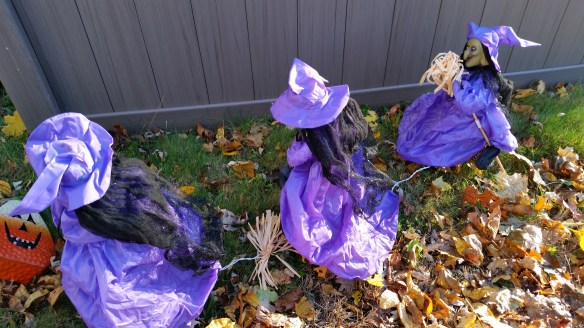
Where I live now Halloween costumes will soon proliferate as children roam the sidewalks for trick or treat,. Dressed as ghosts, scarecrows, or pirates or masked as the current political figures the wearers follow a tradition that goes back many centuries. Halloween in the United States is somewhat similar to the Mexican Day of the Dead. It comes from a long tradition of honoring those who have moved on from their bodies to the wider life of the spirit.

It was once believed that on October 31 the spirits of the dead could inflict harm or at least return in some way to communicate with the living because the veil between this world and the next is thin. Then some hoped to consult spirits of the dead, believing they could tell where treasure was buried, or what the future held. Some remnants of fear remain from then, though they are not taken seriously.

My grandmother passed on when I was in college and hers was the first dead body I ever saw. It did not frighten me. She had been prepared for burial and set out in her living room prior to the funeral the next day. That evening as I approached her body I realized it wasn’t my grandmother, that it was just clothes she had worn once and now no longer needed. Death did not then nor does it now seem to me to be something of which to be frightened. Life is more than a physical experience.

Halloween costumes can serve as a reminder that there is little to fear from the transition called death. A change of clothing is appropriate to a change of form. Just as I can’t fit into my baby garments or the clothes I wore for my first day of school, I can expect someday to outgrow this body, and to discard it for clothing suitable for the form I will then inhabit. While the unknown is always a little unnerving to contemplate, whatever happens whether in this life or the next is an adventure to which I look forward.

The Importance of Responsibility

light-through-the-leaves-2          I don’t remember how old I was when feeding and watering our chickens became my responsibility; something tells me I was around eight. I also had to rake their droppings from the shelf beneath the rod they perched on. I didn’t really like this, however if I wanted my allowance, I had to. They provided us with eggs and occasionally meat. I didn’t care for eggs, and I wasn’t very fond of the live chickens, however I did enjoy roast chicken on a Sunday, (purchased, not from our flock) served up with the crimson jelly my mother made from apples, cranberries and quinces from my great grandfather’s trees.

My mother considered me irresponsible. Perhaps her expectations were too high for my abilities. Or maybe she didn’t start me off a little at a time, learning by doing small tasks. When children are growing up it is important to give them responsibilities. Even a small child can do simple tasks. If the child is forgetful or perhaps deliberately tests the parent by ignoring his or her duties, it is the responsibility of the parent to follow up on the discipline with reminders as well as consistent persistence. That’s part of the responsibility of parenting. It also helps with self-discipline later on when the child is grown.

As an adult I find there are times I have to make a decision as to what is and what is not my responsibility. When I see trash on the sidewalk or paper towels on the floor of a restroom, I wonder if it is my responsibility to pick up after someone else. At home do I put away my husband’s clothes as well as mine or leave them for him to put away? Who is responsible for what in a household is often divided along lines of familiarity. Growing up, who mowed the lawn, took out the trash, checked to see if the door was locked at night?

I remember my mother saying at a certain time in the evening, her father would wind the grandfather clock and that would be his signal for her current boyfriend to depart. We didn’t have a grandfather clock to wind, however my father was responsible for the houseplants and flowers in our home. All summer he would carefully arrange fresh flowers in vases, some from his garden, some from my grandmother’s. My mother was responsible for the cooking, for the purchase of food and for what and when we ate. She also carved the roast or chicken we had on Sundays because she thought she did a better job of it.

The word responsibility implies a response to something. If I am aware of a an important duty, like paying my taxes, being sure to vote, stopping at stop signs, or even washing my hands after I sneeze, cough or go to the bathroom, then I respond by acting. I take responsibility for that which is my personal obligation to society or to myself. However there is this gray area where I need to make decisions: do I try to help if my help may not be wanted? Do I act when my action may not be what is needed? Taking responsibility for what I do or do not do requires me to think and think again.

Tasha Halpert

Where Does the Time Go

dali-clocks

Five minutes or more of waiting can seem to stretch forever, yet when I am engaged in something pleasurable, the moments vanish quickly into wherever time goes. When I look back over the years, they telescope, yet I remember three months in El Paso that while I was living through them, seemed like three years. It is quite beyond my comprehension, and perhaps that is appropriate because after all time is something human beings invented.

Did they do this because life as they were living it needed dividing up in order to be made orderly? Or was it because people needed to make appointments? Or even because there needed to be some sort of way to know the when of things? There are books that will tell you when calendars were invented, and who invented them, and others that detail the kind of clocks that first measured it. I haven’t read any that have told me why.

Sometimes to me time resembles a big clump of jelly like stuff. I try to hold onto it but instead it squeezes through my fingers and disappears. Finding time, using time, saving time…all these are illusions generated by my wanting to accomplish what I want to do when I want to do it. Perhaps I need to think of time differently. If I focused on what needs doing rather than trying to find the time to do it would I manage better?

To be sure, I keep lists of the tasks I hope to accomplish right now or in the near future: phone calls to be made, deadlines for submissions, household tasks to be done. Then there are other items on my lists that do not have a time consideration: letters to be written, information to be googled, piles to sort through. It is these that seem to revolve endlessly, making their way from list to list until I “find the time” to do them and finally cross them off.

Sometimes they fall off the list, never to be seen again. Because none of this type of task is actually necessary it seems more difficult to get done. It is also possible that they don’t matter, or else that I have given them more importance than they originally deserved. It isn’t always easy to know what is important and what is merely something it would be nice to do if there were time to do it. And there’s that word again: time.

Have you ever noticed that it can take the same amount of actual clock time to come home as it does to go somewhere, yet it seems to take much longer to go than it does to come home? This is just one more mystery I experience involving the passage of time. However, to be honest I usually find that I always have enough time when I focus on the doing part rather than the amount of time to do it. Perhaps that is because there really is no such thing as time at all.

Tasha Halpert


Summer Through the Years

Diana's Pond ReflectionsAs a child I so looked forward to school vacation and the freedom it brought from discipline, homework and schedules. Whenever weather permitted, my time was spent out doors wandering around the rather large property where my parents and I lived. It belonged to my Great Aunt Alice, whose father had built the grand house she lived in now, as well as the cottage originally intended for the gardener. That was where I, and later on my brothers and sister lived. There was a broad, open field to roam in, trees to climb, and a small marsh bounded by a dyke that kept out most of the distant seawater.

Wildflowers grew in abundance, insects buzzed and birds called. There were trees to climb, and I also spent time high in their branches, reading. I called it my tree house and brought pillows to the platform I had wedged into my favorite tree, a big beech. Summer was a time to play. The property held plenty of room for my imagination to conjure up all kinds of adventures like the ones in the stories I read: Tarzan, Robert Louis Stevenson’s tales, and the legends of Greek heroes.

Time passed and I was a young mother. Summer meant days at a nearby beach watching my children play in the sand and splash in the waves. Fortunate to be able to stay home with my children, I hung the laundry in the sun, worked on my tan, and took the them to the local church fairs, the annual carnival, and whatever other amusement the season offered. We had picnics and explored the highways and byways of surrounding towns. Later there were softball and then baseball games they played in to attend. The work of motherhood became a kind of play in summer.

Fast-forward to a different kind of summer life, with a swimming pool to clean and care for and a large garden that took me almost as much time to look after as the children did. Still it was a delight to share the pool as well as the garden with visitors. I didn’t mind the weeding too much, or pruning the shrubs. It was an adventure to tackle the wild rose vine I planted for its delicious scent, without realizing the consequences of its rampant growth. I never knew how many would be sitting down to any meal, because people came and went as I practiced my hospitality. Summer held a different kind of play.

My summers have changed again. With age comes less tolerance for extreme conditions. My bones enjoy my home’s warmth in the cold but not its heat in the muggy weather. I appreciate air conditioning far more than I used to, and I spend much more time indoors than I did in the past. While the long summer hours of light are enjoyable, the effect of the heat on my mind is not. Labor Day signals summer’s closing. Once I welcomed its beginning with open arms, now each year I am more appreciative of summer’s end.

Acceptance of What Is Can Be Learned

Cabbage with holes           I began at an early age to learn my role as a would be peacemaker. My parents were both very special and wonderful people, yet they had a lot of differences and often had trouble bridging them. As the eldest and only child by a number of years I had a good deal of practice as a kind of go between for them when there were difficulties to be dealt with. In addition I often found myself with my hands over my ears while my parents attempted to resolve their differences at the top of their lungs. Loving both of them dearly, I was often at a loss as to how to make things better. Most of all I had to deal with my desire for things to be different, and my inability to make this happen.

Fast forward to the present. I recently found myself in the midst of a situation that was very uncomfortable, yet that I could nothing to change. Like all the other times in my life going back to when I was a small child and this was the case, it felt very similar. So in addition I had to deal with these echoes from the past as well as the experience of the present. My nature as a peacemaker, has always made it difficult for me to deal with conflict. This time, as I often do, instead of facing the situation that I was confronted with squarely, I kept wishing things were different.

To be sure that is a natural reaction. Few among us are willing to face a difficult situation without feeling regret as well as the desire to change it in some way to make things easier on everyone. Yet sometimes even with the best of intentions from all concerned, whatever is going on will continue. If I could have accepted this, I would have been better able to come to terms with what was happening. As it was, I had to work hard just to stay calm and keep from trying to help. I have been reflecting on this ever since.

The best that anyone can gain from dealing with a situation where one can do nothing is to allow for a greater sense of compassion to emerge in the heart. A wise woman once quoted me this ancient Hebrew saying: “If there were no grief to hollow out our hearts, where would there be room for joy?” As I have grown older and experienced more grief as well as regret, which is a precursor to grief, I have recognized that there is a treasure to be gained from it. Yet the treasure must be dug out from beneath the stubborn, unyielding crust of denial.

The denial can only be dealt with by my conscious acceptance of my inability to make anything different. As I accept what is and interweave it with threads of compassion, I can come to terms with my own sense of powerlessness, as well as with the pride that weeps over that, and the need to simply let go. The road cannot always be smooth. If there is no grit under the wheals, they will slip and slide without progress. The sandpaper that smooths the rough wood brings out the beauty of the grain. As I allow it to my heart can surely learn to grow.

Assumptions are Deceiving

Bell at Wilbraham best I was fortunate to be able to go to a small private school located in an old mansion with lovely grounds. I had gone to the kindergarten in a small, separate building built especially for that purpose. Now I was excited to be in first grade, going to the real school with the big kids. Because the school was in a nearby town, and my dad needed our only automobile, my parents paid for me to ride with others in an old station wagon driven by the school custodian, Mr. Clews.
There was plenty of room on the grounds of the school for swings, seesaws, and a large wooden slide that was packed with snow for sledding in the winter. As well there were places to play hide and seek. All this surrounded a large white building at least three stories high with four columns in the front.

There were long granite steps going up to an impressive front door that opened onto a grand hall with a double staircase curving down on either side of the central fireplace. The principal’s office was in a small room on the right of the door. The secretary’s office with the small school library was on the left.

While at five I was a bit young for my class, I was excited and happy to be learning to read and write. In my small school the first grade was made up of perhaps ten or twelve boys and girls. I can still see the classroom: the desks, in rows of three across and four down were made all in one piece. They were green metal with light brown, slightly curved plywood seats.

High on the walls were long black cardboard strips of the alphabet and the numbers one to nine. There was a green blackboard, and there were two large windows on one side of the room. We learned to read from small boring books about children called Dick and Jane and their dog Spot. We were also given arithmetic workbooks. When I looked at mine I noticed that a mistake had been made and with all of my five-year-old diligence I set out to correct it.

As I looked at the workbook and judged from what I had learned so far, I saw that on pages later in it, something had been left out: the long part of all the plus signs. I took it upon my self to correct these incorrect plus signs, carefully crossing them one by one with my pencil. Unbeknownst to me they were not supposed to be plus signs. I had not yet learned about subtraction, only addition. To my dismay when we got to those pages I had a lot of erasing to do.

This may have been my first introduction to what can happen when I act on an assumption rather than from actual knowledge or understanding. It certainly wasn’t my last. All my life I have had to deal with my tendency to leap to conclusions without looking carefully where I might land. However, as I got to know myself better, watching for this tendency has been helpful in training my mind to pay attention. The problem with assumptions is that once one discovers one has messed up one must invariably clean up the mess.

Tasha Halpert

The Fruits of Summer

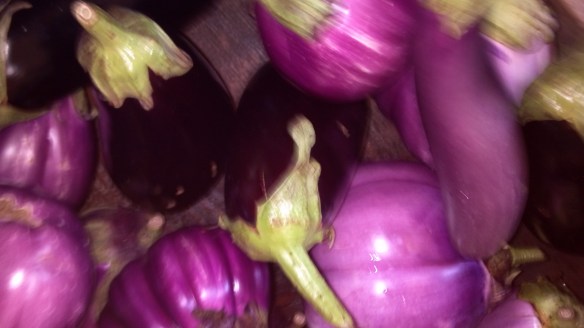
Belfast veggies 12My parents both gardened, but differently. My mother had a vegetable garden; my father grew flowers. She spent her summers growing, harvesting, and putting up what the garden produced. He filled the house with fresh flowers in vases. His roses were lovely. He worked as an arborist and summer was a busy time for him as he helped others plan and tend their property. I always had a little garden of my own. I too grew flowers.

Later as a young wife I grew vegetables, though except for beans, not easily from seed. My children helped some but I did most of the work myself. My tomatoes were successful and appreciated. When I moved to Grafton I enjoyed growing herbs and flowers in my spiral garden, where I learned the virtue of perennials interspersed with annuals here and there. These days I no longer garden, instead I enjoy the fruits others’ efforts.

The farm markets in the surrounding countryside burst with local produce of all kinds. Vegetables and berries gathered daily line shelves and counters, and the freshly picked corn is piled high for the taking. Summer is the perfect time to indulge in this freshness. Between now and harvest time, the hot sun nourishes both roots and leaves. Its warm rays ripen the eventual harvest that people once stored for winter. These days we simply enjoy what grows.

Yet summer is also a time for people to take time off and appreciate the opportunity to spend it relaxing. Whether on the beach or in a park, the hot weeks are a time to be in nature, to let the sun bathe our senses and ripen our opportunities to kick back and nourish ourselves in nature and with play. The long daylight hours encourage extra outdoor activity. The relaxed pace allows time to catch up on reading and as well as see friends and family.

Rest is an important part of good health for everyone. Vacations are intended to provide more than just a change of pace. Whether they are taken at home in the form or staycations, or as trips to planned destinations, days off are a real necessity for everyone’s health and well being. One of the fruits of summer that does not grow on a tree or in a garden is time to let go, to set down the list of tasks and let things slide a bit.

Once a busy gardener with summer weeding chores, I find myself now doing more reading, as well as spending more time enjoying and appreciating others gardens. However, aside from weeding and watering, once the hot days of summer begin a well planned garden does not require much of the gardener. The harvest will come later when trees heavy with fruit and bushes with berries demand attention. For now it is time to enjoy a bit of lazy time, to lean on the fence or sit in my easy chair and let the garden grow.

Tasha Halpert


A New World to Hear

Image

DSCF0168

I remember my great grandmother’s ear trumpet. It was a long instrument, flared at one end. She held the small end to her ear. I also remember a black box the size and shape of a thick brick that had a cord running from sitting on a table that must have been an early hearing instrument. My grandmother wore a case the sizes of a slim cigarette pack clipped to the front of her dress with a cord connected between it and a button in her ear. There was a dial on the box she could turn on and off.

My dad used to say she turned it off when she didn’t want to hear what was being said. I remember as a child thinking how handy that must be. Aids to hearing have come a very long way since then. As people age, much like the normal need for eyeglasses to address a lessening of vision, so too there is a need for aids to hearing. Unfortunately these are extremely expensive compared to eyeglasses. Hopefully one day this will change.

Because of the deafness that seemed to run in my family, I was not surprised when my own hearing began to diminish. I found I needed to have the TV on louder. It was helpful to watch movies on DVD with subtitles, especially when the actors had British accents. If Stephen spoke to me and I was in the other room I had to get closer to him to hear what he was telling me.

Ambient noise interfered with my understanding of words; parties were less fun. My children noticed and suggested I get hearing aids. Still, I wasn’t sure I really needed them, or so I thought. Then as luck would have it I was gifted with a set. My daughter offered me her late mother-in-law’s hearing aids. I am very glad I said yes. It has been an adventure for me to use them. I find myself marveling at sounds I have not really heard before, or not for a long time.

I remember my mother telling me that when my grandmother put on her new hearing aid and went outdoors she said, “What’s all that noise?” It was the birds chirping. She had not heard birds for many years. My ears have not been that bad. I have been able to hear more or less, just not clearly. I notice the difference with the aids: without them, it’s like I have water in my ears. With them when I turn on the sink faucet, I hear splashes and ripples. When I unwrap paper it crackles. The stove timer sounds shrill. I hear sounds I didn’t before.

In the past when I thought about getting hearing aids I felt somewhat uncomfortable. I expected them to be clumsy, perhaps difficult to manage. None of this has proved true. Today’s aids are quite different from those of my grandmother’s or even of recent times. They are virtually invisible. I am very grateful to my daughter for her thoughtfulness, and I look forward to learning more about the new world I am hearing. As I have come to appreciate the clarity I get from wearing eyeglasses, now I enjoy the adventure of listening to a new and different world.