The Gift of Christmas

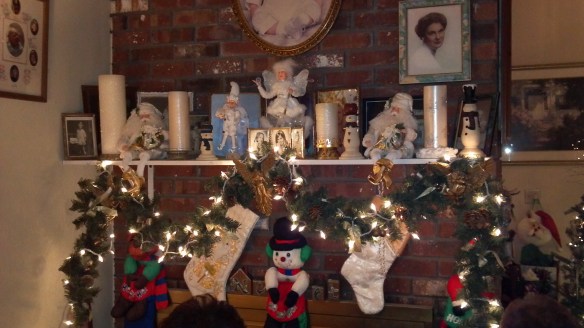
Deb's mantleWhile generally speaking Thanksgiving is about being thankful, for many people Christmas is about gift giving. There are multiple tales about the giving of gifts on this day or shortly before or after. Christmas legends are fun to read. One of my favorites is about La Befana, an old lady from Italy. It is she who leaves the gifts for children on or around Christmas. The story goes she missed out on the actual birth of the holy child and so leaves all children gifts hoping not to miss out.

Lately my mail has been flooded with appeals. Every charity I give to throughout the year and quite a few I never do has sent me an urgent letter stating its need. Some hope to sweeten the pot by saying a donor has offered to match every donation if it comes in before a certain date. Giving at Christmas is built into our society; however, it is also a tradition that is so old it is part of the body of thinking that in psychological terms is called the collective unconscious.

Many people at this season disregard that way of thinking and deplore the emphasis on gift giving, calling it materialistic, or a symbol of our greedy society. They may be right in their way; however, I wonder if they have considered the inspiration to give that is inherent in Christmas. The focus in many ads is all about buying for others, for those on your Christmas list, and so forth. No one has much to say about buying gifts for yourself.

Actually, it is a good idea to buy yourself a Christmas/Holiday gift—at least one. I am a firm believer in giving to oneself as well as to others. That way you don’t feel deprived if you don’t get much back. To be sure, giving with unconditional love—likely the best way to give, means giving without expectations. Yet this is much easier when you give to yourself, perhaps purchased something you really wanted, or bought a highly personal item that no one is apt to give to you.

I believe the true gift of Christmas is the inspiration to give that it inspires. Depending on their belief system, many will tell you what the basis is for this tradition. For them this may be very important, yet from St. Nicholas to Santa, from the Three Kings to La Befana, whatever the inspiration may be, the gifts in the stockings and under the tree spell Christmas/Solstice/Chanukah /Kwanza, and perhaps other days, for us all.

Mementos of Friends Are Special

3musketeersI took the red and white baking dish out of the drawer under the oven and set it on the counter. An image of the person who had given it to me rose in my mind, and I sighed. We had been friends for many years. Now however she had joined the angels that she so often spoke of. Her faith was strong and she shared it on occasion though not intrusively. A colorful character, she was always fun to see and over the years she had given me other gifts I cherished.

As I reached to put on my earrings, I opened a small trinket box and fished around for a tiny plastic “ear nut.” I keep a lot of them in it, ready to make sure I don’t lose a precious earring. The pretty little box with a woman on the lid was another gift from a special friend and I think of her always when I open it to get one. There is a pair of cute stretchy pants in my drawer, a present from a friend who has moved away, so I don’t see her any longer. I am happy to have this reminder of her and of our friendship.

The lovely glass vase I use for flowers when they arrive as a gift reminds me of a friend who lives in another state, too far to visit. Happily, email does help us keep in touch. These and other things are my special treasures, more precious to me than any glittering object in a catalog, because they remind me of someone dear and special. I feel most fortunate in my friends. One of them recently made me a special birthday picture that I frequently glimpse on the shelf next to my bed.

Treasured items come and go, and we cannot hold onto everything we cherish. Some vanish and others fall apart. There are some we hold especially dear because of how they were acquired. They bring us the memory of the giver and perhaps even the circumstances of the giving.  I have a lovely shawl my daughter knit for me. I feel the warmth of her love whenever I wear it. I also have the memory of the time we spent together choosing the wool. It is a pleasure to enjoy the remembrances attached to the gifts friends have given me.

Life is shorter than we know when are young. Each day is more precious than we can imagine while we move through our busy weeks. It is easy to forget to take notice of what may pass away unexpectedly, or be buried in the inundation of our to-do list. When I glimpse them, these gifts and many more from other dear ones are good reminders to stop, say a short prayer of thanks and wish the giver well. Whether or not we are still able to communicate, I cherish what we had while we had it and give thanks for it and for them, always.


Giving Thanks for Family

Family dinner 2        As I found out when I read a poem about family to my poetry group, the term family is for many loaded with negative implications. Unhappy childhoods, misbehaving or denigrating progeny, difficult relationships all become causes of grief and unhappiness. Quarrels erupt over division of property or when sharing the belongings of the deceased. Yet to me, family members may not necessarily be of blood but are of the heart and the relationships are often more peaceful and happier.

When I was growing up, we would have Thanksgiving dinner at the home of either my grandmother Nonny, or my great aunt Alice. As a child I didn’t like having meals at Nonny’s because her dining room chairs were uncomfortable. They had horsehair woven into the seats and it prickled the backs of my legs. Also, there were toys at Aunt Alice’s that I never got to play with except at holiday gatherings. They were special, and unusual.  She had a wooden music player that hung from a strap, with a handle that played metal disks that were inserted, with different tunes, and a wonderful bunny that emerged from a head of lettuce and wiggled his ears.

Because my dad’s family was apt to have much to disagree about, most of the Thanksgiving dinners of my childhood featured a guest who was not a member of the family. The reasoning was that there would not be any “rows” as they called their arguments, in front of a guest who was not a family member. I think it must have worked because I don’t seem to remember any fierce or discordant discussions.

Later, when I had my own family, we had Thanksgiving dinners at our house. The table we sat around was the same one I had sat at, as a child, at Nonny’s although not on the same chairs. My children’s grandmother on their father’s side always came for holiday dinners. She was a rather formal lady with wonderful manners we weren’t always used to. She would say, “My that cranberry sauce looks good.” What she intended was for someone to say, “would you like some? And pass it to her,” which, of course none of us realized.

My father had a toast he always said at every Thanksgiving dinner. It followed the toast to the hostess—inevitably Nonny or Aunt Alice. He would hold up his glass and say solemnly, “A toast to the absent ones.” As time went on more and more of those to be thought of were those who were absent from this earthly life. Now that it is my turn to say the toast, I am aware of how many who once graced my table are no longer available to invite.

All of the family members that graced the Thanksgiving tables of my childhood have gone on to the heavenly table to share their Thanksgivings with the angels. I miss them. Over the years my own Thanksgiving table has been graced by a variety of friends and relatives. As my circle of acquaintances has grown, so has the circle of my extended family. I no longer live close enough for them to visit or to have them for a Thanksgiving meal, however I am very glad for their presence in my life. My family of the heart is large and varied, and I think of them with love and gratitude.

Chicken Soup Made Simple

chickens.jpgWhen my mother made chicken soup, unless she was using a canned or dried variety, she had to start from scratch. In those days, markets had a variety of chicken to choose from: fowl, pullets, capons, broilers and roasters. For soup she might purchase a fowl, an older bird, past its egg laying days. If she chose, she could have one of our chickens killed by my Great Aunt Alice’s gardener, in which case she would have to pluck it and eviscerate it herself, which she often did. I’m very thankful I’ve never had to deal with a freshly killed chicken. I can see her still, pulling out feathers by the handfuls as she prepared a meal.
She would boil the chicken and then remove the skin and the meat from the bones. Alternatively, she might put some ingredients in with it, perhaps an onion and some celery to flavor the broth. Canned broth might have been available however she probably didn’t purchase it. Bouillon cubes were a poor substitute for the real thing. She was thrifty and usually used what she had on hand rather than spend money at the market. Convenience food was rare when I was small. You could find Jell-O, or puddings in boxes, however most things had to be made from scratch.

The chicken broth that comes in a box is one of my favorite ingredients.  I often use it to add to the cooking oil when I am frying a vegetable mixture with a starch like rice or another grain. It is a good substitute for additional fat when the mixture needs more “juice” to keep form drying out. I use it to enrich soups or make a white sauce for any number of recipes. It adds flavor and cuts back on calories when frying.

The other night I was casting about for something simple to make for supper. I often have some soup already made or a nice leftover I can reheat and maybe add to. That night I didn’t. Then I remembered the cans of chunk chicken on my pantry shelf.

I had thought of these as being of use in a salad, however, soup felt more appropriate for a chilly evening. I opened the chicken and poured the broth into a pot. Then I began to add ingredients.

First came chicken broth in the box—around two cups. I had a few mushrooms, so I sliced them up and added them. I put in some finely chopped celery and chopped a small onion. There were some leftover cooked carrots in the ‘fridge. I cut those into smaller pieces to add. Lastly, I spooned in thyme, lemon pepper, chopped parsley, and ground garlic. Once I brought the mixture to a boil, I added a handful of rice noodles and let it all cook for around ten minutes. It was delicious and filling.

You can vary the ingredients to suit yourself. Curry powder might be nice, as would turmeric. Quantities are to taste. Parsley is nourishing. Celery is important for flavor. Ground garlic is a very helpful ingredient and not strong tasting, yet it adds tang without sodium. The main ingredients are the broth and the chicken. If you have leftover rice you can use that. A quick supper is a wonderful help on a busy day, and with the holidays coming, days become busier than ever.


Sharing Some Wisdom

Fall Reflections 15 3

A visiting teacher who had come to a weekly yoga class I attended shared his personal mantra: “I know nothing, I want to learn.” At the time this seemed a negative way to approach life. I now understand this to mean what the Buddhists intend by “beginner’s mind.” If I think or believe I know all about something, my mind will be closed to learning more. I have learned much from the many spiritual paths I have studied, and I appreciate what I have gained. I’ve stored up the most helpful teachings and incorporated them into my life, using them to live by.

Stephen and I were celebrating my birthday with my daughter and her fiancé. “Can you share some wisdom,” she asked, “things you have learned over the years?” I thought about it, and nothing came to mind just then. Later that evening I realized she had given me a fine theme for my latest love note. I told her and she agreed. I began to think what I wanted to share with my readers. As I went to bed that night my mind continued to whirl with thoughts.

What might be my best place to start?  What might be the most important lesson I had learned in my long life? Many possibilities occurred. The more I thought, the harder it became to choose from them. Finally I decided on several. My first is that life has been my best and most important teacher. I have had many wonderful teachers. Some have been helpful by providing an example not to follow. Others have provided guidance and support as I grew through their teachings. Yet life itself as I live it every day has helped me the most to learn and grew.

One example: Many years ago, when I was active as a folk singer, I was asked to perform a song in my church. I didn’t know it. Fearful of having to learn it and perhaps do it badly, I said no. Another performed it and I realized I ought to have said yes. The song wasn’t that difficult, and I would have done just fine. I learned from that not to let fear or vanity hold me back. Because I experienced the effect of my ill-advised decision first hand, I never turned down a request like that again. The reason life is such a good teacher is that personal experience always beats simply being told something. Also, if I don’t learn my lesson at the first opportunity, life gives me more chances.

Something else I’ve learned has been to not offer advice unless asked. No matter how well-meaning my suggestions, or how perfectly I think I can solve someone’s problem, I do best to offer my sympathy and my support, not my advice. The third and final thought I have to share is that eventually everything–every experience and every relationship—good bad or indifferent, comes to an end. Once my life as I was living it took an unexpected turn, ending abruptly. I made a new life. I now know enough to enjoy whatever I have and whomever I am with at the time, because one day they will pass out of my life. What wisdom I possess has helped me greatly over the years, and I hope to continue to accumulate more as I learn and grow.

Beauty Everywhere to See

Fall Patterns shadows and leaves


Many of us inherit our tastes from our parents. I am no exception. My mother was an artist with her own gallery. There she sold her paintings and a few decorative items that included carved wooden works by my brother and his wife, that might be bought by those who came in for a look around. She primarily painted abstracts, and she enjoyed wielding her brush to music. She had a brush in her hand most of every day. She once told me she had sold paintings to people all over the world.

She did not normally paint in bright colors. Even her rare red and purple paintings were slightly toned down.  Her subjects were simple, her canvases were uncluttered. Her personal palette was also muted. She seldom wore any colors but tan, ivory or brown. What little jewelry she wore wasn’t bold. By contrast my father liked bright, bold colors and was himself a colorful character. I inherited his tastes both in clothing and in life. I dress primarily in red, pink, and bright turquoise.  I like bold earrings and bracelets. My tastes are very different from my mother’s. She preferred muted simplicity while I, like my father, like vivid complexity.

The strong colors of fall make it my favorite time of year. The beauty of fall is spread over the roads as well as the hills and meadows like a cloak of brilliant hues, and the loveliness of it resonates in my heart. All during the months of fall when I am driving, I have to keep reminding myself to keep my eyes on the road, and when I have the treat of being driven, I am ever so grateful because then I can look at the landscape without fear of landing in a ditch.

Spring is lovely too. An astute observer once wrote that the colors of spring and fall were similar, only the colors of fall were more intense while the colors of spring exhibited a pastel palette. I hadn’t considered this before, however the next spring I observed the truth of what he was saying. Still, though the spring landscape is indeed lovely, for me it does not have the poignancy of fall. Spring heralds the warmth of summer, vacations, visits with friends and relations, and playtime for many. Fall, at least in the northern hemisphere, heralds the last of the warmth. Its bright days dwindle as the hours shorten. Soon winter will be upon us, and the bleakness of that landscape.

But wait, there is more. In winter, in contrast to the lush, rounded shapes of leaf burdened branches, the bare branches of the trees trace their design against the winter sky, revealing their essential shapes. Too, the dried weeds and grasses exhibit a delicacy that draws the eye, while once the flakes begin to fall their shadows decorate the snow drifts in subtle ways. Beauty does not always shout its presence, sometimes it whispers. The eye of the beholder needs to be attuned to the subtleties of beauty as well as to its obvious ones. If rather than turning my eyes inward with my thoughts I pay attention to what there is to see, I will find beauty everywhere I look regardless of the season.


Angels are Everywhere

Angel melons Pay a visit to the Museum of Russian Icons in Clinton MA and you will see a wonderful variety of angels as well as many saints. Ancient and modern icons from Slavic countries, collected over decades by the founder, Gordon B. Lankton, line the walls of this wondrous building. Their programs and exhibitions are special too, and their gift shop holds many interesting and often inexpensive items you will not find elsewhere.  As you peruse the rooms, angels of every description, as well as saints gaze at you with farseeing eyes.

Angels are found in many lovely aspects in churches and other spiritual buildings. There are books written about them and images of them are part of every classical artistic tradition from ancient times onward. When I was in Italy I saw many paintings of them attending to their tasks. When I was a child I loved seeing images of them in churches’ colorful stained glass windows.

One of the main definitions of angels is as messengers of God. To me they convey the kindness and the goodness that comes to our aid in situations where we can’t always help ourselves. This was true for me once long ago when a Salvation Army truck stopped to help me where I was stranded on a highway. It was true again for me more recently when I tripped and fell in a parking lot, landing flat on my face and just barely able to sit up and assess my situation.

As I sat up, not quite ready to try to climb to my feet with Stephen’s help, a truck pulled into the lot. A man I didn’t recognize leaned out and said, “Are you all right?” As I made an attempt to get up I said I was, and expected him to go into one of the shops on the first floor of the building. Instead he got out of the truck and said, “Let me help you.” He put his hands under my arms and as though I were a little child, he lifted me gently to my feet. He turned away and as I thanked him he waved, got back into his truck and pulled out of the lot.

I was so grateful. Whether he knew it or not, he was at that moment an angel, bringing a message of kindness and goodness. From time to time we can be angels for one another, coming unexpectedly to the aid of strangers or perhaps even friends. It may be that we give directions to someone who is lost. It may be that we help someone across the street or give a hand with a snow shovel or to lug groceries. To be an occasional angel is a special privilege given by circumstance when we are in the right place at the right time.

I would have loved to have known this angel’s name and been able to thank the kind man in a tangible way. What a blessing it was for me not to have to struggle to my feet. I’m no spring chicken. Even with Stephen’s help it would not have been easy. I know I will be sure to keep my eyes open for an opportunity to play angel for someone else. What goes around comes around, and I hope to give back as I have been given.


It’s Hearty Soup Weather

2014-09-16 15.36.53 During most of history, people ate what they had put away for the winter in their cellars and barns. In Colonial New England, unless someone had a greenhouse a midwinter salad was unheard of. In the Middle Ages in Europe and Russia, fasting during Lent was a necessity because what little food was available to most by late winter had to be hoarded and used carefully. People ate with the seasons. Forty years ago on a late spring trip to Russia with my mother I recall cabbage being served to us daily. It keeps well if properly stored.

Root vegetables can stay fresh for months. Turnips, Carrots, Rutabagas and winter squashes keep when in a cold place. I recall the root cellar in my Great Aunt Alice’s large garden—a deep hole with a wooden cover where vegetables could be safely stored for the winter months. I prefer to eat with the seasons. I feel healthier eating root vegetables often in fall and winter.

One thing special thing about fall is that my appetite returns and I can eat more without gaining weight. Those extra calories burn to keep me warm. However I do not eat more empty calories: i.e. desserts, snacks, sweets. Instead I eat more vegetables and healthy carbohydrates. Soup calories are always good fuel for the body. Hearty fall and winter soups are made with root vegetables, winter squash, beans, and other appropriate ingredients.

Sturdy herbs like thyme, oregano, rosemary and tarragon add flavor and food value to these soups as well. I begin most of my soup recipes by sautéing chopped onion, finely chopped celery, and ground garlic (not garlic powder, that has less flavor) in butter and olive oil. The mung beans in this recipe can be found at any health food store if your market does not carry them, and are a nice change from the more commonly used lentils or other kinds of beans.

My mung bean soup is a little different from the average bean soup. For this hearty recipe sauté ½ cup onion and 1 cup celery chopped small in 2 Tbs olive oil and 2 Tbs butter until transparent. Add 1 tsp each of thyme, rosemary, curry powder, and ground garlic . Stir in 2 cups peeled, chopped firm potatoes and 1 cup or more sliced carrots. Add 2 cups beef broth, and 4 cups water. Bring to a boil and simmer for an hour or so, until vegetables are tender and soup is tasty.

Cauliflower has become popular lately. I have seen versions of it prepared in many ways. This is my cauliflower soup: Thinly slice ½ to ¾ of a large cauliflower and 1 or 2 large carrots. Simmer in 2 cups water until soft. Meanwhile, Sauté 1 medium onion and 6 cloves garlic chopped, black pepper and your choice of seasonings in olive oil. Mash simmered vegetables and add sautéed ones. Add 2 cups chicken broth. If desired, thicken with leftover mashed potato or a roux made from 2 Tbs butter and 2 Tbs flour stirred over medium heat, with 1 cup added liquid of your choice stirred until smooth and thick.

Agreeing to Disagree

2014-09-16 15.36.53My parents frequently discussed decisions, disagreed often and usually did so at the tops of their voices. They were a fiery couple and yelled their feelings vociferously. We did not have any neighbors nearby and no one could hear them but me. Though there was never any physical violence between them, I do remember the day my mother hurled a plate of scrambled eggs at my father. He ducked and it sailed into the closed window behind him, breaking through it, to land and shatter on the stone terrace beneath, breaking through the wood.

Their fights were scary for me. As a young child I found their loud discussions difficult to bear. I vowed I would never do that to my family. When I married my late first husband it was with that thought in mind. I worked extra hard to keep the peace. I made sure we did not fight or even disagree  in front of or within hearing of our children.  Also, he was not one to express his feelings anyway. Actually, he did not like to discuss them at all. He made the rules. Our marriage did not survive the rough waters of silent dismay and disagreement.

When Stephen and I first got together I told him that if our relationship were to last it must be based on honesty. As I explained it, what that meant was that when one of us had negative feelings to express or was uncomfortable about something, that person must be able to talk about it freely. He agreed to this and our relationship just passed its forty second year.

Very rarely have we had what could be termed a fight. We do bicker, and we do discuss, and sometimes we need to just say, “I hear you,” and let it go.  No matter how much you may love them it is impossible to agree on everything with one’s loved one. For instance, Stephen finds it easy to ignore his piles of various possessions, clothes, papers, etc.. He doesn’t care how much they accumulate and though he may try to be neat, it’s just not one of his priorities.

We differ radically on this. To my way of thinking , insofar as I am able, to arrange it there’s a place for everything and everything goes into its place. This often creates opportunities for discussion between us. However, because frequent communication is the bedrock of a good relationship, this is good. Talking about how we feel keeps the feelings from piling up and becoming negative behavior. Mutual respect keeps conversation civil, and when we agree to disagree, love prevails and so does harmony.

Though you may not agree with everything a loved one says or does, when you love him or her wholeheartedly you can respect his or her opinions enough to allow him or her to keep them. That does not mean there is nothing to discuss. That discussion is the glue that keeps rhe relationship together. It is important to express your own feelings as well as to allow those of your loved one to be heard. Most importantly, it is vital to speak with tact and gentleness rather than sarcasm and bitterness. The eyes and ears of love are kind.

The Importance of Self Acknowledgement

Fall Dandelions

It can be frustrating when you cannot do something that you have done all your life with ease. I’ve been putting on my own clothes for most of my life. However for the first two weeks I was home from the hospital, I wore the same simple garment every day. It went over my head without effort and kept me adequately clothed. As time went on I could wear more elaborate clothing until finally I could pretty much dress myself in whatever I wished to wear, all except for my shoes and socks. That required more bending than I was capable of.

Shoes and socks seem simple, do they not? Everyone can manage them. I have a distinct memory of learning to tie my shoes as a child. I know I was still only three, because I was attending nursery school at the time. My memory is of bending over my shoes until I had learned to wind the shoelaces into bows that would keep them tied. I didn’t have a choice in the matter. In my mind I can see the bedroom I slept in with my caregiver and feel my sense of frustration as I tried over and over again to tie those laces until at last I succeeded. Then oh, how happy I felt. I can still remember that too.

Just recently I had another small victory. I was able to put on my left sock all by myself. To do that sounds so simple. Yet it was the final step since my hip replacement two months ago, in my being able to get myself entirely dressed without help. To be sure up until now Stephen has been ever so kind about assisting me. Yet regardless how kind someone helping you is, it is very appealing, at least to me, to be able to do something I have always been able to do, by myself once more.

My parents weren’t generous with their praise of my accomplishments. They always informed me I was supposed to do well. They were apt to say, “Now that was quite good, can you do better next time?” They thought this was how to encourage me to try harder or at least keep on trying. I, on the other hand, believe strongly in praise. My children’s father taught me this. No matter how wretchedly the children he coached performed, he found a way to say some encouraging words. His teams invariably did well and I think this was one of the main reasons.

Not many of us have a coach in life to praise us, so it is up to us to pat ourselves on the back when we need encouragement, and more importantly, when we need to be acknowledged. It is not only permissible but also important to take note of our personal victories, most especially to do so for ourselves. We need to feel good for ourselves, not because someone else has praised us. When we recognize our successes we can build on them with a sense of satisfaction. When we feel satisfied with our performance we do not need to seek praise elsewhere but instead can feel good and be happy because we know for ourselves that we have done our best.