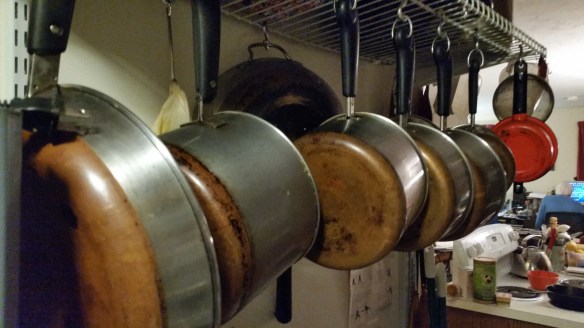
 In the fifties, when I was a young mother with two small daughters, my friends and I often gathered in one another’s kitchens for visits and chitchat. One day one of my friends looked at me, shook her head and said, “You are so brave, hanging your copper-bottomed pots for all to see without polishing them. Most women wouldn’t dare.” I smiled at her. “It doesn’t seem important to polish them,” I told her. “I’d rather play with my children or read to them.”
Today many mothers do not have that opportunity. Most families these days require two incomes for survival. This has not always been true, and it is also true that some mothers sacrifice the income and make do in order to be with their children while they are young. However, at that time, many young mothers did not work outside of the home, and instead put their diligence into their housekeeping and their children. Their pride was put into their homes and its appearance.
I was happy to be home with my children. My mother was an artist. I had not been raised to work outside the home, or to have a career in the wider world. My ambition was to be a writer, and I pursued my craft any way I could, writing publicity for the various organizations I belonged to, and sending my poetry off to magazines. Housework was not my first concern. I even wrote and sang a humorous song about how the housework could wait until my children grew up. I recall one husband of our acquaintance remarking to the children’s father that he felt I was out of line with my sentiments. Truth be told, I was happy to avoid housework any way I could.
One of the main reasons I disliked it so much was that once I began cleaning, it was difficult for me to stop until I was completely finished. Yet finishing was a goal that often eluded me because I kept thinking of more, I could do to make whatever I was cleaning perfect. One day I ran across a magazine article that suggested limiting a task to twenty minutes at a time. This helped somewhat, and I began to attempt to put this regimen into practice. I still suffer from this condition to a degree. I’m not sure why, and I look upon it as one of my opportunities to be mindful rather than go on automatic and be carried on the tide of my forward motion.
I haven’t polished the bottoms of my pots for many a year. My housekeeping duties have changed considerably, nor do I any longer have little children to mind. I can usually sit down to write whenever I like. I truly cherish this freedom, once so rare. Remembering those happy days I spent with my little ones, I do feel for mothers who have to work outside the home, and who don’t have the time to spend with their young children that I and many of my generation had. Rather than spend my free moments polishing, I do my best to find the time for fun that brings me joy, whether it’s watching movies with Stephen, taking a walk in the good weather, or simply sitting and allowing myself to relax and listen to music. Polishing the pots for show is the least of my concerns, and I most likely will never hear anyone comment on them again.
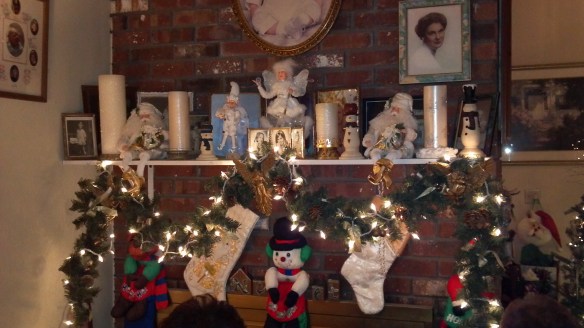 While generally speaking Thanksgiving is about being thankful, for many people Christmas is about gift giving. There are multiple tales about the giving of gifts on this day or shortly before or after. Christmas legends are fun to read. One of my favorites is about La Befana, an old lady from Italy. It is she who leaves the gifts for children on or around Christmas. The story goes she missed out on the actual birth of the holy child and so leaves all children gifts hoping not to miss out.
 Though I am fonder of some than of others, for me every season has its unique blessings. Autumn has always been a favorite of mine because I like the crispness of the air and the vivid colors that paint the scenery. However, the cycle of the seasons produces different feelings in everyone and we all have our favorites. It may be that as a poet I am more sensitive to or pay more attention to the change of the seasons because I feel it so keenly. Winter for me is a time for rest and often for extra sleep. The dark hours encourage it. During the winter, like the bare branched trees and the hibernating creatures, I am less active and more inclined to quieter occupations.
 When I was a child in grade school, each year our music teacher organized May Day celebrations. Every class participated, and a May Queen was selected from among the girls in the ninth, the topmost grade. The younger children had their own maypole. I found it hopelessly confusing. You had to go over one and under the next as you wound your ribbon around the pole, weaving it into the others until there was only a little left. After rehearsals, much to my relief I wasn’t chosen to do it.
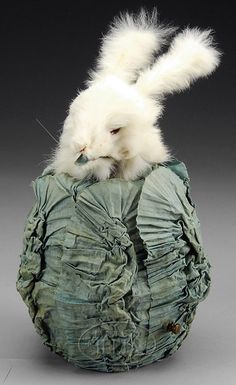 On Easter my family usually went to dinner with Great Aunt Alice. Until my sister was born when I was 8, I was always the only child present. Aunt Alice had several toys she would bring out to amuse me. One was a little truck loaded with colorful blocks. They had letters, numbers and pictures on them. Even now I can see that red and yellow toy with a string to pull it by. The bed of the truck was loaded with the blocks, and I was always careful to put them back when it was time to go upstairs to dinner.


 Pujakins