Thrifty Ways

clothes-in-closetWhen I was a child a friend of my mother’s gave me the dresses that that her twins had outgrown. Because they were dressed alike, I had to wear two of whatever came my way. In the days when I was growing up, thrift meant making do with what was available. Aside from the fact that while my family had enough, they weren’t exactly wealthy, there was a war on and many things, including clothing and shoes were rationed.

In addition, in the years that followed, my mother had to stretch what my father earned to cover the needs of the three more children born after I turned eight years old. I remember how excited I was when in my sixteenth year I got a pair of Bermuda shorts. They were newly fashionable and I felt very special to have a pair. Although they were wool, I wore them all that summer and for a number of summers after that. For a long time they were my only pair.

Growing up in a thrifty household inclined me toward a thrifty lifestyle as an adult. When I was raising my own family of five children I had to stretch our food dollars to try to nourish as well as please my family. I learned all kinds of tricks to make inexpensive cuts of meat palatable and I baked cookies by the dozen so the children would have treats. Home made was far less expensive than store bought. My sewing machine hummed as I made dresses for my daughters and even some outfits for my sons when they were small.

Judging from the advertisements I see today, thrift is not especially fashionable. Bargains, of course are. However what is considered a bargain by some standards is not by others. When I was growing up the annual church fair rummage sales held in local churches were the best places to find inexpensive, serviceable garments. My mother was a faithful customer.

I do not remember there being consignment shops or other places one could find good second hand clothing when I was a child. When we got together I introduced Stephen to consignment and thrift store shopping, and he embraced it happily. I find it more fun to shop that way because you never know what you will find and the prices are far more reasonable than what other stores charge.

Over the years, I have amassed a wonderful collection of clothing. Much of it has come from consignment or thrift stores, the rest from sales. Certain garments have endured the test of time and I wear them joyfully in the appropriate season. Others get rotated back into the mainstream to be discovered by someone else who enjoys saving money by shopping wisely. What is especially nice for me is that now I can have a number of pairs of shorts for the price I would pay for one bought new, or a cashmere sweater that someone has passed on, at a fraction of the cost in a regular store. Perhaps this is a kind of payback for the days when I wore the twins’ hand me down dresses over and over again.

Tasha Halpert
A Valentine to Loves Found

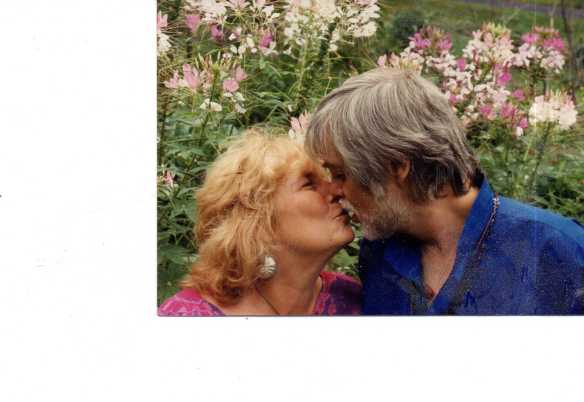
stephen-and-tasha-kissing-2087When I was in grade school I fell in love, or more accurately had a gigantic crush on a boy with blond hair named Teddy. I don’t think he even knew I existed, and I certainly made no advances toward him, being far too shy to do so. I simply gazed at him from afar and thought he was wonderful. In my seventh grade year another fair-haired boy I yearned over named Dana replaced Teddy in my heart. Some years later I discovered that before she met my father, many of my mother’s boyfriends had been blond, and I wondered if her predilections could have subconsciously influenced me in my choices.
My passion for blond men dissipated. When I was sixteen another boy named Teddy though with brown hair, became my first real love. My parents labeled it puppy love, but I knew better. Our dates were conducted via the bus because neither of us had a license to drive. We danced in his parents’ living room to the tune of “Unforgettable,” and snuggled in the movies—it didn’t much matter what was on the screen. When he went away to camp for two weeks he wrote me each day and I waited anxiously by the door for the mailman. I wore his felt beanie with pins on it constantly, which drove my dear parents crazy. I was their oldest child and their initial experience with their children’s first loves.

My first husband and I met at a dance and fell in love quite quickly. I was a rather romantic seventeen-year-old senior in high school. He was from New York, a sophomore in college and quite sophisticated. Our love blossomed over the summer and culminated in an elopement the following year. This was exacerbated by my parents’ protective attitude. They were not happy about our burgeoning relationship and had threatened to send me on a long trip the following summer to visit relatives abroad. They did what they thought best, though their antagonism probably fueled our passion. I was a young bride and soon a young mother. Our children became the focus of our marriage and of our love.

Now so many years later I look back on those early loves and I smile. In those days I knew so little of what love really was about. Most of how I viewed it came from romantic novels and magazines. With time and experience I learned about it for myself, and sometimes this was painful. Yet as I look back I have no regrets. I am married now to the love of my life. Our relationship has endured for nearly forty years. As I age I am grateful for his presence and for the love he brings to our days. As Shakespeare said, “Love is not love that alters when it alteration finds.” We have grown together, changed together, and remained together with all the joy and happiness that our experiences have brought to our relationship. He is my always valentine.

Tasha Halpert

How to Grow Your Heart Bigger

Peace Village 3 Heart.jpgVery young children share quite naturally. Who hasn’t been the recipient of a toddler’s offering of a cookie or a treasured toy? Later, children become more self-centered, and parents have to teach them to share. Then we outgrow our parents’ teaching and begin to form our own ways of behavior. At this point we may often emulate peers who may or may not be good examples of heartfelt behavior. Some, like me, inherit critical attitudes from parents or teachers, and so unwittingly continue them. This can shrink the heart.

Most of us are familiar with a character of Dr. Seuss’s called the Grinch. His heart was shrunken–too small by far. This resulted in his acting meanly toward others and because it annoyed him, trying to take away their joy. When he couldn’t, his heart grew. Most of us believe we would never try to steal another’s joy, however perhaps we could be ignoring opportunities to grow our hearts bigger. This is something I’ve had to learn and I worked hard to learn it. It’s not easy to do so; the first step in he process is to observe one’s very own smallness of heart.

For example, when I look at someone or even myself with a critical eye, observe with distaste mine or another’s extra pounds or unkempt clothing, or think negatively of my or another’s behavior and don’t catch myself doing it, I am missing an opportunity to grow my heart. I could change my thinking and reflect that they could be on medication, indigent, ill or feeling uncomfortable and instead feel compassion for them or myself. I’m aware that when I am tired or someone annoys or irritates me, it takes restraint not to snap back. Yet when I can manage to see them in a different light, it will grow my heart.

Another way to grow my heart is to not act selfishly and take the biggest, the best or the most for myself. Being generous to others is a simple way for me to grow my heart. As children we have often been taught this by well meaning parents, yet depending on how I might be feeling, it is easy to do the opposite. Then too, if I do it grudgingly or without a genuine desire to give, it may not be as effective for heart enlargement, however it can still work to my benefit. The most effective attitude is to put others ahead of oneself with joyful willingness as opposed to grudging obligation.

While it is sometimes painful to observe myself behaving in ways other than how I want to see myself, it is also worth doing. I’ve learned that if I catch myself in the act often enough, I will stop whatever negative behavior I observe. Selfish behavior, a judgmental attitude, an outlook automatically critical of others can lead to shrinkage of the heart. Generosity, compassion, and loving giving can lead to the growth of the heart. Plus there is often a return on one’s investment. What goes around really does come around. Those who practice these virtues may well reap good fortune in some way in return. While this is not a reason to be doing it, it is a nice side benefit.

Tasha Halpert


A Sip of Spring in January

spring-water

The school I attended as a child had no weeks of vacation between Christmas and March. I had little to look forward to except an occasional snow day or being home sick with a cold. Not that I liked being home sick—my mother was not one to allow me to “enjoy poor health” as she put it. This meant I was confined to bed without much to do and no pampering. The best I could expect was an opportunity to listen to the radio. Television didn’t arrive in our household until I was twelve. The winter days were dreary with school and homework. I didn’t like skiing and skating was no fun so I spent my free time indoors reading. The advent of spring at least meant I could spend more time outside.

There is a deceptively warm period in the first month of the year called the January thaw. It usually comes at the end of the month, but sometimes earlier. It is the opening note of a long prelude to spring. Sadly, it raises hopes too soon dashed. February sets in, the snow falls, the cold descends, and winter reminds us that we have a long way to go. The upside is that at least the days are longer and brighter as the sun grows stronger and shines from higher in the sky. The burgeoning light keeps us apprised of spring’s actual advent.

Expectations often create disappointment. However it is difficult to avoid having them. The anticipation that is the creator of my expectations is what happens when I yearn toward something that is just out or reach or even beyond my control, like spring. This habit begins in childhood. Once we outgrow the present moment mindset of our early years, we are vulnerable to it. For instance, when the circus was coming to town it was a big event in my young life. My grandmother always took me and every year I loved it.

The difficulty with anticipation, especially when one is an adult, is that it can suck the juice out of the actual event. A few years ago Stephen and I took a friend’s two children to a local circus in a town nearby. Based on my memories of Barnum and Bailey, I had unrealistic expectations of the little circus and did not enjoy it nearly as much as I would have otherwise. On the other hand the two children we took had a wonderful time. Unexpectedly, my enjoyment ended up being about that rather than about the performances.

Today in the news I saw that the circus of my childhood—Barnum and Bailey, will be no more. This may have started I suppose when they released the elephants and now they are disbanding completely. I wonder if those who like me once anticipated the arrival of the circus will be disappointed. I haven’t been to a Barnum and Bailey performance in many years myself, however I have my memories. Thankfully I can sip those memories whenever I wish. That’s the blessing of memories, like food in the pantry or the refrigerator they are available when I wish to reach for them. Memories of spring, however, cannot compare to its actual advent, and that I eagerly await.

Tasha Halpert


A New Year, A New Beginning

snow-designMy grandmother lived alone in Boston. A widow for many years she had an unusual way of celebrating New Year’s Eve. As my father told it, she would pick a movie theater that was showing a film she wanted to see and go to the last show. In those days on New Years Eve the theaters would pass out noisemakers and at midnight everyone would sound off with them.

I don’t know if any movie theaters do this today; certainly when they did it then it was a wonderful way for her to celebrate. Seeing the old year out is a in whatever way chosen is a ritual that has been practiced by peoples of all times and places for centuries if not millennia. I enjoy my personal rituals, which include ringing all the bells in the house not to mention kissing my husband a midnight. Then there are the ones I also practice for New Year’s Day.

The old year now past holds both failures and successes. I need to take these into account as I do my rituals to begin the New Year. What are my expectations? My resolutions, my hopes and dreams for the next twelve months to come. Realistically I must base them partly on what has been as well as what I hope will be. The trick is not to limit myself by any failures nor be overly egotistical about any successes.

When I look out of my window in the morning after a fresh snowfall, the gleaming white expanse seems like a new beginning. The crusty, trampled, slightly soiled snow beneath is hidden from sight. Everything looks fresh, ready to be inscribed with the present. A new beginning is a blank sheet of paper, a bed newly made with clean sheets, the first breath of air I take when I walk out of my door. A new beginning is a wonderful opportunity.

However, I must remember that beneath the newly fallen snow are the remnants of the snows that fell days before. They lurk there like the mistakes, the mishaps, the opportunities not taken and the regrets I may have for all that remains undone. A new beginning must also take into account what has gone before. Mistakes and misses can be useful if I am willing to learn from them. If I am not, they remain like the old mounds of snow banks–freshly covered but still obvious in any parking lot.

I have always enjoyed my New Year’s Day rituals. I try to do a little of whatever I hope to be doing for the next year: corresponding with friends, calling family, writing a poem, cooking, and other activities that I enjoy. In addition I make two resolutions. Like most I haven’t always kept them. Still I keep hoping. My favorite activity on New Year’s Day is to look back, to see how far I have come, and to plan for the future. Each year brings its share of joys and sorrows, regrets and triumphs; I welcome them all.


After the Gifts Are Unwrapped

gifts-4  In days gone by when my children were small and Christmas was something of a big production, by the evening of the 25th everyone was satisfied to play with his or her toys, eat the festival leftovers and chill out. It was then that I would take my guitar in hand and drive with it to the Beverly hospital to play for the patients. I was a regular volunteer there so I would don my pink volunteer jacket and go around to the wards and private rooms to play Christmas music together with my usual folk tunes.

During my time in Manchester-by-the-Sea I used to play my guitar several times a month and sometimes even more often for the patients who were well enough to be listening. However I did have to be mindful of my lyrics. This being in the days of Pete Seeger and the Weavers, my repertoire consisted mainly of traditional folk songs, some of which had lyrics that might not sound cheerful such as: “Go tell Aunt Rhody the old gray goose is dead,” or one that began “When I’m dead and buried, don’t you weep after me,” a rousing spiritual that was great fun to sing as long as I omitted the first verse and went right into the body of the song.

On Christmas night I felt as though with all the visitors having gone home by then, the patients could use a bit of cheering up. After all, the visitors were returning to their families and friends while the patients were still in their rooms or wards and perhaps more aware of being there than usual. It was heartening to see the welcoming smiles on their faces and to receive their enthusiastic approval. More than once someone who had been relatively comatose would actually clap their hands and manage a smile.

Today my children are grown and gone and my family is for the most part scattered far and wide. Holidays are quieter. Nor do I play my guitar any longer, though next year I hope to have learned some carols on my new harp. However, I don’t expect to be singing them in a hospital. Life brings changes, some welcome, some not so. The happy memories of Holidays past become gifts to cherish with joy, more so perhaps than any other gift beneath the tree.

Now that the presents have been opened and our holiday meal consumed, I find myself reminiscing to myself over past holiday celebrations. I note familiar faces that have moved on from my life. Some still walk this earth others do not. I am reminded of the places where I have lived in the past and see again the rooms as well as the homes that hold the memories of holiday times. Each year holds its blessings. I am grateful for each and every one, and most of all I am grateful to be able to celebrate with joy the love that flows to me from those who each year remember me.


A Wreath of Remembrance

winter-red-and-green          The season of lights, as this time of year could be called, holds many holiday traditions and celebrations. In my home we combined my mother’s German heritage with my father’s American one. We opened our larger gifts from friends and family on Christmas eve, while the stockings that held presents from Santa were opened on Christmas morning.

My mother had played the violin since she was a young child. On Christmas Eve after a light supper of finger food and sweets we gathered around the piano and she played carols while we sang. Silent Night was always sung in German. To this day I more easily remember the German words to this familiar carol. I remember once as people knelt for Christmas eve communion in the Episcopal church I attended then, singing it as I played on my guitar.

Recently as I listened to the wonderful Holiday concert presented by the Claflin Hill orchestra in Milford a rush of remembrance from other times and places swept over me. An image of my mother with her violin tucked under her chin standing by the piano in our dining room playing Silent Night floated into my mind. I felt nostalgic tears prickle behind my eyelids. As the strains of the lovely music flowed on, so did the memories.

My mother loved the lights and other decorations people put on and around their homes for the holidays. I remember one year we drove around together looking at the sparkly holiday homes. I could feel her joy as well as my own as together we appreciated the colorful displays of lights. Another memory surfaced of when my eldest was nearly a year old. Whenever we were in the car on a December evening I would hold her up to the window to see the glowing lights. Her first words at almost a year were her version of mine: “Pitty Light.”

Holiday memories are often tied to music. One year I was to be in the Christmas Pageant at my school, and sing a solo. I had come down with a sore throat and could barely croak. Somehow I got through it. I remember squeezing my best friend Sally’s hand, tears streaming down my face as I sang the best I could. Too, I remember how in the 2nd grade I was to play a little angel in another pageant and my parents took me with them to Florida, leaving the day of the play. I was so sad. Happily I also remember sitting in another school auditorium listening as my own children sang solos in their concerts.

Now many years have gone by, and many things are different. Each year brings new traditions into the mix, new opportunities to add memories and images to be woven into my wreath of remembrance. Old and new merge into a timeless sense of inner joy that brightens and burnishes the present moment. Although many familiar faces may no longer be visible at my table, or certain traditions available to share in the same way, these remain part of my holidays, and they bring their share of joy to the celebration.

By Tasha Halpert

Christmas Expectations

kathys-christmas-wreathsI remember one Christmas my parents gave me four or five board games. The difficulty was, I had no one to play them with. My parents didn’t play children’s games; we lived in the country and there were no kids in the neighborhood; and my schoolmates lived in other towns. Gas being dear—this was during WW II–people did not drive their children around for play dates. My usual Christmas presents were clothing or things I needed. Great Aunt Alice gave strange presents—one year she gave me a wood burning kit that was difficult for me to figure out how to use. I looked forward to stocking presents; they were more fun. Best of all was when I got old enough to play Santa along with my parents and participate in filling their stockings.
I had a small book of the poem by Clement Moore that I always enjoyed rereading at Christmas. Eventually I knew most of the poem by heart. “The stockings were hung by the chimney with care, in hopes that St. Nicholas soon would be there.” These verses have given us all an image of Santa and how he does things that has remained with us through many generations. We expect that he will wear a red suit, come down the chimney, arrive on a sleigh with reindeer, and so on. Cookies and carrots for the reindeer are part of our expectations for his Christmas Eve visit. Presents under the tree on Christmas morning are another. Does Santa always wear a red suit? Or can Santa dress in ordinary clothes?

“Santa Claus is coming to town,” as the song goes, and, some warn you’d better be good or else. “He’s making a list,” as the song goes. There used to be talk of Santa leaving a lump of coal or something else that is undesirable in the stocking of children who were not good enough to deserve toys. One of the original Santas—St. Nicholas, provided dowries for young ladies who otherwise would not have been able to get married. Some cultures used to include a kind of negative Santa called Black Pete, who tagged along to punish or otherwise be unkind to those whose bad behavior merited it. Must gifts be a reward or can they simply be a sign or love from the giver?

The advertisements on television create enormous expectations. The shining allure of the latest toy or newest communication device creates desires that may lead to major dismay if they are not forthcoming. What may be lost in the light of all these expectations is the unexpected, unadvertised gifts that this time can bring: the peace of loving hearts gathered together and the good will that comes from sharing. The opportunity to participate in the love and merriment that is part of the holidays is the real blessing, the actual present to be gained at this time. Those who are too focused on their expectations may well miss out on this, the real gift of this season.

Tasha Halpert


Full of Thanks and Grateful to Be So

family-dinner-2

A Family Gathering several Years Ago

Thanksgiving is a nonsectarian holiday that most of us can celebrate. I remember in school it centered on the Pilgrims. In first grade we made pilgrim hats and talked about how they lived. Today as a result of our treatment of the indigenous peoples since the first US Thanksgiving, the stories I grew up with have changed somewhat. However since time began harvest festivals similar to our Thanksgiving have been universally celebrated. Throughout the history the expression of gratitude for whatever constitutes our abundance endures.

I wasn’t always aware how important it was to be grateful. To be sure, I was brought up to say thank you when given a gift and often to write a letter of acknowledgment to the giver. However, having an actual attitude of gratitude, as the saying goes, was foreign to my thinking. I can remember my mother saying things like: “Finish your liver, there are children starving in China who would be happy to have it.” Of course, the thought that goes with that is, well send it to them then, however that would have been considered a rude remark and would have merited disciplinary action.

As a child, like most I took my safety, my freedom from hunger and cold, and my warm surroundings for granted. I was sheltered from the knowledge of others’ circumstances; then, the only source of outside information besides the newspapers was the radio. I knew much less about the world than children with access to TV and the Internet do today. Whether that makes one more or less apt to be grateful is moot. It might make an interesting study. However most probably even today gratitude is something we become aware of only as adults. It is very easy for children to take their blessings for granted.

My change of heart began with a simple prayer given me by someone I met only briefly yet who had a profound effect on my life. I was complaining about my circumstances when she corrected me. “Rather than bemoan what you don’t have, rejoice over what you do.” She suggested I repeat three times a day, “Beloved Lord I do greatly thank Thee for the abundance that is mine.” The phrasing can be changed to suit those who have a different belief system to honor whatever higher power they may acknowledge–Divine Providence, the Goddess, Mother Earth and so on.

Oddly once I began to do that, my abundance began to grow and has continued to do so. On another occasion I briefly met a wise woman who among other things, told me to take nothing for granted. I took her advice to heart. As I have continued to be grateful even for simple gifts and to acknowledge my little blessings, they have continued to expand. Eventually I even learned to be grateful for difficulties and disappointments because of the opportunities to learn and grow they provided. At this Thanksgiving as always I will sit down at the table with a heart full of gratitude, and for this I am exceedingly grateful.

Tasha Halpert

Cherish Every Moment with Loved Ones

tashas-birthday-party-at-dianasI remember going to church with my mother on Sundays, and how uncomfortable the kneeling benches were. She was a devout Catholic and thought God would punish her if she didn’t go faithfully. As a result we went to my father’s church, an Episcopalian one on special holidays only after we went to early mass at my mother’s church. My fondest memories of her are centered on Christmas eve when she played her violin and we sang carols in front of our tree.

While I do have many memories from my childhood I wish I had more. I can remember my late mother telling me stories about things that happened or that I did that I had no memory of, but that she had cherished herself. Children do not realize that things will change, that what is will not be there forever and must be noted or it will be lost.

The other day Stephen and I were out with my daughter and her fiancé for dinner and a movie. As we sat over pizza afterward, I thought to myself how wonderful this all was, and how much I was enjoying it. I reminded myself to cherish the moment. We never know when something will end, or at least change so that it is no longer available. I did not always feel this way; it is something I have learned from experience.

When my children were little I was a busy mother with five young ones and a husband who traveled on sales calls. When I look back on our lives together I realize my mind was too filled with thoughts of all that I needed to do to be present with them and what they were doing. I know I missed much of what I would cherish now if I could remember it. This is a lesson that can only be learned from experience.

I realize how much I may have missed in my life by not being present. A friend once said to me, “I always take special care to enjoy myself at your home because then when things change I will have no regrets.” We moved away and she went back to South America; we have lost touch. Most likely I will not see her ever again, yet because of what she said she has a presence still in my heart. When I see again someone that came to our home years ago for gatherings or classes and remembers us, and it makes me glad.

Recently I have lost a sister and a sister in law to death as well as a number of friends and acquaintances. At no time did I know when last I was with that person that I would not set eyes on her or him ever again. I am aware more than ever that when I am with someone I know, and especially someone I love that it is vital to be mindfully present, or I will miss out and regret that I did not take advantage of the time I had with him or her. Change is the law of life; nothing stays the same. Every moment is precious, most especially when we are with those we love.