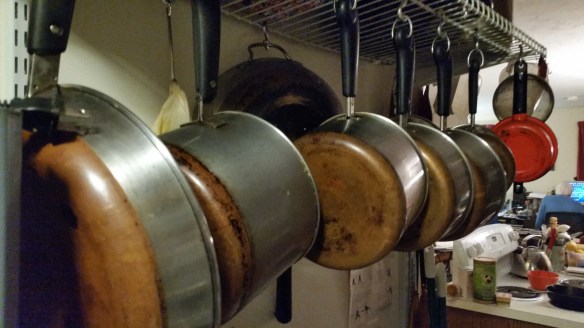
 In the fifties, when I was a young mother with two small daughters, my friends and I often gathered in one another’s kitchens for visits and chitchat. One day one of my friends looked at me, shook her head and said, “You are so brave, hanging your copper-bottomed pots for all to see without polishing them. Most women wouldn’t dare.” I smiled at her. “It doesn’t seem important to polish them,” I told her. “I’d rather play with my children or read to them.”
Today many mothers do not have that opportunity. Most families these days require two incomes for survival. This has not always been true, and it is also true that some mothers sacrifice the income and make do in order to be with their children while they are young. However, at that time, many young mothers did not work outside of the home, and instead put their diligence into their housekeeping and their children. Their pride was put into their homes and its appearance.
I was happy to be home with my children. My mother was an artist. I had not been raised to work outside the home, or to have a career in the wider world. My ambition was to be a writer, and I pursued my craft any way I could, writing publicity for the various organizations I belonged to, and sending my poetry off to magazines. Housework was not my first concern. I even wrote and sang a humorous song about how the housework could wait until my children grew up. I recall one husband of our acquaintance remarking to the children’s father that he felt I was out of line with my sentiments. Truth be told, I was happy to avoid housework any way I could.
One of the main reasons I disliked it so much was that once I began cleaning, it was difficult for me to stop until I was completely finished. Yet finishing was a goal that often eluded me because I kept thinking of more, I could do to make whatever I was cleaning perfect. One day I ran across a magazine article that suggested limiting a task to twenty minutes at a time. This helped somewhat, and I began to attempt to put this regimen into practice. I still suffer from this condition to a degree. I’m not sure why, and I look upon it as one of my opportunities to be mindful rather than go on automatic and be carried on the tide of my forward motion.
I haven’t polished the bottoms of my pots for many a year. My housekeeping duties have changed considerably, nor do I any longer have little children to mind. I can usually sit down to write whenever I like. I truly cherish this freedom, once so rare. Remembering those happy days I spent with my little ones, I do feel for mothers who have to work outside the home, and who don’t have the time to spend with their young children that I and many of my generation had. Rather than spend my free moments polishing, I do my best to find the time for fun that brings me joy, whether it’s watching movies with Stephen, taking a walk in the good weather, or simply sitting and allowing myself to relax and listen to music. Polishing the pots for show is the least of my concerns, and I most likely will never hear anyone comment on them again.
 I’ve never been a competitive person. Usually a sense of competition kicks in around the age of four, when a child gains a clear understanding of “me” and “mine.” Even then there is often a desire to share unless the child is surrounded by competitors. When I was growing up competition was the rule and the idea of a game that required cooperation instead was unknown. I did not enjoy the competitive world I grew up in.
 During most of history, people ate what they had put away for the winter in their cellars and barns. In Colonial New England, unless someone had a greenhouse a midwinter salad was unheard of. In the Middle Ages in Europe and Russia, fasting during Lent was a necessity because what little food was available to most by late winter had to be hoarded and used carefully. People ate with the seasons. Forty years ago on a late spring trip to Russia with my mother I recall cabbage being served to us daily. It keeps well if properly stored.
 My parents frequently discussed decisions, disagreed often and usually did so at the tops of their voices. They were a fiery couple and yelled their feelings vociferously. We did not have any neighbors nearby and no one could hear them but me. Though there was never any physical violence between them, I do remember the day my mother hurled a plate of scrambled eggs at my father. He ducked and it sailed into the closed window behind him, breaking through it, to land and shatter on the stone terrace beneath, breaking through the wood.
 Kittens grow up and become cats. They learn to use their claws on the furniture, and then they reach a point where if we do not pay attention, they may produce more kittens. Snow falls, gets turned by snowmen by eager, mittened fingers, and then when the sun comes out and the cold retreats, they melt. I wash the dishes, polish up the burners on the stove and sigh, remembering that there will soon be more dishes to wash and something will fall on the cooking surface and smell of burning if I don’t notice it before I begin to cook again.
 There is a wonderful song by the Kingston Trio from the 60’s I believe, about lemons. It contains a real truth concerning them: they must be sweetened to taste good. The chorus goes: “Lemon tree very pretty, and the lemon flower is sweet, but the fruit of the lemon is impossible to eat. Very true, and it is also true that lemons can do all sorts of things besides make good recipes..
 Of a recent Saturday, we were out and about checking the yard sales. While Stephen was perusing the items displayed there, I fell into a conversation with the person in charge. She had grown up in Grafton and spoke of how much had changed in the years she had lived here. I agreed. Although we have lived here only thirty years as of this year, we too have seen many changes. This got me to thinking about how it was then compared to how it is now.
 My father always made sure to put fresh flowers on the graves of two special friends on Memorial Day. Buried under two pink granite stones, they were an English couple far from home and family. My four year old self remembers them as two elderly people who smiled at me and gave me two porcelain statues of birds. Honoring someone once a year at the site of their grave is a fine act and the traditional way many choose. However, creating an ongoing memorial tribute could be an even better way.
 My mother did not have good training for the task of mothering. Her mother was the wife of a diplomat and spent her days doing what she needed to do to support my mother’s father in his position. Her children were cared for by nursemaids and tutors. I knew her briefly: a proper, formal woman who came to live briefly in the states in the late forties. I was a young teen at the time, not very interested in this elderly person. Now of course I wish I had asked her more about her life. She returned to Germany and passed on soon after. Ill prepared as she was, my mother did the best she could, and I honor her for it.
 Pujakins