When I was growing up there was local horticultural society in our town. They had a show every year, and I participated in the children’s class, always happy to compete for the prize money awarded. One easy win was to collect 50 wildflower species and label them. This was easy for me, as we lived in the country and there were plenty of them around in August when the show was held. I diligently combed the fields around our home and won. First prize: five whole dollars, was a princely sum for a ten or twelve year old. Later when I studied the medicinal qualities of wild as well as cultivated herbs I learned to value them even more. Now though I no longer live in the country I still feel fond of the weeds I studied as a child.
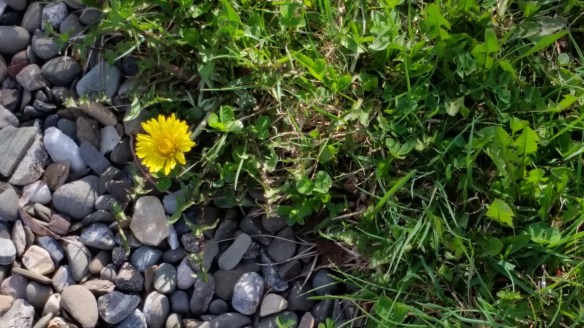
Each spring, whenever I walk through the series of parking lots across the street from my building, my eye is drawn to the weeds decorating the barrier between two of the lots. All year long I watch them grow, flower, and then succumb to the cold, their length still softening the hardness of the barrier they have grown against. I also often notice the weeds growing next to concrete highway dividers. They struggle up through tiny cracks in the pavement, signaling the persistence of nature against human concretization. Soon now snow will fall and the remaining stalks I see when I walk will cast their shadows on the snowfall, reminding me of the inevitability of spring regardless of the current winter weather.
Despite the gardener’s dismay, weeds are flowers too. In addition to their roadside beauty, their seeds feed birds and the roots and leaves may be medicinal and even nourishing. Many of the weeds we have today formed a significant part of the diet of those who lived here before the Europeans arrived. The early settlers who planted them to harvest for food and medicine brought others. The virtues of a plant that we call a weed may be many. Now that I no longer have a garden I can appreciate their beauty even more. A weed is by definition something that grows wild, that grows where it has not been deliberately planted: an unwanted, uninvited guest in the garden. In a metaphorical sense, weeds could be defined as the unwanted catalogues that keep arriving in the mail, the undesired emails that show up in my inbox, or even those annoying begging or advertising phone calls from telemarketers.
How are these flowers in the garden of my life? Perhaps because as I eliminate them, they call me to pay better attention. I could also see them as helping me to be grateful that once they are gone I have more space and a better awareness of what I wish to keep for myself. These weeds are persistent in the gardens that we call our lives. However at least they do not require my bending over to remove them or to dig out their roots. As I appreciate the beauty of the actual weeds when I see them so too I can rejoice for that beauty that comes uninvited yet welcome to my view.
 At the time I was born my mother was newly come to the US, a bride of less than a year. Except for my father, she was very much alone in a big city, and I was her only companion for quite a while. I have often thought that my persistently positive perspective on life may have had its roots in my trying to cheer her up when she was sad and missing her family and friends back in her home country. Over the years since I have come to understand the power of a positive perspective on a potentially negative situation or experience.

 When I was a child one of my favorite occupations was to rearrange my mother’s pantry shelves. I delighted in doing this. It seems to me that I was born with a need to accomplish. In many ways, this has been a source of my happiness and a way of making myself feel good. I can remember when I was a young mother that time spent in the kitchen helped to heal any disappointment or dismay. Baking cookies for my children did wonders for my spirits and helped keep me cheerful. Even simple tasks like the ironing I did then were useful to me in lifting my spirits.
 When I was a child a friend of my mother’s gave me the dresses that that her twins had outgrown. Because they were dressed alike, I had to wear two of whatever came my way. In the days when I was growing up, thrift meant making do with what was available. Aside from the fact that while my family had enough, they weren’t exactly wealthy, there was a war on and many things, including clothing and shoes were rationed.
 Once upon a time I wrote a poem about the eyes of love. It began: “consider with the eyes of love.” Though at that time I hadn’t yet learned about the difference that the qualifying word unconditional makes, what I meant by love in the poem actually was unconditional love. My parents and grandmother loved me very much. They were also quite critical of me, as well as of others they loved and otherwise thought well of. Unconditional love means just that—no criticism, no conditions on the love. It also to me means looking at others as well as at myself without a disapproving attitude.
 In days gone by when my children were small and Christmas was something of a big production, by the evening of the 25th everyone was satisfied to play with his or her toys, eat the festival leftovers and chill out. It was then that I would take my guitar in hand and drive with it to the Beverly hospital to play for the patients. I was a regular volunteer there so I would don my pink volunteer jacket and go around to the wards and private rooms to play Christmas music together with my usual folk tunes.
 I remember going to church with my mother on Sundays, and how uncomfortable the kneeling benches were. She was a devout Catholic and thought God would punish her if she didn’t go faithfully. As a result we went to my father’s church, an Episcopalian one on special holidays only after we went to early mass at my mother’s church. My fondest memories of her are centered on Christmas eve when she played her violin and we sang carols in front of our tree.
 Pujakins