Heartwings Love Notes 2055 Probably Fraud

Heartwings says, “Telephones have evolved, but they do still do the same thing.”

Cell phones have grown to be the norm, these days, rather than the exception. Over the past twenty or so years they have grown in use until now they are ubiquitous. I remember years ago thinking a man jabbering away as he walked down the sidewalk, was talking aloud to himself—and of course he was using one of those phones with a microphone near his mouth. Many people walk along looking at their cell phones, ignoring the world around them. I was once involved in an accident with a woman who was looking at hers while she was driving.

Like all those in my age category, I grew up with a single home telephone. As in most homes, the phone sat on a table, in the hall or somewhere central. Often it was in a kind of booth, a small room with a door beneath the stairs to a second floor. Wherever it was located, it wasn’t detachable nor did it do more than receive and transmit calls. In those days, our family telephone number had only three digits; the one my great aunt was assigned had two. Perhaps she got it back when the phone first went into use. I never thought to ask.

Then, when you picked up the handset, a voice—usually that of a woman, said, “Number please.” You could have a discussion with the operator, or even get advice. If you needed a number, you said, “Information, please.” There was no dial tone, or even a dial, for that matter. Nor did anyone get a spam call. Actually, spam hadn’t been created yet. That was a product of WWII. Long distance, meaning outside the local area was charged by the minute, and could be very expensive.

Many people have given up their land lines in favor of exclusive cell phone use. I’ve resisted this for several reasons. Though we do have cell phones, we still have a land line, of course the phone itself is mobile. I prefer land line reliability over the capriciousness of a cell phone.as well as the comfort of the handset. Aside from how much more comfortable the handset is to hold, it doesn’t heat up over time, as a cell phone does. Of course, this also means we get lots of spam calls. At our request to a helpful number, some spam calls we receive, though not all, are blocked. This results in our getting only a single ring, then silence.

There is another aspect to the land line that keeps me using it: a kind of of entertainment in the voice that delivers its message when it rings: most of our land line telephone calls are identified by a robot, a mechanical voice that calls out their source. The mispronunciations are almost always amusing. They also convey information. We have discovered that spam is easily identified by the MA ending, mispronounced ma or as whatever the state is. Best of all is the one that always makes me wonder how the phone knows, and it is certainly my favorite: “probably fraud.”  

Heartwings Love Note 2000: It’s About Time

This Love Note marks a milestone: Number 2000 in total over a period of many years, at 52 a year. You can do the math how many that is. I am eternally grateful to my readers and to the invisibles who have had a hand in the Notes’ creation.

Heartwings says, “Waste not, want not; use whatever time you have wisely.”

When as a child I visited my grandmother in her summer home in Beverly farms, I would stand by the big cuckoo clock in the hall to see the bird emerge. I loved it! I even remember being very little and someone lifting me to see the bird up close. My dear grandmother would even advance the hands to make it sound the hour ahead, just for me. Perhaps that was the beginning of my fascination with time and clocks. All these years later, its passage remains a mystery.

 I remember as a child waking up on sunny summer mornings and thinking about how I had a whole day to play, and what fun that would be. Indeed, the hours stretched out and brought me much joy as I amused myself. An only child until I was eight, I had developed a good ability to entertain myself. I was never lonely, though I was mostly alone unless an adult was interested in playing with me, and mostly they weren’t, so my time was my own.

Now, some eighty years later when I wake up on any morning, whatever the time of year, I go over in my mind what I need to get done, not to mention what’s left over to do from the day before. (Usually, I had planned more than I could accomplish.) Then as I get ready, beginning with my exercises, I prioritize my “to do” list. It’s simpler than it used to be. Eighty years holds a world of change, and hopefully I have learned what’s important.

Children tend to live as human beings; adults as human doings. And time is at the center of the action in either stage of life.  It seems there is only so much of it—sixty seconds make a minute, or so they say. However, how do you feel after holding your breath for sixty seconds or laughing for the same amount of time? Do they feel the same? That’s the odd thing about time. It’s supposed to measure the same, yet it does not, at least in my experience feel that way. Another example is going somewhere versus coming back, which feels much shorter, clocks to the contrary.

Stephen and I have always collected interesting clocks. Our small apartment is full of them. Most of them are synchronized, more or less, within five or so minutes. Several display the accurate time, and others may lag a bit, depending on the age of their batteries. However, I know which ones are correct. Also, I like seeing what time it is whenever I feel like it, even without wearing a watch—mine is currently in need of batteries. I’m not sure I get any more done by looking, but I do like to know. Recently I came across a study that showed that the heart’s activity influences our perception of time as it passes. Time is a conundrum it’s fun to explore.

Enjoy whatever time you have and don’t try to save it at the price of your joy.

Blessings and best regards, Tasha Halpert

How do you feel about time? Do you take your time? Or do you find there’s never enough? How’s your time management. Write and tell me about your relationship with time. I so love to hear from readers. Please write me at tashahal@gmail.com. You can see more love notes on my website www.heartwingsandfriends.com, or see my blog at https://tashasperspective.com.

Heartwings Love Notes 1098 Where Can It Be

Heartwings says, “Putting things back where they belong is important.”

As a child I was taught to be tidy. Emily, the practical nurse my parents hired to help care for me when I was around two or so, tried hard to make sure I learned to put my toys, and later, my clothing away. She was with us until I was around eight years old when she left to get married and have a family of her own. Unlike my mother, she was patient and physically affectionate.

I am not faulting my mother in any way. Her behavior was molded by her upbringing. While kind and a good mother, she grew up with strict German parents who did not encourage demonstrative behavior. Even as a grandmother she was reluctant to accept or to give physical affection. Fun and fond behavior was not a priority, neatness was. 

Once I was married and had children of my own, I did my best to be as tidy as I could. This grew more difficult with each addition to the family, which eventually added up to five children. I didn’t have a lot of time to devote to being neat or organized. My mother often criticized me for my “messy house,” and it never seemed to occur to her that there was a good reason for this. I thought it was more important to enjoy and care for my children than to be neat.

Neatness does have virtues beyond looking nice. Having things in order means when I need to find something, I’ll know where it is and can find it without any difficulty. That is why the saying, “a place for everything and everything in its place,” has been my guideline as long as I can remember. For instance, I try hard to keep all of my tools where I can easily reach them and as close as possible to where they will be used. Being a systematic Scorpio, I have sectioned off the shelves in my pantry by assigning them to what I can make or do with the contents.

However, unfortunately this works as long as I am the only person putting things away. Also, there often is more to be put away than the shelves can conveniently hold. This results in items get shoved to the back, effectively disappearing from view and becoming unavailable. So, although I no longer have little children to run around after or an eagle-eyed mother judging my attempts to be tidy, I struggle still with my tidiness conundrums.

The current state of my health doesn’t help either. Despite Stephen’s great help, much does not get done. There are days I simply only have enough energy to cook meals and see to my immediate emails, not to mention attend doctors’ appointments. Prioritizing becomes important, and as it was once so it is again: I do what is important and let the rest go.

Remembering to be Thankful

Laura Dove A         While at Thanksgiving we are reminded to be grateful, that is surely not the only time to do so. it is vital to remember to be thankful frequently each and every day of our lives. For some time now I have begun and ended each day with this little prayer: “Thank you for this day and for all my days.” As often as possible each and every day I remind myself to acknowledge my gratitude for any good experience and even those that might not have been so good, because of the knowledge gained.

Recently we were saddened to hear of a friend who died suddenly and unexpectedly just as she was starting a new life with her spouse. Within the past few weeks we have heard news of other friends who are ill or whose lives have been disturbed or changed for the worse. Each time I hear such things, while I say a prayer for those affected, I am also reminded to be grateful for my relatively tranquil, happy life. In this present moment I have so much to be thankful for. When I survey my daily life, even with all its ups and downs, I am reminded to express that gratitude.

My late newspaper editor used to say, “Health is wealth.” How right he was. What are a few aches and pains compared to long term, probably painful illness or worse, an approaching end to life? What’s a broken washer compared to the loss of a parent or of a dear friend? It is so easy to take one’s blessings for granted, to think of them as ordinary or just a part of life. There is an old saying, “I complained because I had no shoes until I saw a man who had no feet.” While I am thankful for what I have, I am also grateful for what I do not have to endure.

There is such joy to be had in a tasty breakfast of a Sunday morning shared with one’s partner. Were this scene to end suddenly and abruptly I would deeply regret having lost even a moment of our time together through inattention . There is no way to know ahead when one’s end will come, when all of a sudden there will be no more time. I have read of a Native American tradition to greet each day with the phrase, “This is a good day to die.” Some might think this is a morbid attitude. To me it says, “Pay attention, live fully in this and every moment.”

Quite simply, though we don’t like to think about it, we begin to die the day we are born. With the increase in medical knowledge the life span of human beings has been greatly extended, still one day life will end for us all. One of the benefits of mindfulness meditation is that when it is practiced, it becomes easier to pay attention. I am grateful for this practice and to the teacher that taught it to me. It behooves us all to remember that every moment we have whether uncomfortable or comfortable, sad or happy, sour or sweet is a precious gift to treasure and to be thankful for.

A Smile is the Best Cosmetic

Tasha full f ace My young daughter asked if she could draw a portrait of me. I sat in the living room, smiling as she drew studiously, being very careful in her five year old way, to get everything just right. Suddenly she ran over, peered at my face and then went back to her drawing. Her pencil went dot, dot, dot on the paper as she put in her final touches. Proudly she showed me the portrait. To my dismay, the dots were a representation of a recent break-out around my lips.

Sadly, I realized at the time, I was becoming allergic to lipstick. This began for me when I was twenty five with the break out of the skin around my mouth. When I stopped using lipstick my skin cleared up. Then eye makeup began to make my eyes itch. Any lotion I put on my face created more breakout. I realized that my days using any form of makeup were over, and so they have been ever since.

The history of cosmetics is long and varied. As far back as 10, 000 B.C. in Egypt Women and sometimes men have used cosmetics. In the days of Queen Elizabeth fashionably inclined women painted their faces with lead to look fashionably pale as well as to cover up any blemishes. This was extremely dangerous to their health. Believe it or not, according to Wikepedia red lipstick,  was popular way back in 13th century Italy.

At times in history, women of the peasant class were forbidden to wear makeup; at other times it was thought to be sinful and thereby frowned upon or even forbidden. Earlier in the last century and even before, makeup was thought to be used only by “fallen women.”  The used of cosmetics has waxed and waned through the years, yet it seems one way or another always to have been part of human society. The high school I attended strictly forbade us to wear lipstick in class. Every morning the older girls would wipe it of in the coat room before they went in to study.

Although at first I felt a bit out of place among my friends, let alone women in general, I soon got used to the freedom it gave me not to have to spend time putting  on makeup. Now when I see the price of cosmetics in stores I rejoice to think how much money I have saved by not having to buy any. I use only hot water on my face. For occasional dry skin I have a lotion made from herbs and vegetables that helps keep it to keep from getting too dry.

It is also possible to create natural cosmetics from foods and herbs. I knew a woman who used beet juice to make her cheeks rosy. They did look quite bright. However, it is also true that good health, exercise that enhances the circulation, and a good night’s sleep go a long way toward nourishing the skin. Yet the best of all cosmetics is a smile. It strengthens the muscles of the face makes every face glow with youthful energy and is free to all.

A Recipe for making life’s lemons into lemonade

Tasha and Lemons 2  The perspective I bring to my everyday life influences the way I understand what is happening, and how I respond to what seems to me to be going on. When I look with compassion on how life has evolved for someone, I also feel differently about how they act toward me or anyone else. I may then see the gift they may bring me. Gratitude and compassion are closely intertwined. Both are necessary for a truly happy life.
The gift of a difficult person or experience may simply be one of patience practice. Compassion helps me to be grateful for that. I wasn’t raised to be compassionate. My parents were highly critical of others. As I realized I needed to change and worked on developing compassion, I found it easier to respond to life and its lemons with gratitude. Being grateful for life’s lemons is a good way to make that lemonade as well to sweeten life. I have found it takes much practice to learn to respond automatically with an attitude reflecting gratitude.

Gratitude as a first response to whatever life hands to you is an important ingredient to build into one’s lifestyle. However as with the deliberate incorporation of any habit, time and effort are required. As I worked to develop my attitude of gratitude, I began by taking small steps. Over time I worked my way up to larger ones. Now it is easier than it used to be to remember to be grateful, regardless of the reasons or circumstances.

Right now I am extremely grateful that my new book, Up To My Neck In Lemons has been published. It is a collection of ways to use lemons both in recipes and in life. It contains my relevant poetry and most importantly some of my experiences in life that have helped me make the proverbial lemonade from the lemons I have encountered. It is my hope to help others with this book, and I am very thankful to those wonderful friends who have helped me to make my hope a reality.

Here is a recipe from my new book: Lemon Sauce for many uses.

This recipe makes a cup and an eighth of sauce. It is easy to make, keeps well and can be used to make any dessert very special.

 Ingredients: 1/2 cup sugar 3/4 cup water, divided, 1/4 cup lemon juice, Grated peel of a lemon, 2 tablespoons butter, 2 tablespoons cornstarch.

Method: In a sturdy pot mix together 1/2 cup water, sugar, and butter. Boil for several minutes. Add juice and rind of lemon. Stir well, cook on low for five minutes. Mix cornstarch and 1/4 cup water. Add, stir into lemon mixture and cook until nicely thickened. This has a good flavor and can be used over angel cake or muffins, plain cake or even a combination of fruit.

My book is available on Amazon and of course if you want a signed copy you can write to me at tashahal@gmail.com and let me know.

Lose Weight Gently the Three Bite Way

Orange squash 2When my children were small I used to insist they eat at least three bites of anything they thought they didn’t want to eat at all. My theory was that by my having them do that, they would grow up to eat a broad variety of foods. I was even bold enough to insist that any visiting friends do the same. No one ever seemed to make too much of a fuss over this, nor did I get any bad feedback from my children for doing that either. They did grow up to be adventurous eaters and to enjoy trying new foods.
Some children use food as a kind of bargaining chip or power play. Mine didn’t thank goodness. Nor did I tell them what my mother used to say to me: Eat your (beans, eggs, etc.) there are little children starving in China who would love to have what you have on your plate. I wasn’t allowed to get up from the table until I had finished whatever it was I was supposed to eat. No three bite rule for me! When it was liver, which I hated with a passion, I cut it up in small pieces and swallowed them whole with my milk.

Working with a limited budget, my well-intentioned mother tried her best to make nourishing meals. I did grow up to be healthy, so it must have worked. However when I was eight I became chubby and stayed that way. Like many I have tried a number of different ways to slim down, slenderize, or otherwise lose weight. Some methods were more successful than others. However in my opinion calories in, calories out is the key. Less consumed equals more taken from what is stored in the body:portion control works.

In my search for dietary strategy I came across another very good suggestion. It’s called the Three Bite Rule. You can have three bites of anything highly caloric you want to eat, and you can eat anything highly caloric you wish to as long as those three bites are all you eat. It’s also true that after three bites you really do not get the same taste experience as you do from your first three. This is especially true of anything cold like ice cream, but also of sweet things. The real test though is to be able to put down your fork or spoon after the third bite and count yourself satisfied. When you do this, you’re creating a habit that allow for both pleasure and discipline, an excellent combination.

To be successful with this strategy it is important to allow yourself to really taste whatever you are eating. You can roll it around in your mouth and take your time chewing it slowly and thoroughly. Even liquids can be “chewed.” It is also true that when you eat anything slowly and chew it thoroughly you are satisfied sooner, and that applies to meat, vegetables and grains as well as anything on your three bite list. Taste buds get “tired.” The appetite, however keeps us munching away even when we are not getting the most out of what we are eating. Portion control, as well as the three bite strategy is much more successful if you eat what you put on you plate slowly and with attention.

Saying Goodbye to our Friend

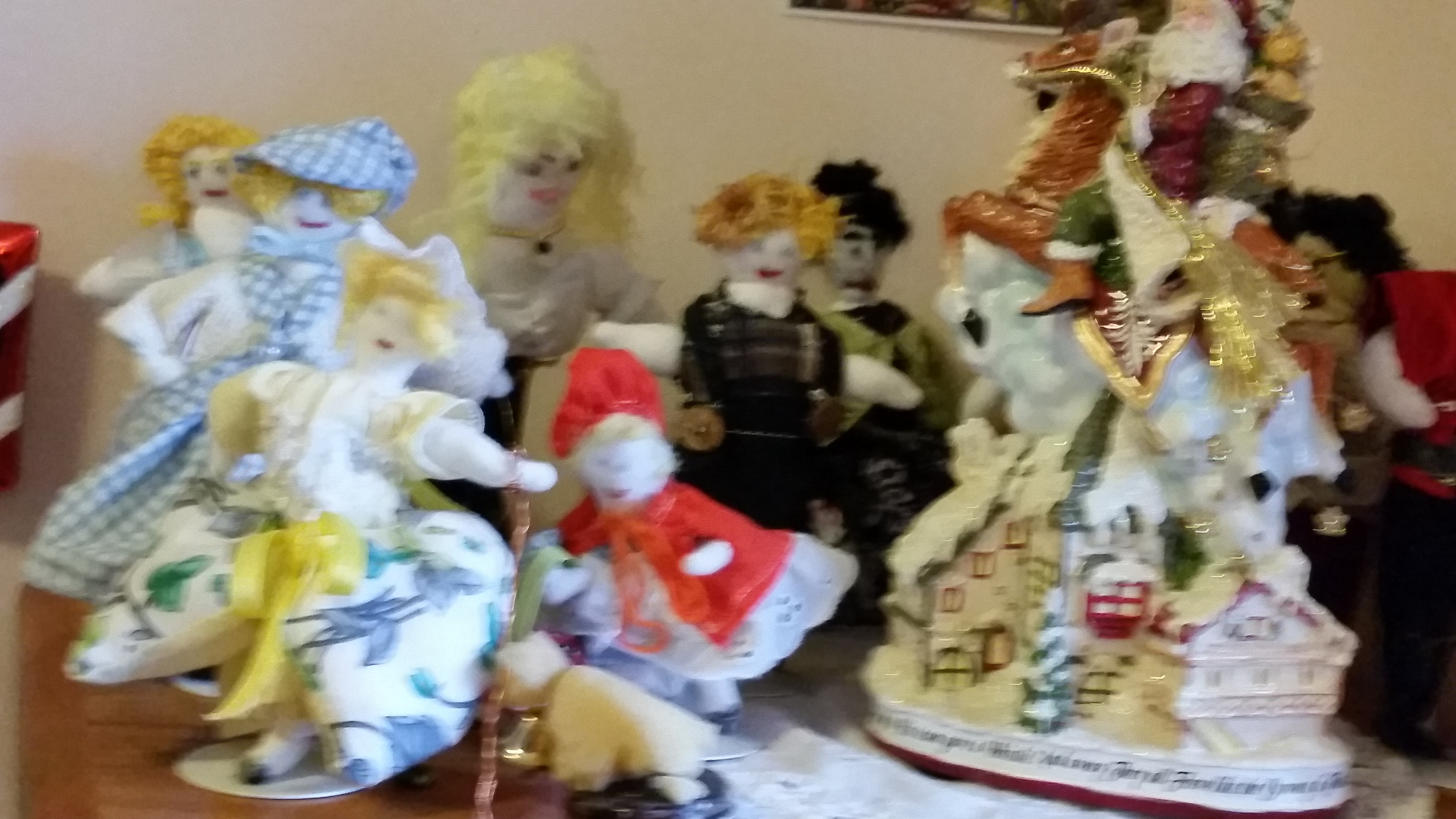
Laura Dodge's Dancing DollsAs we were moving into our Forest Lane apartment, we needed to assemble some of our new furniture. My tools had not yet made it over to our new home so I went knocking on my neighbors’ doors to see if I could borrow a hammer. Met with headshakes in the negative at each one I tried, I arrived at the last one. A spry older woman with a wonderful smile opened it. “Yes,” she said, “I have a hammer I can lend you.” That was approximately ten years ago and the beginning of a wonderful friendship with my neighbor Laura Dodge. I loved her spunk and her bright mind, but most of all I treasured her kind heart.

Over time as we visited and got to know one another, she told me her entertaining stories and shared her crafts with me. She also at my request shared space in her freezer with me. Over her protests I paid her “rent” in fruit sweetened jams and frozen desserts. She also had Stephen and me to tea and made popovers and other treats for us. I have recipes of hers in my collection that she wrote out in her tiny script. When she visited us in our apartment she admired my husband Stephen’s art. “Would you like to try collage?” he asked, and handed her a canvas. “Here, have fun.” She began to turn out wonderful collages of her own, asking for guidance from her teacher, as she called Stephen.

As her canvasses mounted and her skill increased, Stephen arranged for her to have art shows two years running at a restaurant in Worcester. Many came to her openings and admired and purchased her collages. We invited her to our birthday parties and she became popular with our friends. Everyone loved her stories. We included her in some of our shopping trips, took her to the Worcester Art Museum, and through a car wash, which she said was a first for her. When at Stephen’s suggestion she began to make dolls, we had fun helping her with designs. Eventually we loaned her a cabinet to keep them in.

When we met she was quite able physically, considering. As time went on and her physical health became worse, she couldn’t get out as much as she used to. Many of the evenings that she was home I would go down and visit with her. She had pain in her legs and in her back. At her request, I did some energy healing for her, singing to her and using my hands to remove painful energy and replace it with healing energy.

The day came when she could no longer live by herself. When she moved out we were both sad to part. We moved too very shortly, yet we kept in touch by telephone nearly every day. It was always a joy to hear the stories of her life and daily doings. Despite her many ailments and illnesses, she was so very filled with life. One of my favorite things she told me was, “It’s a small life, but I make it interesting.” Laura was an inspiration to me and to many others as well. I will miss her always.

Do you have a story to share with me or a suggestion for a column? I love hearing from readers. Send me an email at tashahal@gmail.com.

The Climate of Violence We Live In

Icy Branches

Growing up I read fairy tales featuring ogres and ferocious creatures, yet I knew they were not real. Besides the hero or heroine always won, often through trickery and clever alternatives to violence. I grew up protected from discussion of ugly or violent happenings. I’d hear, “Nicht fur das Kinder,” (not in front of the child) Then I would be sent away so the grownups could talk.

As a mother I brought up my children to work things out peacefully. There was no fighting allowed in our back yard or the combatants were sent home. Before TV and its depiction of worldwide conflict and violence, American children were not directly exposed to war and cruelty. Sadly, while there have always been violence, cruelty and destructiveness in our world, only recently has it been so blatantly displayed. Today’s youngsters will never remember a time of peace.

Watching the Olympic Games, I found it inspiring to see the athletes of today carrying on its tradition of peaceful competition rather than conflict between countries. Unfortunately, despite peaceful athletic competition, today’s youth is growing up in a climate of violence. Most newspapers feature that. Good news is often buried somewhere within the paper almost like a footnote. What has the acceptance of conflict as perhaps the only way to resolve issues done to young minds and hearts?

Yet it is not only the immediate media we encounter daily that contributes, there is also the tenor of our language. We speak of “fighting” bad conditions, disease, and what we dislike in the world. Killing is a casual term for stopping or eliminating: “kill” that article or image. The majority of video games seem to be about fighting and destruction. Comic books and illustrated novels have similar themes. When I was growing up there were curbs on the ugly and the dreadful. There was a comic code whose job it was to protect the young.

Now there seem to be no limits and no safeguards for young minds. When I was young we had bomb drills in our schools, yet the war was far away and no immediate threat. Today children have drills to rehearse for someone coming into the school and shooting them. How can this make them feel? A friend spoke of their child in college as being potentially unsafe in his school. No one ought to have to go through life feeling fearful, yet that is how things seem to be today.

Fear and anxiety separate us from one another. Love and acceptance bring us together. While no one person can make more than a small difference, whatever any of us can do to generate peaceful acceptance of each other’s differences and live in cooperation with each other contributes to a happier world. Where conflict resolution is taught in schools, violence greatly diminishes. Let us do what we can to encourage a climate of peace. Youth no longer bathed in violence will be free to see the world differently and react toward it accordingly.

I welcome your comments and/or questions.


Intentions, Resolutions and Reminders

Dead Branches and reflections 2

Growing up I was somewhat clumsy and awkward. I was always tall for my age—I stopped growing at the age of twelve and was even taller than most of the boys in my class, who soon outgrew me. My parents also thought I was careless. I wasn’t really, just lacking in experience. I also had poor proprioception. That word defines an actual sense: awareness of where one is in space and how much effort is being put out. I once embarrassed myself dreadfully when my best friend’s mother asked me to help her set the table, by pulling it completely out of the sideboard and dumping its contents on the floor.

While I outgrew the awkwardness and with the aid of yoga even became quite graceful, I still struggle with the proprioception. However I found that mindfulness helps greatly with that. Centering myself, slowing down, and practicing deliberate awareness when I am moving around or even pouring water from a pitcher into a glass, is a must. Over the years I have tried to make this a habit, like washing my hands with frequency, especially lately.

The flu season has made it vital to remember to wash my hands each time I return home, especially when I’ve been touching things like Grocery cart handles, restroom doorknobs and even counters or tabletops. The other day in a restaurant a woman near us was coughing with frequency into her hand as well as into the air around her. We are told that washing hands well is more effective than using sanitizers and better for our health.

I learned this the hard way. Last week I picked up a germ that invaded my sinuses and hit my right eye causing me great pain and rendering me unable to read for any length of time. As a result I have strongly resolved to wash my hands carefully not only when using any restroom but especially immediately upon arriving home. I hope to avoid not only the flu, but any other germs.

Resolutions are better kept when we have a reminder to do so, and a deliberate intention is well bolstered by any negative experience that happens when we haven’t. Hand washing is now an imperative for me, and while I regret the suffering and pain of my illness, I am grateful for the positive reinforcement of my intentions. Powerful reminders are not always pleasant, however they certainly are useful. Making lists helps too. Without a list my intentions, let alone whatever I have resolved to do may be forgotten.

Getting older has its good and its bad aspects. Becoming wiser by virtue of experience is helpful. Becoming more mindful as a result of that experience helps greatly also. On the other hand, becoming forgetful is a nuisance. However, my lists do help considerably. The trick is to remember to write things down and then also to look at the list. When I was a young parent in order to stay on top of things I had to outwit my children. Now instead in order to stay awake and aware I have to outwit myself.