
 Do you take satisfaction in what you may have accomplished? Or do you tell yourself you could have done whatever it was better, or done more? Most of us have a critical voice inside that will not let us be satisfied with what we may have done, even though we may well deserve it. That critical voice can originate early in life from a parent, a teacher, or a boss. Now it has become a part of us as adults, and it robs us of the joy we might take from our satisfaction. To be satisfied may actually take courage, the courage to admit we have done something worthwhile.
It is easier to take satisfaction from small accomplishments. My mother used to find it very satisfying to hang up a basket of laundry on the clothesline in her back yard. When she finished, she’d stand back, sigh, and then smile as she beheld the washing flapping in the breeze. It gave her a feeling of accomplishment. I understand how she felt. When I have done some cleaning, or tidied a bureau drawer, I get a similar feeling. The good thing about these small tasks is that they can be done relatively quickly, providing instant joy. Unfortunately, even they are subject to that critical inner voice.
I have encountered that niggling voice all too often in the past, especially when it was connected to a major accomplishment. I have also learned from it to stop, recollect my effort, and remember to pat myself on the back. When you feel good about what you have accomplished, it is vitally important to pat yourself on the back. That unkind voice might tell you not to. It is not a voice from the heart but one from the past. The person voicing those words may have felt it was unwise to praise you for fear you would rest on your laurels and grow lazy. My mother’s mother passed on that way of thinking to my mother.
Many years ago, I taught myself to play my guitar. Proudly I played my mother a song I had just learned. “That was nice,” she said, ‘Now when will you write your own songs?” To say I was disappointed is an understatement. Though eventually I did write my own songs, it wasn’t because of what she had said, but perhaps in spite of it. Praise by oneself for oneself is an important act of self love. The more we love ourselves, the bigger our heart grows, and more we can love others. The more grateful and appreciative we are of our own efforts, the more we can enjoy those of others.
Taking satisfaction is a conscious decision. It may start with or end with contentment. When I look at my clean kitchen floor, I can be content and satisfied with how it looks, and how it is for me to have made it look this way. Even if I notice a smudge I may have missed, I can still feel satisfaction, because I have done my best, and then I can wipe up that smudge. However, this does not have to change my sense of satisfaction. I can still feel good about my efforts. Were I so inclined, I could criticize myself and say, “Look at you! You missed that spot. See? You didn’t do a good job!” Or I could say to myself, “Because I did such a good job, the floor is so clean that small smudge became obvious. Now I have made it look even better; good for me! I feel satisfied and content.”

 When I was growing up it was my responsibility to care for the chickens. In the winter what that meant was carrying a heavy bucket of water from our house the thirty or more yards to their coop. The spring I was twelve the wetlands near the coop flooded and there was plenty of water right there. I took advantage of it. However, something then happened to the chickens. They began dying. Apparently, they had somehow caught a disease.
 The phrase “waste not want not,” sounds as though it might have come from the Bible, however it did not. It also sounds like old fashioned New England thrift. My mother being German, definitely learned the concept from her experience. I have found it useful in trying to utilize whatever food I might have left over from any meal. In my book, wasting food is not to be done.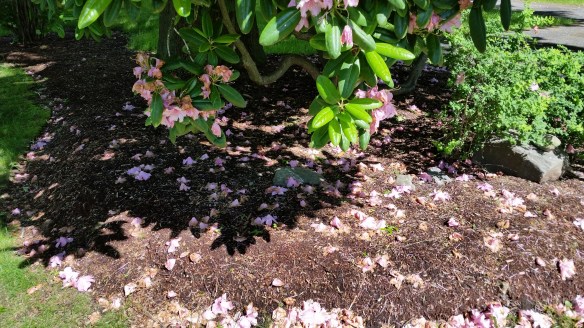
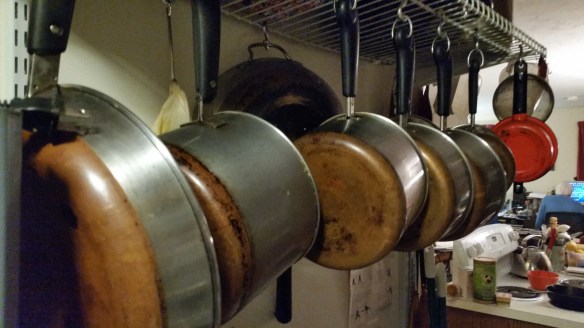 In the fifties, when I was a young mother with two small daughters, my friends and I often gathered in one another’s kitchens for visits and chitchat. One day one of my friends looked at me, shook her head and said, “You are so brave, hanging your copper-bottomed pots for all to see without polishing them. Most women wouldn’t dare.” I smiled at her. “It doesn’t seem important to polish them,” I told her. “I’d rather play with my children or read to them.”
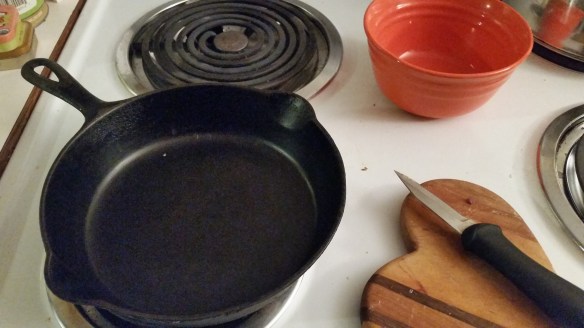 There was an advertising phrase that went, “Nothing says loving like something from the oven…” however, I think the advertising agency had it backward. It’s the love in the preparation that does this. The oven only helps, as do the ingredients, preferably as clean and fresh as possible. Love helps us to choose them, as well as to guide the utensils used in the preparation. Furthermore, the focus of the mind is an important ingredient as well. If I am angry or upset when I am preparing food, it could affect the way it tastes as well as the way it is digested. Though I can’t prove it, it’s my belief that thoughts and feelings can be powerful in their effect on food.
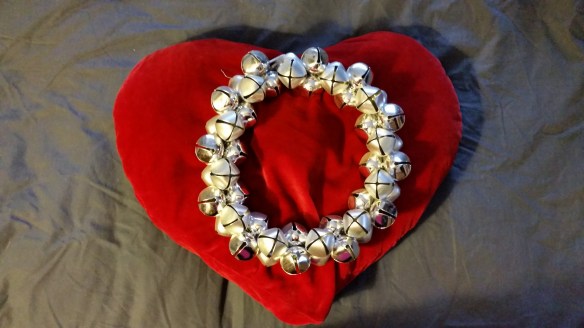 When I was growing up it was the custom for valentine cards and gifts to be sent unsigned. I believe this was a tradition that dated back many years. The custom of celebrating Valentine’s Day goes back even further, to ancient Rome. It originated in a festival of the time called Lupercalia, after Lupercus, a nature god of the Romans who resembled the Greek god Pan. It also has roots relating to Juno Februata, honoring Goddess Juno. Then, young boys and girls drew lots to see who they would be partnered with for the year which began in March. The Christian church opted to keep the holiday and rename it, calling it after a saint who may or may not have existed.
 I’ve never been a competitive person. Usually a sense of competition kicks in around the age of four, when a child gains a clear understanding of “me” and “mine.” Even then there is often a desire to share unless the child is surrounded by competitors. When I was growing up competition was the rule and the idea of a game that required cooperation instead was unknown. I did not enjoy the competitive world I grew up in.
 I took the red and white baking dish out of the drawer under the oven and set it on the counter. An image of the person who had given it to me rose in my mind, and I sighed. We had been friends for many years. Now however she had joined the angels that she so often spoke of. Her faith was strong and she shared it on occasion though not intrusively. A colorful character, she was always fun to see and over the years she had given me other gifts I cherished.
 Pujakins