 When I was a young wife in the fifties, my father helped us buy a house in the small town where I had grown up. Just outside my kitchen door was a garbage pail sunk into the ground. I would step on the lid, dump in my orange peels, potato peelings, stale food, etc. and once a week a man would come by with a big truck, pull out the bucket, empty it into his truck, and along with all the other garbage he had collected, take it to feed his pigs.
His piggery was deep in a wooded area and the smell bothered no one because it was quite isolated. I expect that today his pig farm would have been deemed unsanitary and done away with. Then it fitted in with a more appropriate attitude of the time of waste not want not. It made a good thrifty use for what otherwise would go to waste. In those days there was a more sensible attitude toward what we have and what we need, or so it seems to me. The Covid 19 crisis seems to have exacerbated a prevailing need to have more and more.
Not long ago people were treating toilet paper as if it were about to vanish from the earth. One person even spotted a woman loading her SUV with an entire tray of rolls from a Walmart. Other items vanished from shelves as people reacted out of fear of lack. How much I need is one amount. That need springs from a logical, rational approach to having. How much I want may stem from a fear of loss, a desire to own more than I already have, plain greed, or envy driven by a competitive nature.
Need and want are such different conditions. Operating from an awareness of need is different than operating from a feeling of want. I once read a story told by someone waiting in an airport who overheard a mother and daughter saying goodbye to one another. As they embraced, she overheard one say to the other, “I wish you enough.” The other replied with the same words. At first it seemed a curious thing to say for a farewell. As I reflected, I realized that to have enough is actually an absolutely perfect condition in which to be.
When I have enough, I have the space to put it. When I have more than enough, whether food needing refrigeration or clothing to find room for in our shared closet, I have to become creative about fitting whatever it is in. I may end up shoving things to the back of the refrigerator and losing sight of them, or into the back of the closet and doing the same. Then what I have lost sight of may become either moldy or essentially useless. It is said that much food goes to waste in this country, and no doubt leftovers may be a large part of that food.
Raised in a New England family by a thrifty German mother, I try to be very mindful not only about my leftovers but also my wardrobe. My beloved, however was raised by a mother who enjoyed abundance and showered it on her family. Sometimes we experience minor conflict around our divergent opinions. As the days go by, my refrigerator goes from full to empty and back again. Our closet, too has its moments. What matters to me is that we work out what constitutes enough for each of us, and that we make peace with our different opinions.
Comments? Questions? Suggestions? Write me at tashahal@gmail.com
 While generally speaking Thanksgiving is about being thankful, for many people Christmas is about gift giving. There are multiple tales about the giving of gifts on this day or shortly before or after. Christmas legends are fun to read. One of my favorites is about La Befana, an old lady from Italy. It is she who leaves the gifts for children on or around Christmas. The story goes she missed out on the actual birth of the holy child and so leaves all children gifts hoping not to miss out.
 During most of history, people ate what they had put away for the winter in their cellars and barns. In Colonial New England, unless someone had a greenhouse a midwinter salad was unheard of. In the Middle Ages in Europe and Russia, fasting during Lent was a necessity because what little food was available to most by late winter had to be hoarded and used carefully. People ate with the seasons. Forty years ago on a late spring trip to Russia with my mother I recall cabbage being served to us daily. It keeps well if properly stored.

 I love the berries, peaches and plums of summer. I eagerly await and devour local strawberries as they appear at our farmstand. My ‘fridge fills with blueberries and raspberries, then with luscious cherries, peaches and plums as they ripen. Of course I enjoy our special local corn, which reaches it peak as summer wanes. The foods of the local farms are my favorite aspect of summer. What I don’t like about summer is the heat. It discourages my consumption of food and causes me to do as little cooking as possible.
 Yankee thrift originated long before the pilgrims arrived on these shores. Being of a saving nature is a key to survival in tough times no matter when or where they occur. In today’s opulent, throwaway society times thrifty behavior isn’t very fashionable, however, I am happy to practice my version of it. My mother, though not a Yankee, certainly was a great example of that kind of behavior. I try to emulate her, though I do not go to the extremes she did.
 When I was growing up we usually said grace only at Thanksgiving, Christmas or on other very special occasions. I don’t remember any special discussion of gratitude in my family. God was often presented as a punitive figure, rather like my dad—as in or God will punish you for that, see if He doesn’t, and “Just wait until I tell your father what you did…” The church I grew up with emphasized being sorry for one’s sins and saying prayers for the protection and preservation of my family and myself. All that changed when I was in my mid thirties and I learned about the virtue of gratitude and its importance for a happy life.
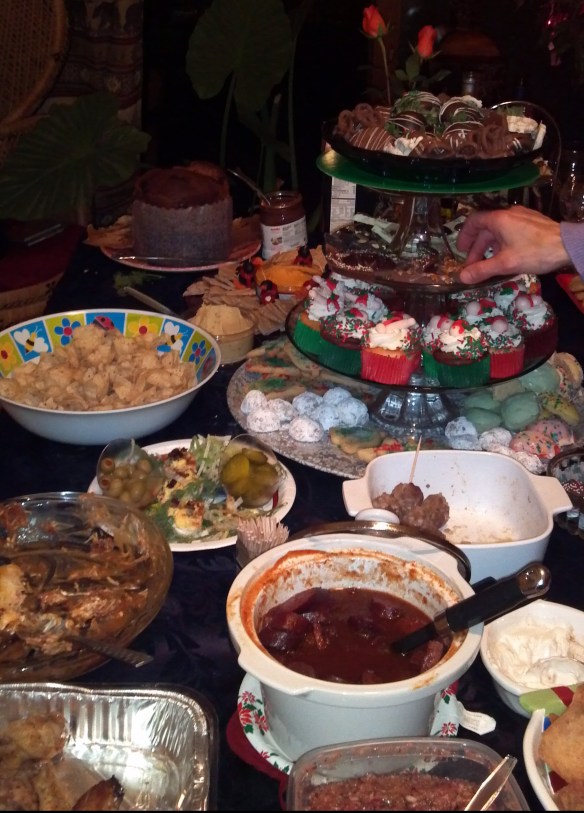
 However, with my large family and my small budget I had to make sure everyone got enough and my children still remember how they had to cross off each fruit or cookie on their list whenever they took one. That was how I made sure no one felt cheated. These days with just me and Stephen to feed, I don’t have to ration treats. However, my recent diagnosis of diabetes means I cannot indulge my taste for sweets or for fruit the way I would like.
 Pujakins