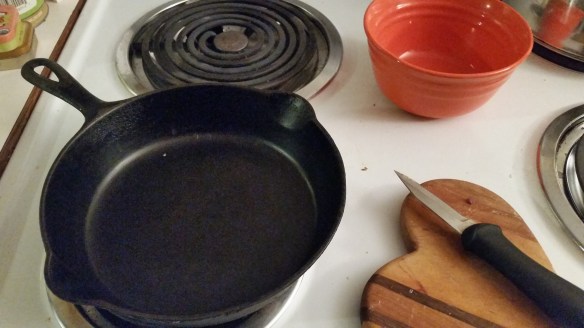
 There was an advertising phrase that went, “Nothing says loving like something from the oven…” however, I think the advertising agency had it backward. It’s the love in the preparation that does this. The oven only helps, as do the ingredients, preferably as clean and fresh as possible. Love helps us to choose them, as well as to guide the utensils used in the preparation. Furthermore, the focus of the mind is an important ingredient as well. If I am angry or upset when I am preparing food, it could affect the way it tastes as well as the way it is digested. Though I can’t prove it, it’s my belief that thoughts and feelings can be powerful in their effect on food.
A study of this potential would make an interesting experiment for a science project, though it could be difficult to set up. I do really enjoy cooking. Though I’ve never had any courses or training for it and am completely self-taught, I get great praise from those who taste my cooking. I remember one person saying, “This must be Tasha’s kitchen because it smells so good.” Another time, I had prepared a tropical entrée made with bananas with other ingredients, baked inside their skins. When I stopped one guest from cutting into his, he said, “Oh, I thought if you had cooked it, I could eat it.” I laughed and thanked him.
One of the most cherished comfort food desserts is bread pudding. According to the internet, sometime in the 11th or 12th centuries, a frugal cook somewhere in Europe needed to use up their stale bread and began thinking up ways to do it. Perhaps instead the cook needed a dessert and had only stale bread, eggs and milk to go with it. Be that as it may, bread pudding has become a staple food. Once called “Poor Man’s Pudding,” it is said to be served in upscale restaurants as well as homes all over the world. Many of the recipes for it call for some form of fat. My recipe omits this ingredient and I don’t think the calories or the taste of it will be missed. Feel free to experiment, I still do. You can butter the bread first if you wish to include it.
The recipe I have evolved from making it often is simple, and we eat it all the time. You do not have to wait until the bread is stale, though of course that is a good use for any you might have. Preheat the oven to 350. Grease a 1 ½ or 2-quart covered casserole. Put a pan of water the casserole will fit in into in the oven. Begin with 2 cups torn up bread—around 4 to 6 slices. I use a raisin bread and it’s on the small side. Sprinkle on ½ cup sugar and ½ to 1 cup raisins if not using raisin bread. Beat up 2 eggs and 2 cups any kind of milk. Add 1 plus teaspoon vanilla and 1 plus teaspoon cinnamon and beat again. Pour over bread and stir to combine well. Place covered casserole in the oven in the pan prepared with water. Bake 1 hour, remove cover and bake to brown for 15 or so minutes. If you can resist diving into it, the pudding tastes best the next day when flavors have developed.
I have no recollection of having been served bread pudding in my childhood; I have evolved this recipe from following one in a cookbook of recipes based on the Cat Who mystery series by Lillian Jackson Braun, both of which which I highly recommend.
 The appointment for my hip surgery was made more than three months ago. Now its time has come. While I feel positive about the outcome of the experience, I also feel a tiny bit apprehensive. Everything I have heard about the surgery from those who have had it done has been good. I even ran into someone who had the procedure done by the same doctor I have and she said hers had gone wonderfully and she was very pleased.
 While at Thanksgiving we are reminded to be grateful, that is surely not the only time to do so. it is vital to remember to be thankful frequently each and every day of our lives. For some time now I have begun and ended each day with this little prayer: “Thank you for this day and for all my days.” As often as possible each and every day I remind myself to acknowledge my gratitude for any good experience and even those that might not have been so good, because of the knowledge gained.
 My parents taught me much by their example. My father served in many capacities as a volunteer. He was generous with his time, talents and energy. He read for a radio station that served the blind; for many years he held the position of treasurer for a non-profit orchestra; and he helped out in various capacities at the church to which he belonged.
 While I was growing up, when it came to household chores my mother did not consider me to be capable. This may have been because she expected more of me than I was able to do at a young age, or it may have been that she was so particular that my childish efforts were simply inadequate. She had very high standards. Regardless of the reason, she never encouraged me to do any cleaning or other household tasks even after I was in high school. What this meant was that I never really learned how to clean properly.


 Pujakins