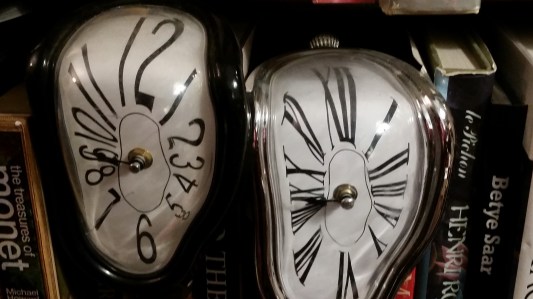
All over the world, New Year’s Eve is celebrated in a variety of ways. In the US many of us watch our TV screens as the ball drops in Times’ Square. My grandmother used to go to the movies. She told me that before midnight they gave out horns and other noisemakers. As midnight struck everyone blew and rattled vigorously. Making a loud noise is one way to drive out any lingering old negativity and start the new one clean and fresh. We have a bell collection and I go around the house ringing each one at midnight.
There are many superstitions associated with the coming of the New Year. Some go as far back as the height of the Greek and Roman civilizations. There are also attempts to predict events for the New Year. I remember my parents once melting lead in a ladle held over the fire in the fireplace. The melted lead was then poured into cold water and examined after it had hardened. The shape it might take was used to predict something for the new year to come. I was quite young and all these years later I can’t remember much more than that.
The old year is often portrayed by an elderly man tottering about and the New Year is portrayed as a baby or young toddler. Father Time himself is seen as an older man with a long beard, carrying a scythe with a long handle. He uses it to cut through the past and reap it in order to help us make use of what has been learned or experienced as we move into the future. Toward that end, most people feel it is important to make New Year resolutions.
As the new year approaches many of us will be doing just that. Sadly, most resolutions will be broken and probably forgotten by the end of January if not sooner. I believe resolutions are best not made, because inevitably we choose not wisely but with wishful thinking. What we wish is often to be thinner, spend less, save more, exercise more, or take better care with whatever or whomever we cherish. Our resolutions are made with well meaning and not realistically, which is why we don’t or can’t keep them.
Most of our resolutions are for what we believe we ought to be doing—losing weight being the most common. Yes, often it is important to lose weight for our good health. Yet making a resolution to do so almost invalidates the effort. It implies that we are making a special effort, not that we are participating in normal behavior. Yet what is usually best is for us to be mindful of what and how much we eat on a daily basis, rather than make a heroic attempt that leaves us feeling hungry and deprived.
The New Year is a good time to look over the last twelve months, see how far we have come, and assess how far or not we may need to go. One of my husband Stephen’s favorite phrases is, “Take your time.” Perhaps that might be our best possible resolution: To take our time, to see what really needs doing and then use the time we have to accomplish the goal of that moment. When we can do that, we are better equipped to live effectively as well as to observe carefully how we are doing. As to resolutions in general, resolving to be kind, to be thoughtful, to be more mindful might be easier and more effective than giving in to our “oughts.”
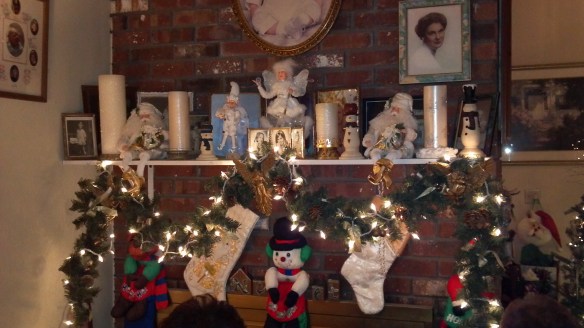 While generally speaking Thanksgiving is about being thankful, for many people Christmas is about gift giving. There are multiple tales about the giving of gifts on this day or shortly before or after. Christmas legends are fun to read. One of my favorites is about La Befana, an old lady from Italy. It is she who leaves the gifts for children on or around Christmas. The story goes she missed out on the actual birth of the holy child and so leaves all children gifts hoping not to miss out.
 I took the red and white baking dish out of the drawer under the oven and set it on the counter. An image of the person who had given it to me rose in my mind, and I sighed. We had been friends for many years. Now however she had joined the angels that she so often spoke of. Her faith was strong and she shared it on occasion though not intrusively. A colorful character, she was always fun to see and over the years she had given me other gifts I cherished.
 As I found out when I read a poem about family to my poetry group, the term family is for many loaded with negative implications. Unhappy childhoods, misbehaving or denigrating progeny, difficult relationships all become causes of grief and unhappiness. Quarrels erupt over division of property or when sharing the belongings of the deceased. Yet to me, family members may not necessarily be of blood but are of the heart and the relationships are often more peaceful and happier.
 When my mother made chicken soup, unless she was using a canned or dried variety, she had to start from scratch. In those days, markets had a variety of chicken to choose from: fowl, pullets, capons, broilers and roasters. For soup she might purchase a fowl, an older bird, past its egg laying days. If she chose, she could have one of our chickens killed by my Great Aunt Alice’s gardener, in which case she would have to pluck it and eviscerate it herself, which she often did. I’m very thankful I’ve never had to deal with a freshly killed chicken. I can see her still, pulling out feathers by the handfuls as she prepared a meal.

 Pay a visit to the Museum of Russian Icons in Clinton MA and you will see a wonderful variety of angels as well as many saints. Ancient and modern icons from Slavic countries, collected over decades by the founder, Gordon B. Lankton, line the walls of this wondrous building. Their programs and exhibitions are special too, and their gift shop holds many interesting and often inexpensive items you will not find elsewhere. As you peruse the rooms, angels of every description, as well as saints gaze at you with farseeing eyes.
 During most of history, people ate what they had put away for the winter in their cellars and barns. In Colonial New England, unless someone had a greenhouse a midwinter salad was unheard of. In the Middle Ages in Europe and Russia, fasting during Lent was a necessity because what little food was available to most by late winter had to be hoarded and used carefully. People ate with the seasons. Forty years ago on a late spring trip to Russia with my mother I recall cabbage being served to us daily. It keeps well if properly stored.
 My parents frequently discussed decisions, disagreed often and usually did so at the tops of their voices. They were a fiery couple and yelled their feelings vociferously. We did not have any neighbors nearby and no one could hear them but me. Though there was never any physical violence between them, I do remember the day my mother hurled a plate of scrambled eggs at my father. He ducked and it sailed into the closed window behind him, breaking through it, to land and shatter on the stone terrace beneath, breaking through the wood.
 Pujakins